An SSP helps publishers and ad networks make inventory available to programmatic demand while managing bid requests, demand connections, auction rules, pricing, reporting, and optimization. A white-label SSP extends this model by enabling operators to run a branded, configurable sell-side environment without building the core programmatic infrastructure from scratch. Read on for a supply-side platform explained and discover all the details.
The monetization landscape for publishers and ad networks is becoming more and more complex. More ad formats, a growing number of demand partners, stricter data requirements, and constant pressure to improve margins – these are just some of the factors to consider
Supply-side platforms (SSPs) were designed to address these challenges. An SSP acts as the operational layer between sellers and the programmatic advertising ecosystem, making publisher inventory available to buyers while providing tools to control, optimize, and monitor monetization. The growing SSP market illustrates the need for such platforms. By 2033, it is expected to surpass $64 billion.
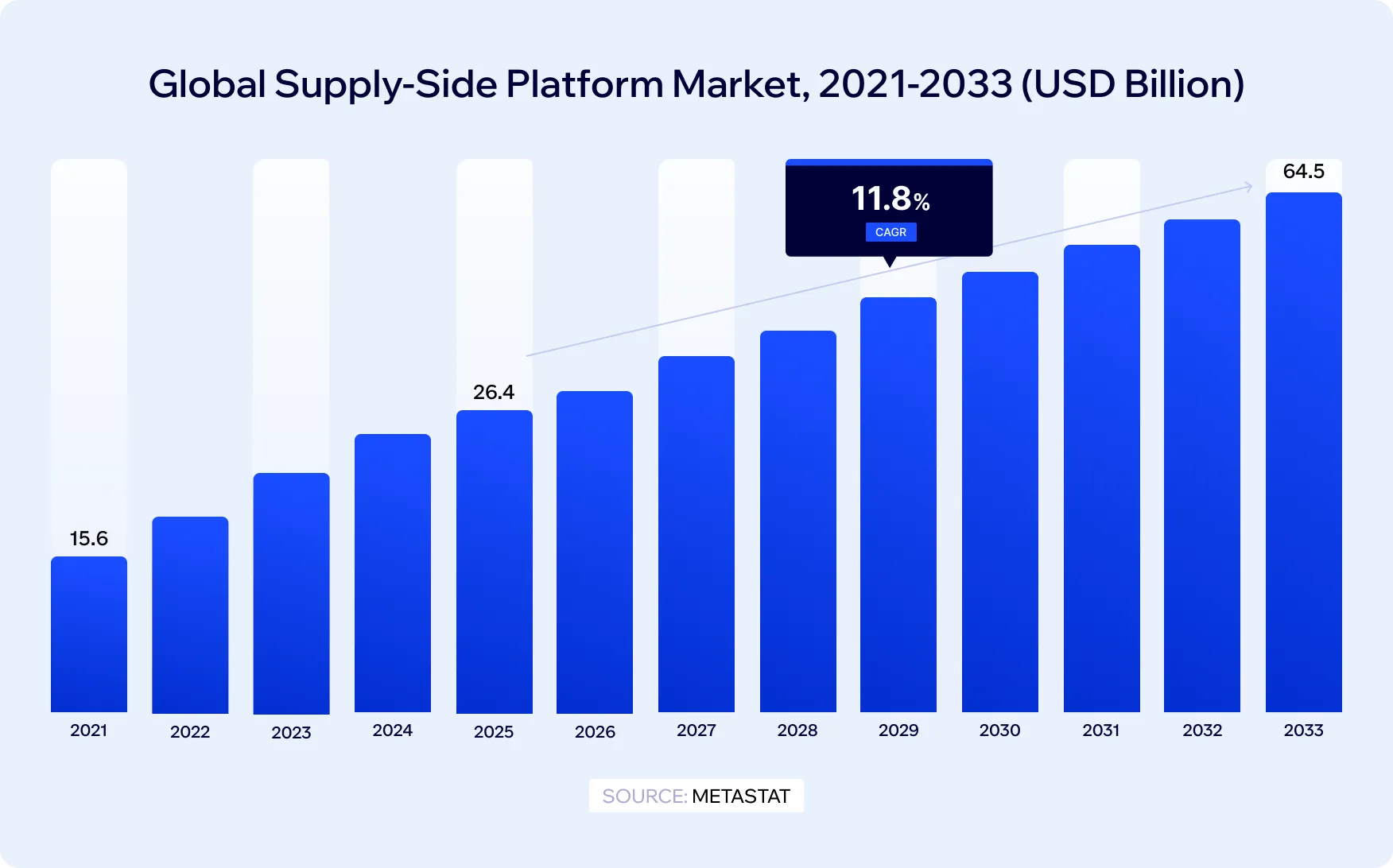
Source: Metastat
Eager to have a supply-side platform explained? This guide is here to help. We will explore how an SSP works, from its core role in the programmatic ecosystem to its technical architecture and key features, and examine when a white-label solution (like the one offered by Attekmi) can become strategically relevant. Read on to learn more.
Supply-side platform explained: the definition of SSP
A supply-side platform enables publishers, app developers, and ad networks to manage and monetize their digital advertising inventory. They can use an SSP to bring multiple programmatic demand sources together and manage how their available impressions are offered to buyers.
Besides, an SSP, as a publisher ad monetization platform, provides media owners with controls over how inventory is exposed, classified, priced, and routed through the programmatic ecosystem. Sellers can define inventory characteristics, apply pricing rules, control which demand partners can access specific placements, and use other settings.
An SSP also collects information about impressions, bids, wins, revenue, fill rates, and other aspects of the auction process. Monetization and AdOps teams can use this data to identify underperforming inventory, compare demand sources, fix issues, and make decisions regarding yield optimization.
To get a better understanding of the programmatic ecosystem, learn more about the differences between DSPs, SSPs, and ad exchanges.
How a supply-side platform works: the SSP workflow
Basically, an SSP workflow starts when a publisher has an ad opportunity and ends when an eligible buyer wins the auction and the ad is delivered. The entire process happens within milliseconds – that is why more and more media owners switch to programmatic monetization.
1. An ad opportunity becomes available
The process begins when a user creates an opportunity to show an ad. This could happen, for instance, when someone enters a website or an app.
After the available impression is identified, contextual and technical signals may be collected for the request. The exact data shared depends on the publisher’s setup, applicable privacy requirements, and the permissions available for that user and environment. The goal is to provide enough information for demand partners to evaluate the opportunity without unnecessarily exposing user data.
2. The SSP classifies and packages inventory
Then, the SSP platform can organize and enrich the supply information so that demand partners receive a clear and useful representation of the opportunity.
This classification can include the placement and ad format, the site, app, channel, or content category, as well as device, geography, language, and other signals. Where privacy requirements and user consent allow it, publishers can also use first-party data or audience segments to make inventory more relevant to specific buyers. Note that around 33% of publishers continue adapting to privacy-first identity frameworks.
The SSP may also apply inventory quality and policy checks at this stage. These can help identify invalid traffic, enforce publisher-defined rules, or prevent certain types of inventory from being exposed to particular demand sources.
Common inventory dimensions include:
Ad format: display, video, native, audio, CTV, etc.
Environment: web, mobile web, in-app, CTV, etc.
Placement: ad position, page location, or app screen.
Technical context: device, operating system, browser, or connection type.
Geography and timing: country, region, language, and time of day.
Content and audience: contextual content categories and publisher-defined audience segments.
3. The SSP sends bid requests to eligible demand
After this, the SSP determines which demand sources should receive the bid request. Eligibility can depend on publisher rules, inventory type, geography, technical integration, demand relevance, pricing strategy, partner performance, and so on. DSPs are the most common demand sources, but other options may also be on the list.
Publishers can control which partners have access to specific inventory, apply quality requirements, and avoid sending opportunities to demand sources that are unlikely to provide meaningful competition.
The result is a more targeted auction: rather than maximizing the number of bid requests, the SSP can focus on sending each opportunity to demand sources that are technically capable, commercially relevant, and authorized to compete for it.
4. Buyers evaluate the opportunity and bid
Then, eligible buyers evaluate the opportunity. A DSP, for example, can compare the impression against an advertiser’s campaign requirements, including targeting criteria, budget, frequency limits, brand-safety preferences, etc. It can also estimate how valuable the impression is based on the available signals and the advertiser’s objectives.
If the impression matches a campaign’s requirements and the buyer considers it valuable enough, a bid is returned.
5. Auction logic selects an eligible winner
Finally, the SSP and/or exchange layer applies auction logic and business rules. Depending on the platform and configuration, the auction can account for factors such as pricing controls, partner eligibility, technical response quality, inventory rules, and other requirements.
Once the winning bid is determined, the associated creative is passed into the configured ad-serving flow for delivery to the user. The auction outcome is also recorded as data that can later be used for reporting, troubleshooting, and optimization.
Supply-side platform architecture: the technology behind an SSP
An SSP is not a single component but a collection of systems that have to process large numbers of ad requests, make decisions in real time, communicate with multiple demand sources, and turn auction activity into actionable data. Let’s review the supply-side platform technology in greater detail.
Inventory and ad-tag / SDK layer
The inventory layer is the point where the publisher's digital property connects to the monetization infrastructure. On the web, this can involve ad tags or a header bidding setup. In mobile applications, an SDK or mediation-related integration can initiate advertising requests. CTV environments can use platform- or application-specific integrations to make ad opportunities available.
This layer needs to reliably collect the signals required to evaluate an impression and initiate the appropriate request without creating unnecessary delays for the user. Implementation quality matters because problems at this stage can affect everything downstream. Incorrect configuration, unsupported formats, excessive client-side processing, or poorly managed requests can increase latency or reduce the number of monetizable opportunities.
Decisioning and auction layer
When an ad request arrives, the platform needs to process it quickly, determine which demand sources are eligible, send the relevant bid requests, receive responses, validate them, and apply the configured auction logic.
A typical decisioning flow can include:
Request processing: analyzing ad requests.
Eligibility checks: determining which demand partners, formats, and inventory configurations apply.
Partner routing: selecting the appropriate demand sources.
Auction logic: comparing eligible bids according to the platform's auction rules.
Pricing controls: applying floor prices and other pricing configurations where supported.
Response validation: checking that bid responses and creatives meet technical and policy requirements.
Timeout management: ensuring slow responses do not unnecessarily delay the auction or ad delivery.
This layer has to operate under strict latency constraints. An SSP can potentially process enormous volumes of requests, but adding too much processing time to each auction can negatively affect the user experience. The architecture therefore needs to remain responsive not only under normal traffic levels but also during traffic spikes.
Learn more about header bidding and waterfall auctions to discover which of them is the best choice for your business.
Demand integration layer
An SSP needs to communicate with a wide range of external demand sources, each with its own technical requirements and operational characteristics. The demand integration layer provides the infrastructure for these connections and allows the platform to manage them at scale.
Programmatic integrations commonly rely on industry protocols and formats such as OpenRTB, while video environments may also require standards such as VAST. Supporting common standards reduces integration friction, but the right SSP still needs to handle differences in partner implementations, supported fields, response behavior, and technical requirements.
The integration layer typically needs to support:
Scalable connections to multiple demand sources.
Standardized protocols and ad formats.
APIs and configuration mechanisms for partner management.
Partner onboarding and technical testing.
Controls for enabling, disabling, or modifying integrations.
Ongoing monitoring of partner response quality and performance.
The operational side is particularly important. Adding a demand partner is not simply a matter of connecting an API. The integration needs to be tested, configured correctly, monitored after launch, and periodically evaluated for response quality, latency, errors, and overall performance.
Data, reporting, and analytics layer
Every auction generates data, so the platform needs to collect, process, and expose information that allows publishers to understand both the financial results and the technical behavior of their setup.
Reporting can be broken down across dimensions such as demand partner, placement, ad format, geography, device, inventory segment, and time period. This allows teams to move from a revenue overview to more detailed analysis.
Core metrics in ad revenue analytics dashboards (and not only) can include:
Impressions and ad requests.
Bids and bid density.
Win rate and fill rate.
CPM and total revenue.
Auction and partner latency.
Timeout and error rates.
Both business and technical reporting are necessary. Revenue and CPM data can show that a particular partner or inventory segment is underperforming, while latency, timeout, or error data can help explain why.
Controls, governance, and quality layer
An SSP also needs a control and governance layer that determines who can configure the platform, which inventory can be monetized, which partners can access it, and what rules apply to the auction and data flows.
Role-based access and permissions can help separate responsibilities between different teams. For example, an AdOps user may need to manage inventory and demand configurations, while other users may have access primarily to reporting or administrative functions.
Governance can also cover inventory policies and quality controls. Depending on the platform's capabilities, these may include mechanisms for managing supply eligibility, monitoring traffic quality, applying brand-safety requirements, and enforcing publisher or marketplace policies.
Privacy is another consideration. A technically capable SSP should support consent-aware data flows and privacy-aligned implementation. The same applies to security, fraud prevention, and traffic-quality capabilities.
Essential supply-side platform features
Ready to choose an SSP but wondering what features to look for? The most useful monetization capabilities give you control over inventory, demand, RTB auctions (RTB makes up 60-65% of programmatic transactions), reporting, and integrations. The supported features should be enough for you to monetize successfully and expand your operations when you are ready to do so. For instance, here you can learn more about ad exchange optimization and scaling.
But no worries, we are not going to compare SSP vs ad exchange (or SSP vs ad server) right now. Instead, let’s focus on the critical SSP capabilities. The exact feature set varies between platforms, but several functionalities are particularly important.
Inventory management and segmentation
Typical capabilities here include:
Placement and format setup: defining ad units, placements, sizes, formats, and other inventory characteristics.
Content and context classification: organizing supply according to site content, app context, channel, or other relevant signals.
Inventory grouping: creating logical groups of inventory that can be managed or monetized according to shared characteristics.
Configurable supply rules: applying rules that determine how particular inventory can be exposed, priced, or routed.
Multi-channel support: for instance, an SSP for web, mobile app, and CTV inventory gives you monetization flexibility.
Demand access and partner controls
Important features are as follows:
Multiple demand integrations.
Partner eligibility and routing.
Configurable access by inventory type, region, format, or other business rules.
Partner onboarding and management workflows.
Tools for monitoring and adjusting individual integrations.
These controls allow you to build a more tailored demand strategy. For example, you may want to make premium CTV inventory available only to selected partners, while routing standard display inventory to a broader group of demand sources.
Auction and yield controls
Depending on the SSP, these capabilities can include auction-based monetization logic, price floors and other inventory controls, partner prioritization, and routing rules. The objective is not simply to maximize the bid price for an individual impression, but to give you tools for managing monetization strategy across different inventory and demand scenarios.
An SSP should also support ongoing yield experimentation. Market conditions change, demand partners behave differently across regions and formats, and inventory performance can shift over time. Being able to test different configurations, pricing approaches, or partner combinations allows you to make decisions based on actual performance.
Reporting and real-time visibility
Here are the main capabilities to consider:
Granular dashboards and data exports.
Revenue and technical performance metrics.
Comparisons across placements, demand partners, formats, and markets.
Historical and near-real-time performance views.
Data access for BI systems and internal workflows.
For monetization teams, reporting can answer questions such as which partners generate the highest CPM, which placements have weak fill, or which markets are contributing the most revenue. Technical teams may need to investigate different questions, such as whether latency or error rates have changed for a particular integration.
The more granular the underlying data, the easier it becomes to connect a change in revenue to the operational factors behind it.
Scalability and reliability
The key characteristics here are as follows:
Request-volume capacity: the ability to process increasing numbers of ad opportunities.
Low auction latency and bidder response times: fast request and auction processing to minimize the impact on ad delivery and user experience.
Auction stability: consistent performance during normal conditions and demand spikes.
Multi-region support: the ability to operate across different markets and geographic environments.
Multi-format support: infrastructure capable of handling the formats relevant to your business.
Scalable expansion: the ability to add inventory and demand partners as your business grows.
APIs, integrations, and custom workflows
Depending on the platform, this can include:
API access for configuration or data retrieval.
Flexible integrations with ad server platforms, analytics platforms, and other components.
Data exports for internal BI and reporting systems.
Configurable operational workflows.
Automation of repetitive monetization or partner-management tasks.
This flexibility is especially important for larger publishers, ad networks, and businesses with specialized monetization models. Rather than forcing every operator into exactly the same workflow, the SSP should be able to adapt to the way the business actually operates.
What is a white-label SSP?
A white-label SSP operates under your own brand, identity, workflows, and commercial model. Instead of building every component of an SSP from the ground up, you use established technology for core programmatic functions such as inventory management, demand integrations, auction processing, reporting, and monetization controls.
Customization opportunities depend on the provider. Many white-label vendors offer solely UI personalization; however, some other providers go further. For instance, Attekmi also offers custom feature development to tailor your monetization platform to your needs in full.
White-label does not simply mean putting a logo on another vendor's solution. Its strategic value comes from the ability to create a more differentiated operational and commercial environment around inventory, partner access, reporting, and marketplace workflows.
This can be particularly relevant for businesses that want more control over their programmatic infrastructure but do not want to take on the cost, development time, and operational complexity of building a complete SSP independently.
When a white-label SSP becomes your go-to
The programmatic market offers diverse types of solutions for those striving for greater control: a white-label ad exchange, a white-label ad serving platform, etc. Let’s review several scenarios when a white-label SSP can be the best choice for your business.
Hi-tech ad network building a differentiated marketplace
An ad network may initially operate using a relatively generic reseller model, connecting publisher inventory to external demand sources and earning a margin on the resulting transactions. As the network grows, this may be no longer enough.
A white-label SSP can give the network a technical foundation for creating a more distinct marketplace. The network can potentially combine its own branding and workflows with more structured inventory packaging, differentiated partner access, centralized reporting, and its own approach to optimization.
The underlying infrastructure of a hi-tech ad network SSP handles core programmatic functions, while the network itself can focus its resources on how it organizes supply, manages relationships, and creates value for its ecosystem.
Publisher group expanding across properties and formats
For a publisher group managing multiple websites, applications, CTV properties, or other digital channels, monetization can become fragmented quickly. Different properties may have different inventory structures, formats, demand relationships, and reporting requirements.
White-label infrastructure can provide a way to centralize more of these operations. A publisher group can organize inventory across properties, establish consistent monetization logic, and bring performance data into a more unified operational environment.
This can be especially useful as the group expands into additional formats or acquires new properties. Instead of creating a completely separate monetization setup for every property, the organization can build a more consistent infrastructure layer while still maintaining the flexibility required by individual channels.
App-first business scaling monetization operations
Mobile devices delivered over 62% of global impression volume in 2025, which means strong app engagement. However, app-first businesses usually have pretty specific requirements. Their monetization infrastructure needs to support in-app inventory, mobile-specific technical environments, relevant reporting, and reliable performance as traffic grows.

Source: Mordor Intelligence
A white-label SSP can provide a scalable foundation for managing these operations while allowing the business to build its own workflows and partner strategy around the underlying technology.
However, when evaluating a white-label solution, an app-first business should examine the actual mobile implementation, supported ad formats, request and auction behavior, reporting dimensions, data requirements, and integration options. Not every SSP provides the same level of support for mobile environments simply because it supports in-app inventory.
Agency or media business productizing its programmatic offer
An agency or media business may also reach a point where it wants to create a more differentiated experience for its clients. Instead of relying entirely on third-party interfaces and reporting environments, it may want programmatic infrastructure that can operate under its own identity and support its own operational processes.
A white-label SSP can provide the underlying auction-based monetization infrastructure while allowing the business to create branded workflows and reporting around it. This can make the programmatic offering feel more like an integrated platform or service environment rather than a collection of external tools.
Where Attekmi fits
Attekmi provides white-label programmatic infrastructure that can support branded sell-side and exchange environments. The solution is relevant for businesses seeking more control and differentiation than a generic hosted interface may provide.
The main advantage of Attekmi’s white-label programmatic advertising platform is that it gets fully tailored to your requirements: from UI personalization to custom on-request functionality development. You get the solution you need while bypassing the limitations of development from scratch. In addition, you can count on configurable workflows, scalable infrastructure, integration flexibility, transparency, and operational tools for ongoing ad revenue optimization.
Attekmi is a trusted partner in any AdTech matter, so whether you need a fully customizable monetization system, a white-label ad exchange solution, a ready-to-use platform, or custom development services, we are here to help your business grow.
Conclusion
So, a supply-side platform explained: it is much more than a connection between publisher inventory and programmatic demand. It is a technology that manages the flow of ad opportunities, from inventory classification and demand routing to real-time auctions, reporting, and optimization.
For publishers and ad networks, the right SSP should therefore be evaluated beyond the number of demand integrations it offers. Scalability, latency, auction stability, inventory controls, reporting depth, partner management, integrations, and operational flexibility all influence how effectively the platform can support a growing monetization business.
For organizations that need greater differentiation or control, a white-label SSP is often the right choice. Instead of investing in the time and resources required to build an SSP from scratch, you can use established infrastructure while developing your own branded workflows, inventory strategy, partner environment, and marketplace operations around it.
Ready to experience Attekmi’s white-label technology? Contact us.
FAQ
A supply-side platform (SSP) is a technology platform that helps publishers, app developers, media owners, and ad networks manage and monetize their digital advertising inventory. It connects available impressions with programmatic demand while providing controls for inventory management, pricing, partner access, and performance optimization.
When an ad opportunity becomes available, the SSP classifies the inventory, identifies eligible demand partners, and sends them bid requests. Buyers evaluate the opportunity and return bids, after which the SSP applies auction rules and selects an eligible winner for ad delivery.
Key features include inventory management and segmentation, multiple demand integrations, partner and auction controls, yield optimization, granular reporting, scalability, low-latency processing, and APIs. Strong governance, quality controls, and flexible workflows are also important for larger monetization operations.
An SSP helps publishers manage and monetize their inventory, while an ad exchange facilitates the buying and selling of impressions between supply and demand. An ad server manages the delivery and serving of ads based on configured campaigns, targeting, and delivery rules.
A white-label SSP can make sense when a publisher or ad network needs more control, differentiation, and scalability but does not want to build an entire SSP infrastructure from scratch. Such a platform can provide established programmatic technology while allowing the business to develop its own branding, workflows, inventory strategy, partner environment, and reporting.


'%3e%3cpath%20d='M415.5%20380.133C415.5%20554.655%20911.5%20609.133%20714%20818.633C447%20850.133%20200%20677.655%20200%20503.133C200%20328.611%20341.478%20187.133%20516%20187.133C690.522%20187.133%20415.5%20205.611%20415.5%20380.133Z'%20fill='%231A4CFF'/%3e%3c/g%3e%3cg%20filter='url(%23filter1_f_654_7533)'%3e%3cpath%20d='M819.862%20539.146C969.42%20389.588%20963.912%20273.412%201000.6%20310.096C1037.28%20346.78%201059.92%20590.588%20910.362%20740.146C760.804%20889.704%20503.861%20847.646%20447.362%20760.146C348.862%20547.146%20670.304%20688.704%20819.862%20539.146Z'%20fill='%23052AAE'/%3e%3c/g%3e%3cg%20filter='url(%23filter2_f_654_7533)'%3e%3cpath%20d='M647.331%20285.725C443.031%20230.983%20408.998%20311.131%20358.6%20243.729C295.498%20194.631%20571.852%2052.1078%20776.152%20106.85C980.452%20161.592%201072.5%20405.139%201024.97%20497.82C889.759%20689.623%20851.631%20340.467%20647.331%20285.725Z'%20fill='%231B4DFF'/%3e%3c/g%3e%3c/g%3e%3cdefs%3e%3cfilter%20id='filter0_f_654_7533'%20x='0'%20y='-12.8672'%20width='960.465'%20height='1035.25'%20filterUnits='userSpaceOnUse'%20color-interpolation-filters='sRGB'%3e%3cfeFlood%20flood-opacity='0'%20result='BackgroundImageFix'/%3e%3cfeBlend%20mode='normal'%20in='SourceGraphic'%20in2='BackgroundImageFix'%20result='shape'/%3e%3cfeGaussianBlur%20stdDeviation='100'%20result='effect1_foregroundBlur_654_7533'/%3e%3c/filter%3e%3cfilter%20id='filter1_f_654_7533'%20x='228.938'%20y='103.27'%20width='998.816'%20height='935.965'%20filterUnits='userSpaceOnUse'%20color-interpolation-filters='sRGB'%3e%3cfeFlood%20flood-opacity='0'%20result='BackgroundImageFix'/%3e%3cfeBlend%20mode='normal'%20in='SourceGraphic'%20in2='BackgroundImageFix'%20result='shape'/%3e%3cfeGaussianBlur%20stdDeviation='100'%20result='effect1_foregroundBlur_654_7533'/%3e%3c/filter%3e%3cfilter%20id='filter2_f_654_7533'%20x='149.441'%20y='-105.473'%20width='1087.81'%20height='860.301'%20filterUnits='userSpaceOnUse'%20color-interpolation-filters='sRGB'%3e%3cfeFlood%20flood-opacity='0'%20result='BackgroundImageFix'/%3e%3cfeBlend%20mode='normal'%20in='SourceGraphic'%20in2='BackgroundImageFix'%20result='shape'/%3e%3cfeGaussianBlur%20stdDeviation='100'%20result='effect1_foregroundBlur_654_7533'/%3e%3c/filter%3e%3c/defs%3e%3c/svg%3e)