Global publishers should view header bidding architecture as a balance between revenue, identity, and user experience. Client-side setups provide more transparency and cookie match, but can increase latency. Server-side improves performance and scale, but may add complexity and weaken identity signals. Timeout strategies require testing, often ranging from 800–1500 ms or Prebid’s ~1000–2500 ms, depending on traffic mix.
Header bidding started as a solution providing publishers with an opportunity to maximize income and ensure fairer conditions for advertisers. Now, it has become a standard component of the ad monetization stack, especially among large media owners. For instance, among one million websites receiving the largest traffic, 2.2% was leveraging header bidding technology (as of July 2025).
For global publishers, the question is no longer whether to adopt header bidding or not. Instead, it is about designing an architecture that can support multiple regions, devices, partners, and traffic volumes without affecting user experience.
This guide explores header bidding from an architectural and operational perspective. We will compare server-side bidding vs client-side for global campaigns, review common performance challenges and Prebid timeouts best practices, and discover how technologies such as white-label SSPs and ad exchanges (like the ones offered by Attekmi) can integrate into a publisher’s ecosystem to provide scalable monetization without adding unnecessary complexity.
Header bidding architecture 101 (for global publishers)
Before we dive deep into the challenges and recommendations on how to implement header bidding architecture for publishers, let’s explore how different models work.
Client-side header bidding: how it works
In a client-side header bidding setup, the auction takes place directly in the user’s browser. A header bidding wrapper, such as Prebid.js, is loaded on the publisher’s website and sends bid requests to multiple demand partners simultaneously.
The process typically works as follows:
A user enters the website.
The header bidding code is triggered in the browser.
Bid requests are sent to multiple SSPs, exchanges, or demand platforms in parallel.
Demand partners return their bids.
The winning bid is identified, and the ad is delivered to the user.
The biggest advantage of client-side header bidding is the direct connection between the user’s browser and demand partners. Because requests happen in the browser, publishers can often achieve stronger cookie matching, better access to user-level identifiers, and more precise audience targeting. This can result in stronger competition and higher CPMs.
Client-side setups also provide publishers with greater transparency. Media owners can access detailed auction data, analyze partner performance, and optimize their demand stack more easily.
However, the main limitation is performance. Every additional bidder increases the number of browser requests, network connections, etc. The impact becomes especially visible on slower devices, weaker Internet connections, or pages with many other scripts. Poorly optimized client-side setups can increase page load times and negatively affect user experience – over 40% of consumers do not return to slow websites.
Server-side header bidding: how it works
Now, let’s have server-side bidding explained. The server-side model moves the auction process away from the user’s browser. Instead of making multiple requests to demand partners, the browser sends a request to, for instance, a header bidding server or a server-side wrapper.
Here is what the process usually looks like:
A user opens a webpage or app.
A request to the server-side auction endpoint is sent.
The server distributes requests to multiple SSPs, exchanges, and demand partners.
The server collects responses and evaluates bids.
The winning bid is selected, and the ad is shown to the user.
Improved efficiency is the key advantage of server-side header bidding. Since the browser only communicates with one endpoint, the user’s device does less work. This can reduce latency, improve page performance, and ensure a better experience. For mobile users, this is especially important.
Server-side architecture also simplifies the scaling process. Publishers can manage bidder connections, routing logic, timeout rules, and partner configurations in a centralized manner.
However, since demand partners do not communicate directly with the user’s browser, cookie matching and user-level targeting signals may be less accurate. Publishers may also have less visibility into auction behavior (e.g., if the server-side solution does not provide detailed reporting, logs, etc.).
This way, the quality of the server-side infrastructure plays a crucial role. A robust setup can provide publishers with strong control and visibility. In turn, a poorly configured one can create a “black box” between publishers and demand partners.
Hybrid approaches for global publishers
Instead of choosing between server-side bidding vs client-side for global campaigns, many large publishers prefer a hybrid architecture. They combine both approaches based on business priorities, audience characteristics, and technical requirements.
For instance, a media owner may keep a limited client-side setup for the most valuable demand partners while moving the remaining bidders to the server side. This way, a publisher can preserve the benefits of direct connections for selected partners while reducing the overall browser workload.
Global publishers may also adapt their architecture by region or device. Here are several examples:
Regions with slower connectivity may use server-side auctions to reduce the impact of multiple external requests.
Desktop traffic in high-value markets may use more client-side bidding to maximize targeting and CPM potential.
Mobile traffic may rely more heavily on server-side bidding to protect page speed and user experience.
Note that at the moment (as of May 2026), the shares of desktop and mobile traffic are virtually equal (48.96% and 51.04%, respectively), but these numbers tend to fluctuate:
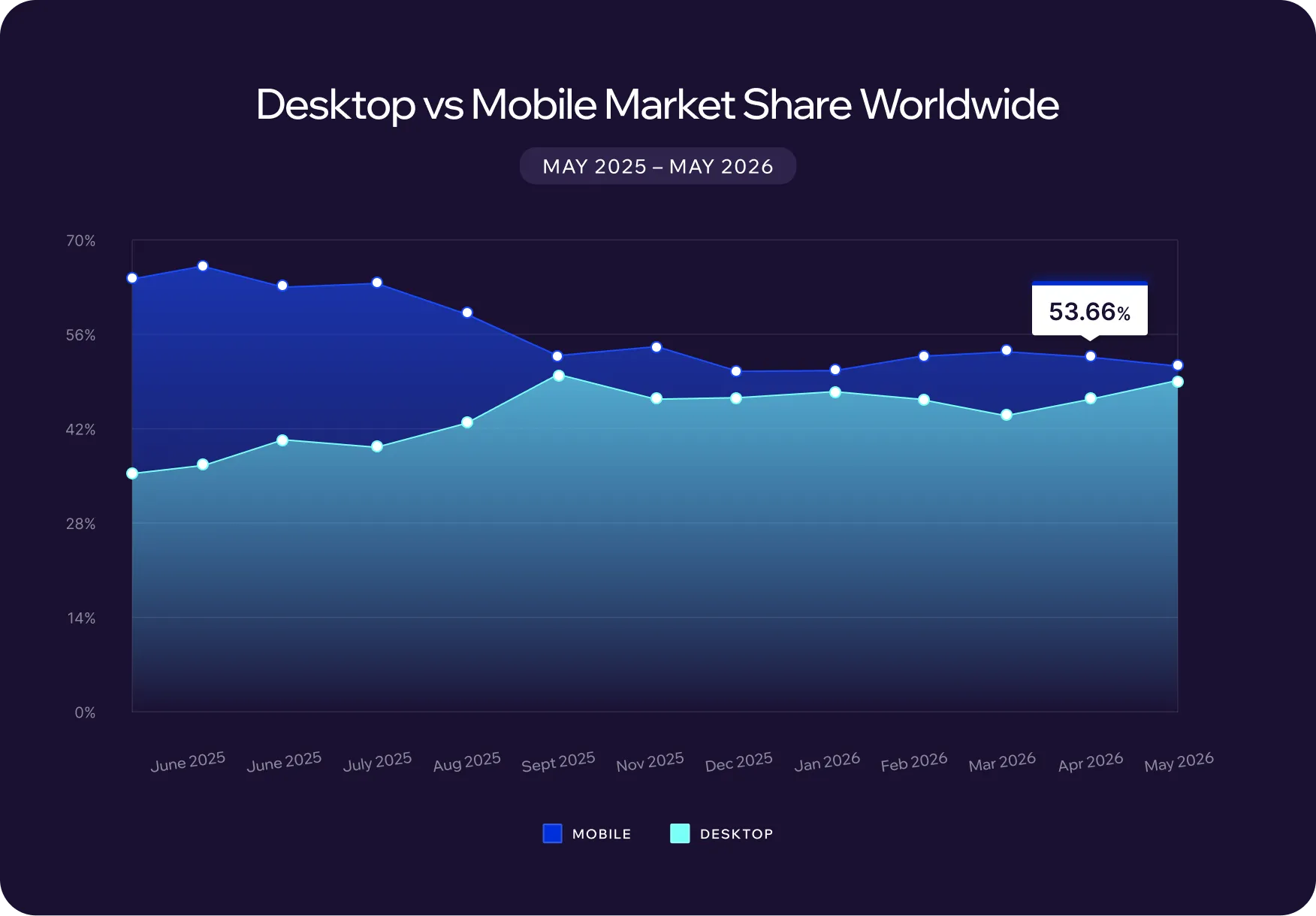
Source: Statcounter GlobalStats
From our experience, another effective approach is using a white-label ad exchange solution for header bidding (or a white-label SSP) as the central server-side auction layer. In this model, client-side wrappers can send selected demand into a centralized auction environment, while the white-label platform manages partner connections, routing, optimization, and scalability behind the scenes.
Global publishers rarely use only a client-side or server-side setup. The most effective architectures are designed around specific audiences, regions, devices, and monetization goals. For header bidding success, a flexible infrastructure that balances revenue potential with performance and operational efficiency matters more than choosing a single approach.
Client-side vs server-side header bidding: pros and cons
Now, let’s summarize the main advantages and disadvantages of both client-side and server-side header bidding.
Revenue, identity, and transparency
As for the pros of client-side header bidding for global publishers, they are as follows:
More effective cookie matching and access to user-level identifiers. These help improve targeting and bidding decisions. As a result, competition often increases, which also usually leads to higher CPMs.
Greater visibility into the auction process. Publishers can analyze individual bid requests and responses, evaluate partner performance, and optimize more effectively. This level of transparency helps teams identify underperforming partners, adjust timeout settings, and improve overall auction efficiency.
In turn, here are the main cons of client-side setups:
The risk of latency. As the number of demand partners grows, the impact on page speed increases, which can affect user experience.
Complicated standardization. Different markets may require different bidder combinations, compliance settings, and optimization rules, which increases operational complexity.
Now let’s take a look at the main pros of the server-side approach:
Reduced workload for the user’s device. This improves website or app performance, helps ensure better user experience, and allows publishers to connect with more demand partners without increasing complexity.
Centralized control and easier global configuration. Publishers can manage bidder integrations, rules, and settings from a single environment. For global organizations operating across different regions, this makes it easier to maintain consistent monetization and apply changes at scale.
The disadvantages are as follows:
Weaker access to user identity signals. Publishers may need to rely more heavily on identity solutions, ID modules, and alternative targeting methods to maintain addressability.
Transparency can vary depending on the technology provider. If publishers use an external server-side solution without access to detailed logs, reporting, or auction-level data, they may have limited visibility into how demand partners behave and how auctions are optimized.
Global campaign and geo-specific considerations
Global publishers need to consider the differences between markets, audiences, and technical environments. A setup optimized for one region is not likely to deliver the same results everywhere.
Let’s say, markets with slower Internet connections or higher mobile usage often benefit more from server-side header bidding. For instance, in 2025 (as of the end of the year), Africa had the slowest mobile Internet speed – around 54 megabytes per second.
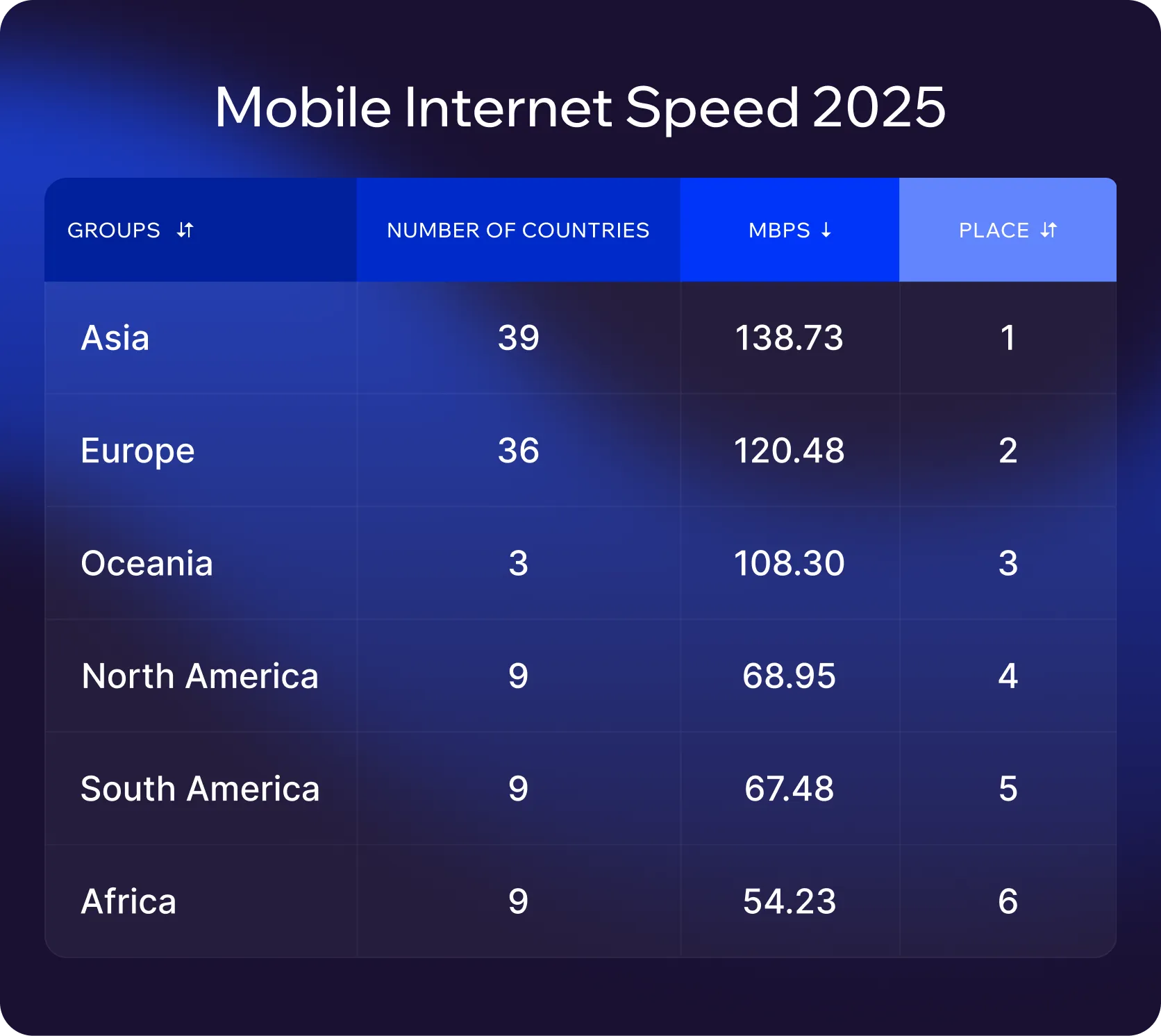
Source: Statbase
Reducing the number of browser requests helps protect page speed and user experience, which directly impacts engagement and long-term monetization potential.
In turn, for markets where identity signals and direct cookie matching matter most, client-side header bidding may be the right choice. Publishers can use it specifically for premium demand partners or high-value audiences – as long as latency remains within acceptable limits.
Because of these nuances, many global publishers adopt a balanced approach:
Leveraging server-side header bidding as the default architecture for scalability and performance.
Using a controlled client-side setup for top-performing partners, premium inventory, or markets where identity advantages justify the additional browser load.
Adjusting bidder lists, timeout settings, and auction logic based on region, device type, and audience behavior.
Remember, the goal is not to maximize the number of bidders or choose one architecture universally. It is more important to focus on a flexible header bidding ecosystem that delivers competitive auctions while protecting user experience across every market you operate in.
Timeouts: what “ideal” is for global publishers
For global publishers, timeout optimization is a crucial but complex process – there is no single setting that can work equally well across different audiences.
Why timeouts matter so much
A header bidding timeout defines how long the publisher’s website or app waits for bidder responses. When the timeout window ends, the available bids are passed to the ad server, and any late responses are ignored.
Longer timeouts give demand partners more time to respond. This can increase bid density, improve competition, and potentially generate higher revenue. However, waiting longer can delay ad rendering, increase page load time, and negatively affect user experience.
Shorter timeouts allow ads to load faster and protect performance, but some demand partners may fail to respond in time. This can reduce the number of available bids and limit monetization opportunities.
What is the ideal timeout for header bidding?
Basically, there is no universal ideal timeout for header bidding. However, here are several examples for you:
Client-side header bidding: You may want to start testing timeout ranges around 1,000–1,500 ms. Bidders will have enough time to respond, while the impact on page performance will be limited.
Server-side header bidding: There is greater flexibility for timeout management because the auction happens outside the user’s browser. However, you still need to balance response time with the need to return competitive bids quickly.
Mobile environments: You may want to prefer shorter timeouts because users are more sensitive to delays, and mobile connections are less predictable.
High-value inventory: Consider setting slightly longer time windows if the additional auction competition consistently produces higher CPMs.
Testing timeouts at scale
Timeouts are not something that you can set up and forget about. Effective optimization requires continuous testing. A structured testing framework may include the following steps:
Establish baseline metrics. Measure session duration, bounce rate, bid response rates, ad revenue, etc.
Test controlled variations. For instance, you may want to test different regions separately or compare shorter timeout windows with longer ones.
Analyze incremental value. For example, you may find out that the timeout increases bid participation but provides little CPM improvement. In this case, protecting user experience may be a better choice.
Header bidding latency: a troubleshooting checklist
Latency is one of the biggest challenges related to header bidding, and for global publishers, managing it is especially complex.
Common sources of latency
There are many potential reasons why latency occurs: too many bidders participating in the auction, too slow responses, poor timeout configuration, regional network differences, heavy client-side execution, and so on.
For instance, some bidders may consistently respond more slowly than others. Even if they occasionally provide valuable bids, frequent timeout behavior can have a negative impact on the overall auction performance.
Step-by-step troubleshooting checklist
Here is a header bidding latency troubleshooting checklist for you to follow:
Identify the source of delays. This can be done by monitoring auction duration and bidder response times, comparing ad load performance before and after header bidding changes, analyzing latency by region, device type, and other factors, etc.
Review every demand partner and analyze their performance. This can help you remove consistently slow and low-value media buyers.
Reduce unnecessary client-side load (when applicable). For instance, you may want to limit the number of active bidders, remove duplicate integrations, prioritize demand partners that deliver the highest revenue, etc.
Evaluate whether parts of the auction should move to the server side.
Continue monitoring after changes – latency optimization is an ongoing process.
When to move more load server-side
Moving more auction logic server-side allows you to centralize demand management, simplify configuration, and reduce the amount of work performed on the user’s device. This can be especially helpful if you manage multiple properties, regions, and demand relationships.
Here are the common signs indicating that you may need to shift more load server-side:
Page load times increase after expanding the bidder list.
There is a large number of bidders that add technical overhead but generate limited revenue.
You have a high share of mobile traffic, where device limitations and network conditions make client-side auctions more expensive.
Your media source attracts a significant amount of traffic from regions with slower connectivity.
Where a white-label SSP / exchange fits into header bidding
There are multiple ad serving tools for global publishers available in the market. However, using a white-label solution is a great choice for those searching for ultimate control over the processes.
Using a white-label exchange as the central endpoint
A white-label exchange can serve as a central endpoint within the header bidding architecture. Instead of client-side wrappers (e.g., Prebid.js) sending requests to multiple independent SSPs and exchanges, they can connect to a single exchange layer that manages demand access behind the scenes.
A white-label exchange (like a white-label solution offered by Attekmi) can handle much of the technical complexity: managing demand partner integrations, applying routing and auction logic, collecting and organizing bid data, maintaining logs and reporting infrastructure, and so on.
At the same time, you retain control over how the system operates. You can define preferred partners, adjust configurations, manage supply rules, and maintain your own brand identity. Besides, Attekmi’s solution is fully customizable, so you can count not only on UI personalization but also on custom on-request feature development.
The main benefits of using a white-label system include:
Fewer direct integrations in the page and app code.
Centralized demand management helps reduce technical overhead and protects user experience.
Simpler global bidder management.
Improved visibility and cleaner data.
Analytics and optimization on top of header bidding
A white-label SSP or exchange can provide a centralized data layer by combining auction logs with header bidding performance metrics. This enables deeper analysis across different factors. For instance, you may compare bidder performance, latency, and revenue contribution across regions, identify differences between desktop, mobile web, and in-app environments, evaluate demand sources based on revenue contribution and response quality, and so on.
With this level of visibility, you can move from manual troubleshooting to data-driven optimization. Examples of ongoing improvements include partner curation, dynamic timeout optimization, supply-path optimization, etc.
How global publishers can design a header bidding roadmap
If you are a global media owner planning to implement a header bidding strategy, there are two main recommendations for you to follow.
Start simple, then evolve
First of all, avoid adding complexity too early. Start with a focused client-side setup for core regions and partners. This will help you understand auction behavior, measure revenue impact, and establish baseline performance metrics.
Then, as complexity grows, you can introduce server-side capabilities or a white-label infrastructure to improve scalability. Remember, the transition does not need to happen all at once. Many publishers gradually move specific bidders, regions, or inventory types to server-side environments based on performance data.
As header bidding systems evolve continuously, you should regularly evaluate your partners, architecture, and technical complexity. Low-performing bidders and inefficient auction paths should be removed based on measurable impact rather than assumptions or industry trends.
Align tech, yield, and product
Keep in mind that architecture choices cannot be managed only by engineering teams or only by monetization teams. Instead, they require alignment between AdOps, product, engineering, and business stakeholders. Decisions around, for instance, timeout settings, bidder selection, and regional configurations should be based on both revenue and user experience metrics.
For example, a change that increases bid participation may appear positive from a yield perspective, but if it slows page performance, the long-term impact may be negative. Cross-functional collaboration helps ensure that header bidding evolves as a business strategy rather than just a technical project.
White-label infrastructure can support this approach by giving you more flexibility over how your auction environment develops. Instead of relying on a single vendor-controlled system with limited visibility, you can maintain control over configurations, integrations, and optimization strategies.
Conclusion
For global publishers, the real challenge is designing the right combination of technologies, partners, and auction strategies for different audiences, devices, and regional aspects.
Client-side header bidding can provide valuable identity signals, transparency, and direct control over auctions, while server-side approaches offer scalability, improved performance, and easier global management. You need to consider the strengths and limitations of each model and build your architecture accordingly. Besides, remember that a white-label SSP or exchange can provide a centralized layer for partner management, analytics, routing, and optimization.
Ready to experience the power of Attekmi’s white-label monetization solution? Just contact us.
FAQ
Client-side offers stronger identity signals, transparency, and potentially higher CPMs but adds latency. Server-side improves performance and scalability but reduces identity quality and increases infrastructure complexity. Most global publishers use a hybrid approach based on region, device, and audience.
Typical starting ranges are ~800–1500 ms for client-side and ~1000–2500 ms in broader setups, depending on geo mix. Optimize through A/B testing, analyzing incremental revenue vs. latency impact, and adjusting by region, device, and bidder response speed.
There’s no fixed number, but diminishing returns often appear beyond ~8–12 active client-side bidders. Too many slow partners increase latency without improving CPMs. Global publishers should continuously remove underperforming bidders based on revenue contribution and timeout behavior.
Measure auction timing, bidder response speed, and timeout rates by region/device. Remove slow or low-yield bidders, adjust timeouts, reduce client-side load, and evaluate architecture efficiency. If issues still exist, shift parts of the demand server-side to reduce browser overhead.
It acts as a centralized auction and demand orchestration layer. Instead of multiple SSP integrations, publishers route traffic through one endpoint that handles bidding, routing, and logging. It simplifies global management, improves visibility, and supports scalable hybrid client/server setups.


'%3e%3cpath%20d='M415.5%20380.133C415.5%20554.655%20911.5%20609.133%20714%20818.633C447%20850.133%20200%20677.655%20200%20503.133C200%20328.611%20341.478%20187.133%20516%20187.133C690.522%20187.133%20415.5%20205.611%20415.5%20380.133Z'%20fill='%231A4CFF'/%3e%3c/g%3e%3cg%20filter='url(%23filter1_f_654_7533)'%3e%3cpath%20d='M819.862%20539.146C969.42%20389.588%20963.912%20273.412%201000.6%20310.096C1037.28%20346.78%201059.92%20590.588%20910.362%20740.146C760.804%20889.704%20503.861%20847.646%20447.362%20760.146C348.862%20547.146%20670.304%20688.704%20819.862%20539.146Z'%20fill='%23052AAE'/%3e%3c/g%3e%3cg%20filter='url(%23filter2_f_654_7533)'%3e%3cpath%20d='M647.331%20285.725C443.031%20230.983%20408.998%20311.131%20358.6%20243.729C295.498%20194.631%20571.852%2052.1078%20776.152%20106.85C980.452%20161.592%201072.5%20405.139%201024.97%20497.82C889.759%20689.623%20851.631%20340.467%20647.331%20285.725Z'%20fill='%231B4DFF'/%3e%3c/g%3e%3c/g%3e%3cdefs%3e%3cfilter%20id='filter0_f_654_7533'%20x='0'%20y='-12.8672'%20width='960.465'%20height='1035.25'%20filterUnits='userSpaceOnUse'%20color-interpolation-filters='sRGB'%3e%3cfeFlood%20flood-opacity='0'%20result='BackgroundImageFix'/%3e%3cfeBlend%20mode='normal'%20in='SourceGraphic'%20in2='BackgroundImageFix'%20result='shape'/%3e%3cfeGaussianBlur%20stdDeviation='100'%20result='effect1_foregroundBlur_654_7533'/%3e%3c/filter%3e%3cfilter%20id='filter1_f_654_7533'%20x='228.938'%20y='103.27'%20width='998.816'%20height='935.965'%20filterUnits='userSpaceOnUse'%20color-interpolation-filters='sRGB'%3e%3cfeFlood%20flood-opacity='0'%20result='BackgroundImageFix'/%3e%3cfeBlend%20mode='normal'%20in='SourceGraphic'%20in2='BackgroundImageFix'%20result='shape'/%3e%3cfeGaussianBlur%20stdDeviation='100'%20result='effect1_foregroundBlur_654_7533'/%3e%3c/filter%3e%3cfilter%20id='filter2_f_654_7533'%20x='149.441'%20y='-105.473'%20width='1087.81'%20height='860.301'%20filterUnits='userSpaceOnUse'%20color-interpolation-filters='sRGB'%3e%3cfeFlood%20flood-opacity='0'%20result='BackgroundImageFix'/%3e%3cfeBlend%20mode='normal'%20in='SourceGraphic'%20in2='BackgroundImageFix'%20result='shape'/%3e%3cfeGaussianBlur%20stdDeviation='100'%20result='effect1_foregroundBlur_654_7533'/%3e%3c/filter%3e%3c/defs%3e%3c/svg%3e)