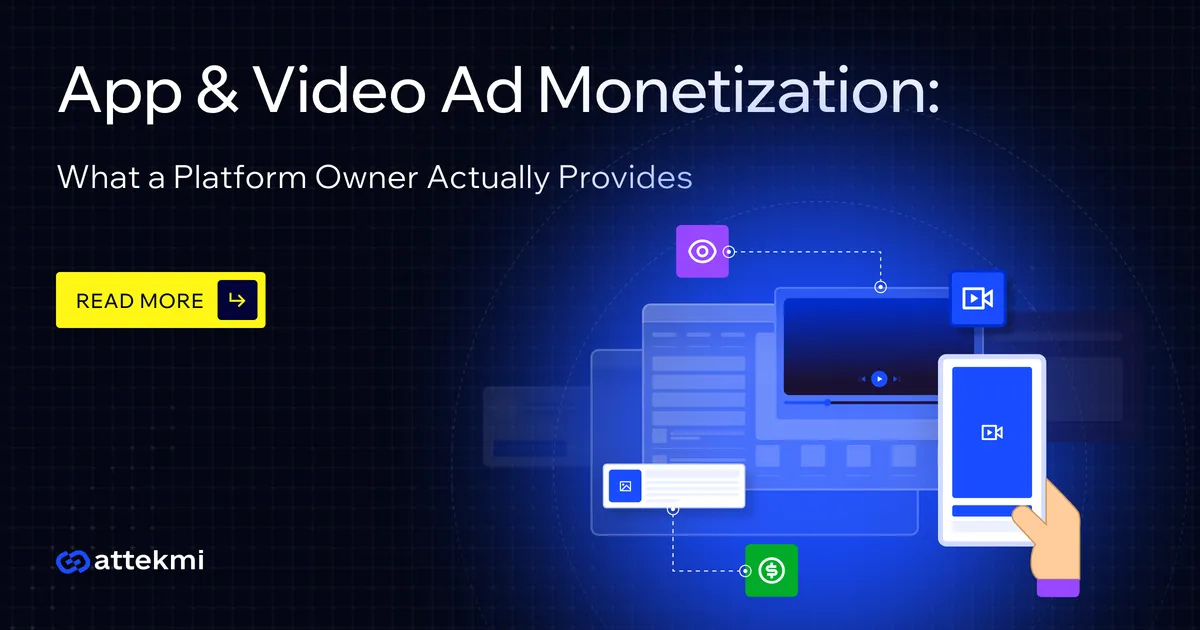
App monetization platforms do more than serve ads. A platform owner connects supply and demand, sets pricing and auction rules, controls video and app quality, protects user experience, and turns reporting into revenue decisions. White-label infrastructure lets qualified operators deliver those capabilities under their own brand without rebuilding core programmatic technology.
Basically, app monetization is the process of turning inventory (app, CTV, etc.) into sustainable advertising revenue while maintaining a positive audience experience.
Owners of app monetization platforms take responsibility for the underlying commercial and technical marketplaces that actually make monetization possible. However, what tasks does this involve?
In this article, we explore the value programmatic app monetization platforms deliver to app publishers, video publishers, and internal operations teams. Read on to learn more, as well as to discover when it makes sense to become a platform owner yourself.
What is an app monetization platform?
An app monetization platform is the technical layer that helps turn available advertising inventory into revenue. It can support diverse types of ad space and connect it with multiple demand sources. For a platform owner, it is an operating environment that brings together supply, demand, decisioning, delivery, data, and controls.
Such platforms keep gaining momentum, reflecting the current market trends. For instance, the in-app advertising market is forecasted to surpass $614 billion by 2031.
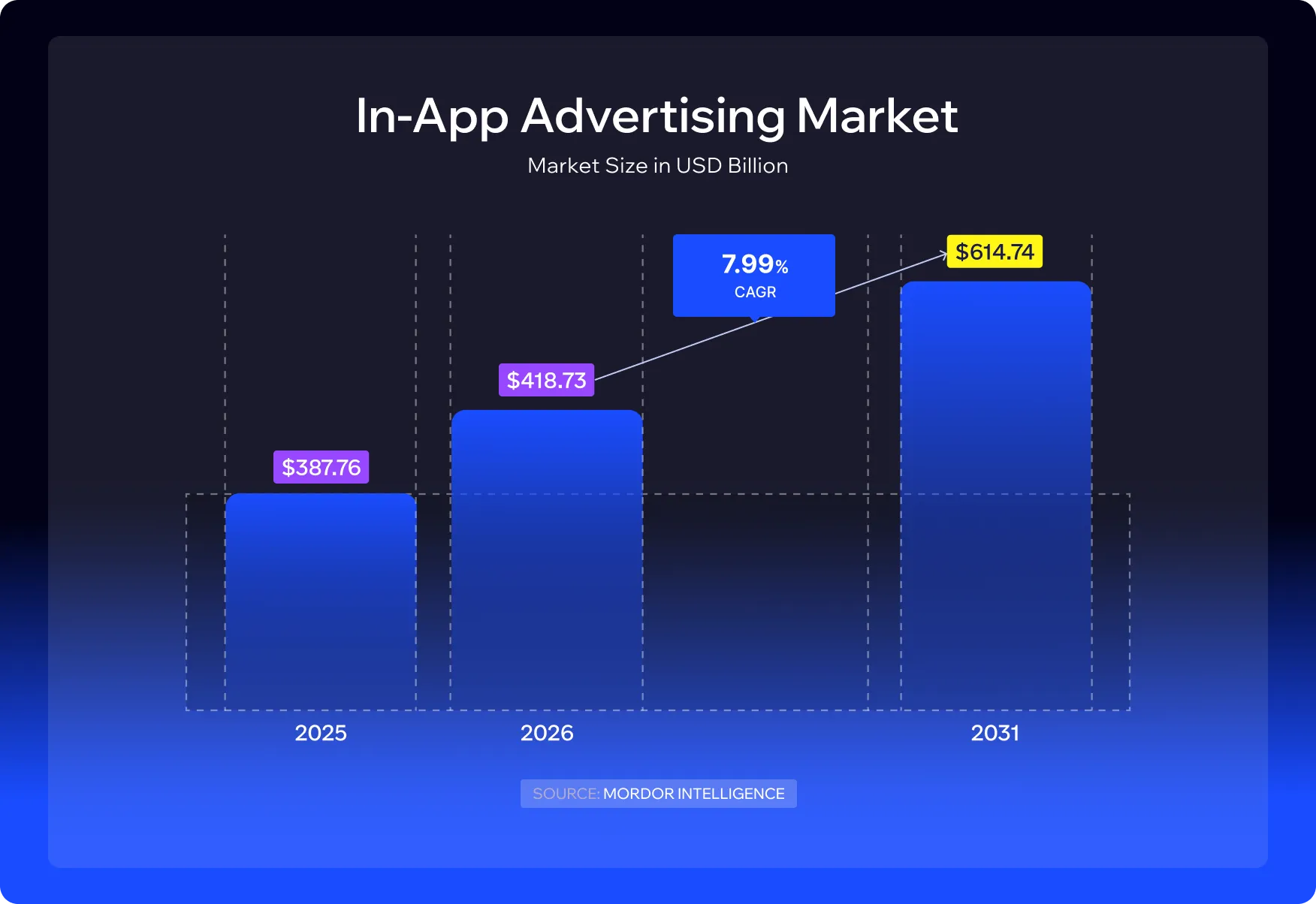
Source: Mordor Intelligence
The core job: turning inventory into reliable revenue
Monetization solutions help operators do the following:
Define sellable inventory: Platforms organize apps, placements, ad units, video slots, CTV channels, content categories, and audience or contextual signals so buyers can understand what is available and apply relevant targeting or buying rules.
Connect partners: A platform can integrate networks, DSPs, SSPs, direct buyers, agencies, and PMP partners, giving the operator multiple opportunities.
Decide which ad wins: Mediation, in-app bidding, ad-server decisioning, SSP rules, exchange auctions, and deal priorities determine which demand source gets the opportunity to serve an impression.
Deliver and validate creatives: The platform handles ad rendering and delivery while validating VAST responses or other creative assets, applying creative approvals and brand or category restrictions, controlling latency, and fixing delivery errors.
Measure and reconcile: Reporting should cover requests, impressions, fill, eCPM, win rate, video views and completion events, revenue, discrepancies, and partner-level performance.
The main components behind the interface
A monetization platform consists of multiple components that enable inventory access, demand competition, ad delivery, measurement, and quality controls.
Component | What it does | Why a platform owner cares |
SDK or tag/player integration | Connects apps, websites, video players, or CTV environments to the monetization infrastructure and sends ad requests or receives ad responses. | Provides the technical connection to supply. |
Mediation or in-app bidding | Compares multiple demand sources and determines which source should receive an impression opportunity based on bids, rules, floors, priorities, or other logic. | Helps operators manage demand competition. |
Ad server | Manages campaigns, targeting, frequency rules, priorities, creatives, direct deals, and delivery decisions. | Gives the platform owner control over how inventory is allocated across monetization channels. |
SSP/exchange | Connects available supply to programmatic demand, runs auctions, applies rules, and facilitates transactions between publishers and buyers. | Expands access to demand and turns the platform into a marketplace rather than simply an internal ad-serving tool. |
Reporting and reconciliation | Collects delivery, auction, performance, and revenue data and compares results across partners. | Enables financial and operational visibility, helps identify discrepancies, and provides the data needed to optimize performance. |
Quality and privacy layer | Applies creative controls, fraud and traffic-quality checks, brand-safety rules, consent and privacy requirements, and other restrictions. | Protects the inventory, audience experience, and commercial relationships while helping the platform meet technical and regulatory requirements. |
What a platform owner actually provides
Now, let’s review in detail what an app monetization platform owner provides – this is much more than access to advertising demand. The real “product” is the combination of supply organization, demand access, auction and pricing controls, delivery infrastructure, quality measures, and revenue operations that allows multiple participants to achieve their goals.
1. A sellable supply product
The primary responsibility is turning a publisher's inventory into a product that buyers can understand and purchase. This starts with a clear inventory taxonomy covering the app bundle, content vertical, placement, format, device, country, operating system, CTV environment, and relevant audience or contextual signals.
Standardization also matters because publishers and buyers need a common understanding of what is being sold. A platform can define which inventory attributes are exposed, how they are categorized, and which combinations can be targeted or packaged.
Once inventory is structured, it can be packaged into different products. Depending on the strategy, this might include open-auction inventory, private marketplace deals, programmatic guaranteed deals, etc.
Supply quality and metadata also affect how attractive inventory is to buyers. Clear signals, accurate classification, consistent identifiers, and reliable delivery data can give buyers more confidence and help increase bid density.
2. Demand access and partner workflows
A platform owner is also responsible for onboarding DSPs, SSPs, ad networks, agencies, and direct buyers. The integration method should match the inventory and business model. Depending on the environment, a platform may work with OpenRTB, VAST, JS tags, header bidding, Prebid Server, or other integrations.
Additionally, platform owners may define partner access, margins, billing terms, and traffic-routing rules. However, adding more partners does not automatically create more revenue. Multiple integrations can introduce duplicated demand, additional latency, operational complexity, etc. The operator needs to determine whether each partner adds incremental value.
Note that Attekmi’s monetization solutions support a wide range of connection types: OpenRTB 2.6, JS tags, header bidding, VAST to VAST, VAST to RTB, VAST to All, etc. Recently, we have also equipped our Attekmi Enterprise solution with the PMP Deals capability.
3. Auction, pricing, and revenue controls
A platform owner needs mechanisms for deciding how inventory is priced and distributed. These can include price floors, deal rules, access controls, traffic allocation, margins, and prioritization rules.
The objective is not necessarily to maximize the price of every individual impression. For example, a very high floor may increase the potential value of a winning bid but reduce both the number of eligible bids and fill rate. This means platform owners need to monitor a broader set of metrics:
eCPM and net revenue
Fill rate
Win rate
Bid density
Timeout and error rates
Latency
Demand-partner contribution
Revenue by inventory type and market
Rules can be configured differently depending on the market, app, placement, format, or buyer relationship. For instance, a premium CTV placement may require different pricing and access rules from a standard mobile-app banner.
4. Video and CTV delivery that protects the experience
The platform may need to validate VAST tags, manage, for instance, VAST to RTB or VAST to VAST flows, and handle different video demand sources. It can also apply rules around ad duration, pod structure where applicable, frequency (frequency capping increases efficiency by 32%), creative categories, and fallback behavior when the preferred ad cannot be delivered.
Video-specific measurement is also important. The platform should track starts, quartile events, completions, errors, latency, and completion rates so operators can distinguish between an impression that was technically served and one that actually delivered a successful viewing experience.
Experience protection is part of monetization quality. Too high frequency, long loading times, broken creatives, disruptive placements, or inappropriate advertising can reduce engagement and ultimately affect the value of the inventory. A platform owner has to balance monetization opportunities with the conditions under which users are willing to continue consuming the content.
Learn more about in-app video advertising here.
5. Quality, privacy, and governance
A robust solution (for instance, an in-app ad monetization platform or a CTV monetization platform) also provides controls designed to protect both the marketplace and the people using the apps or services. These can include traffic filtering, invalid-traffic detection, creative scanning and review, blocklists, and category controls.
Supply-chain transparency also plays a critical role. The platform may need to support mechanisms such as app-ads.txt, sellers.json, supply-chain objects, and accurate seller or domain declarations.
Privacy and consent workflows must also be incorporated into the technical architecture. The specific requirements depend on the markets, platforms, inventory types, and applicable privacy frameworks.
6. Reporting, reconciliation, and revenue operations
Last but not least, publishers and buyers need reports covering metrics such as requests, impressions, wins, spend, revenue, payouts, and partner performance.
The platform also needs to reconcile information across different systems. One partner may report a different number of impressions or revenue from another because of counting methods, time zones, filtering, latency, or other technical differences. These discrepancies should be identified and explained before they become billing or payout problems.
That is why a platform dashboard should not automatically be treated as the financial source of truth. Reporting definitions, reconciliation rules, contractual terms, and billing logic need to be aligned first.
One more thing to mention is that the platform should support invoice, payout, revenue-share, credit, and partner-performance workflows.
App and video monetization have different operational requirements
The key monetization principles are similar across digital environments, but the operational requirements can differ significantly. Mobile apps, online video, and CTV imply differences in technical integrations, ad formats, user behavior, measurement, and other aspects.
In-app monetization
In-app monetization starts with the SDK lifecycle: integrating the SDK, maintaining compatibility with new app versions, managing updates, and ensuring that ad requests and responses work properly across different devices and operating systems. Latency, consent collection, app-ads.txt, and measurement limitations should also be considered, as they can affect how impressions and user activity are observed. Common in-app formats include banner, interstitial, rewarded video, native, playable, and app-open ads, where supported by the app and the app publisher monetization strategy. In-app display accounts for over 70% of mobile programmatic impressions.
The platform owner has to consider more than immediate revenue. Monetization decisions can affect retention, session depth, engagement, and app ratings or reviews. A configuration that increases short-term impressions may not be a way to go if it affects the overall product experience.
In-app bidding and mediation can also coexist in hybrid setups. The platform operator can determine which demand partners, placements, or app environments use mediation, in-app bidding, or another decisioning approach, based on factors such as partner capabilities, latency, competition, and operational requirements.
Online video monetization
In the case of online video, the platform needs to support VAST compatibility, player behavior, in-stream and out-stream inventory, error handling, ad duration, podding where applicable, and completion signals.
The relationship between the video ad server, player, demand source, and content experience is also important. A technically valid ad response is not necessarily a successful delivery if, for instance, the player cannot render it correctly. Demand suitability matters as well. Platform owners may need to apply rules around creative categories, duration, frequency, and other delivery conditions. This way, quality video inventory depends on more than simply having a video player.
CTV monetization
CTV adds another operational layer because advertising takes place within a more controlled, often long-form viewing environment. Platform owners may need to account for ad frequency, longer content sessions, household and device-level signals, content context, and measurement requirements that differ from standard web or mobile environments.
CTV monetization also requires compatible supply and demand connections, appropriate video and ad-format rules, detailed reporting, and privacy governance. The platform needs to handle the technical requirements of CTV inventory while preserving a viewing experience in which excessive repetition, inappropriate ad duration, or poor delivery can be particularly noticeable.
CTV can attract distinct demand when the inventory has the right quality characteristics and the platform provides buyers with appropriate access, signals, and measurement. Thus, by 2029, the U.S. CTV market is projected to reach $51 billion in annual ad spend. However, it should not be assumed that CTV inventory automatically implies higher CPMs. Pricing depends on factors such as inventory quality, audience and content signals, buyer demand, measurement, and the specific marketplace.
Need to learn more about Attekmi traffic types? Our solutions support desktop, mobile web, in-app, and CTV environments, while the supported formats include banner, video, audio, native, and CTV ads. If you are in search of a monetization platform with advanced functionality, consider Attekmi Enterprise. It enables access to all the features our team has developed so far and helps you drive income with maximum efficiency.
Managed monetization vs. owning the platform
The difference between managed monetization and platform ownership is primarily about control and responsibility. Both models can connect inventory to demand, but they give different levels of control over technology, workflows, relationships, and day-to-day operations.
Managed monetization | White-label platform ownership | |
Control | The provider controls most of the portal, workflows, infrastructure, and partner access. | The operator runs a branded environment and has greater control over partner access, marketplace rules, workflows, reporting, and commercial relationships. |
Infrastructure | The provider operates the full technology stack and typically manages its maintenance and technical operation. | A technology partner maintains the core infrastructure while the operator shapes the customer-facing platform, configuration, and monetization strategy. |
Operations | The provider may handle AdOps, demand management, optimization, and other operational tasks. | The operator usually takes responsibility for supply, demand, quality, optimization, and partner management. |
Commercial relationships | The provider generally controls or manages demand relationships. | The operator has more direct control over partner access, commercial terms, and marketplace relationships. |
Best suited for | Teams that want to start monetizing quickly with limited operational overhead. | Businesses that want to make monetization part of their own product and commercial offering. |
Note that many businesses use a hybrid approach. For example, a company may use external demand and specialist vendors while owning the partner-facing platform, supply controls, reporting structure, and commercial strategy.
When it makes sense to become a platform owner
Being an owner of a mobile app ad platform (or any other similar solution) looks like a great responsibility. However, in certain cases, this is the most suitable strategic decision.
You manage multiple apps, publishers, or video properties
If you manage several apps, publishers, or video properties through separate monetization setups, it can be challenging for you to maintain consistent rules and visibility. A unified platform can centralize inventory rules, partner onboarding, reporting, quality thresholds, and direct/programmatic priorities across the portfolio. This way, the platform becomes a shared infrastructure layer, and you do not have to manage each property in isolation.
You want to build a branded marketplace for partners
If you run an ad network or a media company, you may also use white-label infrastructure (e.g., a white-label ad exchange) to turn your supply and demand relationships into a branded marketplace. You can provide your own environment through which publishers or other supply partners access monetization services. In this case, the underlying technology is provided by an AdTech partner, while you control the strategy and other monetization aspects.
Your differentiation comes from data, format, or workflow
Platform ownership can be particularly relevant when you have assets or processes that are difficult to benefit from through a standard monetization dashboard. Here are several examples:
Retail media can use first-party commerce and transaction signals to organize and package advertising inventory around shopping behavior or product context.
A CTV business can package video supply according to content, viewing environment, audience signals, and buyer requirements.
A gaming or app network can build specialized rules around rewarded video monetization, frequency, user experience, and creative quality.
A regional publisher network can incorporate local sales workflows, inventory rules, consent requirements, and market-specific privacy processes.
In these cases, the technology supports a specific commercial model instead of providing generic ad-serving functionality.
You need custom logic beyond a standard dashboard
A standard mobile app advertising platform or, for instance, a CTV monetization solution may cover common requirements: integrations, reporting, basic optimization, etc. A custom platform becomes more relevant when you need proprietary workflows, specialized integrations, custom data logic, unique reporting, or a monetization experience embedded directly into your own product.
By owning a monetization platform, you can gain a competitive advantage that third-party solutions cannot really provide.
How Attekmi supports app and video platform owners
Attekmi provides white-label infrastructure and enables businesses to launch branded monetization platforms in the shortest time possible. What makes our Attekmi WLS special is that its customization opportunities go beyond UI personalization. You can request unique functionalities, and we will build them for you to tailor the platform to all your requirements.
The supported environments are mobile web, in-app, desktop, and CTV.
The available formats include banner, video, audio, native, and CTV ads.
The range of connection types includes OpenRTB 2.6, header bidding, JS tags, and specific SSP and DSP connectors. In addition, for profitable VAST video advertising, we offer VAST to RTB, VAST to VAST, and VAST to All cross-integration bidding opportunities.
Advanced targeting, filtering, and optimization capabilities.
The ability to integrate traffic and demand scanners to keep your system secure.
Compliance with GDPR, CCPA, COPPA, and TCF 2.0.
Besides, we offer custom AdTech development services. Therefore, if you need a unique solution (an SSP, a DSP, an ad exchange, etc.), our skilled team is ready to build it for you.
Case studies: what platform ownership can enable
Here are a few case studies of our partners showing what results platform ownership can lead to:
House of Pubs, a business empowering website and app owners to monetize their traffic, achieved payback in 1 month, 55% profit growth in 2 months, and increased platform capacity from 10k to 20k QPS in 2 months.
ExplorAds, an ad network supporting various ad formats, achieved payback in 1 month and reached stable ROI and profit growth.
In both cases, the Attekmi team prepared a tailored strategy that helped House of Pubs and ExlorAds achieve their goals. In addition, we provide ongoing support and reach out to our partners proactively to help them detect both opportunities and bottlenecks.
Conclusion: own the parts that create your advantage
Video and app monetization platforms combine technical infrastructure, commercial operations, demand access, quality and privacy safeguards, measurement, and user-experience management to turn digital inventory into a sustainable revenue source. For a platform owner, the product is more than just a tag, SDK, or dashboard. It is the marketplace and operating model behind monetization: how inventory is structured, which partners can access it, etc.
Managed monetization tools can make sense when speed, simplicity, and low operational overhead are the main priorities. Branded platform ownership becomes more relevant when you need greater control over partner relationships and marketplace rules, want to activate first-party data, have differentiated workflows, or aim to turn monetization itself into a product.
The right scope should be defined by the inventory, formats, partner model, commercial objectives, and operational capacity. The goal is to own the parts of the monetization process that create a real advantage.
Need a monetization platform fully tailored to your needs? Contact Attekmi.
FAQ
An app monetization platform connects app, web, video, or CTV inventory with advertising demand and manages the processes needed to generate revenue. It can handle auctions, pricing, ad delivery, quality controls, reporting, reconciliation, and partner management.
Mediation typically coordinates multiple demand sources for a publisher or app and decides which source gets an opportunity to serve an ad. An ad exchange acts as an intermediary that enables programmatic buying and selling through real-time auctions.
It needs to support video-specific standards and workflows such as VAST, player integrations, in-stream or out-stream delivery, ad pods where applicable, creative validation, and video event tracking. It should also manage latency, errors, frequency, duration, and quality controls that affect the viewing experience.
No. For publishers with limited scale or operational resources, managed monetization can provide access to demand and infrastructure without the complexity of running a platform. Ownership becomes more relevant when monetization is strategically differentiated or spans multiple properties and partners.
Yes, a single platform can support apps, web video, and CTV, provided its infrastructure accommodates their different integrations, formats, auction workflows, measurement requirements, and privacy controls. The platform should allow environment-specific rules rather than assuming that the same monetization configuration works everywhere.


'%3e%3cpath%20d='M415.5%20380.133C415.5%20554.655%20911.5%20609.133%20714%20818.633C447%20850.133%20200%20677.655%20200%20503.133C200%20328.611%20341.478%20187.133%20516%20187.133C690.522%20187.133%20415.5%20205.611%20415.5%20380.133Z'%20fill='%231A4CFF'/%3e%3c/g%3e%3cg%20filter='url(%23filter1_f_654_7533)'%3e%3cpath%20d='M819.862%20539.146C969.42%20389.588%20963.912%20273.412%201000.6%20310.096C1037.28%20346.78%201059.92%20590.588%20910.362%20740.146C760.804%20889.704%20503.861%20847.646%20447.362%20760.146C348.862%20547.146%20670.304%20688.704%20819.862%20539.146Z'%20fill='%23052AAE'/%3e%3c/g%3e%3cg%20filter='url(%23filter2_f_654_7533)'%3e%3cpath%20d='M647.331%20285.725C443.031%20230.983%20408.998%20311.131%20358.6%20243.729C295.498%20194.631%20571.852%2052.1078%20776.152%20106.85C980.452%20161.592%201072.5%20405.139%201024.97%20497.82C889.759%20689.623%20851.631%20340.467%20647.331%20285.725Z'%20fill='%231B4DFF'/%3e%3c/g%3e%3c/g%3e%3cdefs%3e%3cfilter%20id='filter0_f_654_7533'%20x='0'%20y='-12.8672'%20width='960.465'%20height='1035.25'%20filterUnits='userSpaceOnUse'%20color-interpolation-filters='sRGB'%3e%3cfeFlood%20flood-opacity='0'%20result='BackgroundImageFix'/%3e%3cfeBlend%20mode='normal'%20in='SourceGraphic'%20in2='BackgroundImageFix'%20result='shape'/%3e%3cfeGaussianBlur%20stdDeviation='100'%20result='effect1_foregroundBlur_654_7533'/%3e%3c/filter%3e%3cfilter%20id='filter1_f_654_7533'%20x='228.938'%20y='103.27'%20width='998.816'%20height='935.965'%20filterUnits='userSpaceOnUse'%20color-interpolation-filters='sRGB'%3e%3cfeFlood%20flood-opacity='0'%20result='BackgroundImageFix'/%3e%3cfeBlend%20mode='normal'%20in='SourceGraphic'%20in2='BackgroundImageFix'%20result='shape'/%3e%3cfeGaussianBlur%20stdDeviation='100'%20result='effect1_foregroundBlur_654_7533'/%3e%3c/filter%3e%3cfilter%20id='filter2_f_654_7533'%20x='149.441'%20y='-105.473'%20width='1087.81'%20height='860.301'%20filterUnits='userSpaceOnUse'%20color-interpolation-filters='sRGB'%3e%3cfeFlood%20flood-opacity='0'%20result='BackgroundImageFix'/%3e%3cfeBlend%20mode='normal'%20in='SourceGraphic'%20in2='BackgroundImageFix'%20result='shape'/%3e%3cfeGaussianBlur%20stdDeviation='100'%20result='effect1_foregroundBlur_654_7533'/%3e%3c/filter%3e%3c/defs%3e%3c/svg%3e)