Supply-side platforms are used well beyond traditional publishers. They help businesses organize digital inventory, connect supply to programmatic demand, run auction-based monetization, and analyze performance. Across industries, advanced operators may use white-label SSP and exchange infrastructure to build branded, configurable monetization operations without developing the full technical stack from scratch.
Most guides exploring supply-side platforms (SSPs) focus on the technology. What is an SSP used for? It connects publishers with programmatic demand and helps automate the processes. The SSP market is projected to surpass $245 billion by 2035. However, what really matters is how an SSP can fit into a specific industry.
The supply side of digital advertising has expanded far beyond traditional web display. Publishers, mobile app developers, CTV and streaming operators, audio platforms, retail media businesses, gaming companies, and ad networks can all manage inventory programmatically. While their businesses differ, they still need to organize inventory, connect it with relevant demand, and maximize its value without losing control over the monetization. This is what an SSP can help with, but the exact role it plays can look very different from one industry to another.
At the same time, before choosing a platform, you should also consider the kind of supply operation, data, format support, partner flexibility, and control your business needs. In some cases, you may also choose a white-label publisher ad monetization platform to run a branded and configurable programmatic environment.
In this article, we will review twelve supply-side platform examples, so read on to find out which industry-specific challenges such a platform can help you solve.
Supply-side platform explained: the common pattern behind every use case
In general, an SSP can help you with the following programmatic monetization tasks:
Make inventory available to programmatic demand.
Organize and classify inventory using signals such as format, placement, content or context, device, geography, and other attributes.
Send auction opportunities to eligible demand sources.
Apply controls over inventory, demand partners, access, pricing, auctions, etc.
Track performance through metrics such as revenue, CPMs, fill rate, bid activity, etc.
Optimize ad revenue by using performance data.
Note that web, in-app, CTV, gaming, audio, and retail-media environments have different technical requirements. Therefore, the SSP needs to adapt to the way each type of business manages and sells its inventory.
By the way, here you can learn more about supply-side integrations supported by Attekmi’s solutions.
12 supply-side platform examples across industries
Note that the supply-side platform use cases we are going to explore below are just representative scenarios to help you understand how things could work. Unless marked as an Attekmi customer case, they are not claims about someone’s specific results.
1. Digital publishers: increasing programmatic revenue from website inventory
Business model and inventory
Digital publishers, blog networks, lifestyle websites, specialist content platforms, and multi-property editorial groups monetize website traffic through a range of advertising formats. Their inventory may include standard display placements, native ads, video, rich media, and other formats supported by their setup.
Core business challenge
The main challenge is to increase revenue from available page views without simply adding more ads. Publishers need to understand which placements and types of content generate the most value while avoiding excessive ad density, slow page loads, or a poor user experience. Treating every impression as equally valuable can also lead to missed revenue opportunities.
How the SSP helps
An SSP for publishers can classify and organize inventory using signals such as content category, placement, device, geography, viewability, and contextual relevance. It can then connect eligible impressions with relevant programmatic demand and give visibility into how different parts of inventory perform.
For example, a publisher may discover that in-article video placements generate higher CPMs than standard sidebar banners. Instead of applying the same monetization strategy across the entire site, the publisher can use this information to make more targeted yield decisions.
Potential outcomes
More structured inventory packaging.
Better visibility into which placements and contexts generate value.
More effective yield decisions based on actual performance.
A clearer balance between revenue, page quality, and reader experience.
Capabilities to prioritize
Contextual inventory classification.
Placement-level controls.
Reporting by page type, category, device, and demand partner.
Yield and CPM analysis.
Latency and page-performance monitoring.
2. News and media: monetizing high-traffic content with partner control
Business model and inventory
News publishers, media groups, online magazines, and other similar platforms often operate at significant scale, but their traffic can be highly unpredictable. For instance, a major sporting event or cultural moment can generate traffic several times higher than normal within a short period.
Core business challenge
Such businesses need to capture the revenue opportunity created by sudden traffic growth while maintaining control over which demand partners can access different content environments. This becomes particularly important when inventory includes sensitive editorial topics, premium sections, or content where brand suitability is a concern.
How the SSP helps
An SSP can segment inventory according to editorial section, content context, audience, geography, traffic source, and placement type. Monetization teams can then apply different rules to different inventory groups, including controls over which demand partners can bid.
For instance, a media group could make general lifestyle content broadly available to programmatic demand while applying stricter partner and quality requirements to sensitive editorial environments.
Potential outcomes
Greater control over monetization during traffic spikes.
Better reporting across premium, standard, and sensitive content environments.
Stronger supply-quality governance.
Less reliance on one generic site-wide monetization rule.
Capabilities to prioritize
Contextual and content-category controls.
Demand-partner governance.
Real-time traffic and revenue reporting.
Quality controls and brand-safety workflows.
Scalable infrastructure for high-traffic events.
3. CTV and streaming: maximizing premium video revenue across buyers
Business model and inventory
Broadcasters, FAST channels, streaming platforms, niche video services, and CTV-focused media businesses monetize premium video inventory across connected TVs and other streaming devices. Depending on the platform, available opportunities can include pre-roll, mid-roll, post-roll, and other supported video placements.
Core business challenge
CTV operators need to monetize premium video inventory across multiple buyers without compromising the viewing experience. They also need to manage latency, ad delivery, inventory availability, and demand participation reliably, particularly when viewing volumes increase.
How the SSP helps
An SSP for CTV can organize supply relying on signals such as channel, program or content category, device, region, and ad position. It can connect compatible demand sources and provide visibility into revenue, bid activity, delivery, and technical performance.
For example, a streaming operator could differentiate inventory from a premium sports channel from general entertainment content, ensuring more relevant ways to package and evaluate the supply.
Potential outcomes
More consistent visibility into CTV monetization performance.
Better inventory packaging by content and viewing context.
Improved ability to monitor buyer participation and technical delivery.
Stronger operational control during high-demand events.
Capabilities to prioritize
CTV and video compatibility.
VAST-related support where relevant.
Low-latency auction infrastructure.
Content and channel classification.
Market-level reporting.
Peak-traffic resilience.
StreamKey’s success with Attekmi
StreamKey, a company helping advertisers, publishers, and content owners optimize profits and performance on any connected device, reached out to Attekmi while searching for a robust technology platform. It looked for a solution supporting integration with a wide range of systems.
With Attekmi, StreamKey migrated to the new platform within a few weeks, achieved 2x profit growth in 2 months, and scaled capacity from 10k to 20k QPS.
4. Mobile apps and gaming: scaling in-app monetization without damaging UX
Business model and inventory
Utility apps, lifestyle platforms, mobile games, PC and console gaming ecosystems – all these can monetize a variety of in-app and in-game advertising opportunities. These may include banners, interstitials, rewarded video, native units, in-app video, and other supported formats. By the way, in-app display accounts for over 70% of mobile programmatic impressions
Core business challenge
These operators need to grow advertising revenue while protecting session quality, retention, gameplay, or application performance. They also have to manage traffic that can vary significantly across devices, operating systems, markets, and individual apps or games.
How the SSP helps
A programmatic solution (e.g., an SSP for mobile apps or an SSP for gaming) can organize inventory by app, game, screen, session stage, placement, format, geography, device, and other signals. Performance data can then help understand how different formats and demand sources perform and identify a more effective balance between revenue, demand quality, and user experience.
For example, rewarded video may perform well at particular gameplay stages, while interstitials or display placements may be more appropriate elsewhere. Granular reporting makes it easier to evaluate these differences.
Potential outcomes
Better visibility into how formats perform across apps and placements.
More granular management of rewarded video, interstitial, native, and display opportunities.
More informed demand and inventory decisions by market or device.
More scalable operations.
Capabilities to prioritize
Mobile-compatible integrations and SDK support where applicable.
In-app inventory configuration.
Game-, app-, and placement-level reporting.
Low-latency processing.
Traffic-quality controls.
Device and geography analysis.
5. E-commerce and retail media: building revenue from first-party traffic and onsite inventory
Business model and inventory
Retailers, e-commerce sites, grocery chains, consumer-electronics stores, delivery platforms, and retail-media networks can monetize advertising inventory across their owned digital properties. Opportunities may appear on product and category pages, search-related experiences, mobile apps, recommendation surfaces, and other relevant environments. The retail and e-commerce segment accounts for almost $10 billion of the global SSP market in 2026.
Core business challenge
Retail-media operators need to monetize valuable commerce context without compromising the shopping journey. Ads must remain relevant and appropriately placed while the business protects customer trust and maintains productive relationships with brands, sellers, and advertisers.
How the SSP helps
An SSP for retail media (or any other relevant categories) can organize inventory by product category, shopping context, page type, placement, platform, geography, and campaign environment. It can provide a structured way to make inventory available to programmatic demand while giving teams visibility into the commercial value of different shopping contexts.
For example, a retailer may distinguish between high-intent product pages and broader discovery environments. This allows the business to evaluate its inventory separately rather than treating every impression as equivalent.
Potential outcomes
A clearer view of which commerce environments attract demand.
More structured inventory taxonomy for product, category, and onsite-media placements.
Better reporting for high-intent versus discovery-stage environments.
An incremental advertising revenue stream built around first-party traffic.
Capabilities to prioritize
Granular contextual classification.
Flexible inventory taxonomy.
Page- and product-category reporting.
Data and API integration capacity.
Role-based access and workflow controls.
Infrastructure that handles seasonal demand spikes.
6. Online marketplaces and classifieds: monetizing high-volume marketplace traffic
Business model and inventory
Property platforms, automotive marketplaces, job boards, local-service platforms, comparison sites, and other related businesses manage large volumes of high-intent traffic. Their digital environments can include listing pages, search results, category pages, recommendation surfaces, and other stages of the user journey.
Core business challenge
These businesses need to monetize selected inventory without disrupting conversion paths or reducing trust in a marketplace built around search, listings, and user actions. An ad placement that generates revenue but distracts users from completing a valuable transaction may affect the core business.
How the SSP helps
An SSP for marketplaces can classify supply by vertical, category, location, listing type, user-journey stage, device, and placement. Reporting can help distinguish high-intent search and listing environments from broader discovery or content traffic and evaluate monetization value.
For instance, a property marketplace could separately analyze advertising performance on property-detail pages, search results, and general editorial content. This gives the business more control over where programmatic advertising adds revenue without hurting the primary marketplace experience.
Potential outcomes
More accurate monetization analysis across different marketplace journeys.
Better control over where and how programmatic ads appear.
More structured packaging of high-value marketplace contexts.
An incremental revenue stream that does not rely only on transaction fees or subscriptions.
Capabilities to prioritize
Category and context-level segmentation.
Placement management.
User-journey-aware reporting.
Demand-quality controls.
Scalable handling of listing and search traffic.
Flexible data exports.
7. Sports and entertainment: capturing revenue from live audience spikes
Business model and inventory
Sports publishers, entertainment platforms, fan communities, live-event media, streaming and gaming content platforms, and music or celebrity-content sites can experience major audience spikes around matches, tournaments, premieres, releases, and live events. These peaks can create substantial short-term advertising opportunities, but they also put additional pressure on infrastructure and monetization operations.
Core business challenge
Such businesses must capture the value of rapid and sometimes unpredictable traffic growth while maintaining fast page or app performance. They also need to avoid low-quality or poorly matched advertising that can damage the experience in premium fan environments.
How the SSP helps
An SSP can segment inventory by event, content type, device, geography, live versus on-demand traffic, and ad format. It can also help teams monitor demand participation, auction performance, and technical metrics as traffic increases.
For example, inventory associated with a major sporting event can be analyzed separately from regular content, allowing teams to understand whether the event attracts different demand levels, CPMs, or buyer participation.
Potential outcomes
Better visibility into event-driven inventory value.
Improved readiness for large traffic spikes.
More informed routing and demand decisions during high-attention moments.
Stronger control over ad quality in premium fan environments.
Capabilities to prioritize
High-volume scalability.
Event- and content-level reporting.
Low-latency infrastructure.
Multi-format support for display, video, and CTV.
Traffic-quality and partner controls.
8. Audio and podcasting: monetizing digital audio inventory
Business model and inventory
Podcast networks, streaming-audio services, digital radio providers, music platforms, and creator networks can monetize streaming audio and podcast advertising opportunities alongside companion display and other digital-audio placements. Inventory can vary considerably by show, genre, market, device, listening session, and content environment. By the way, programmatic digital audio ad spending is expected to surpass $2.5 billion in 2026.
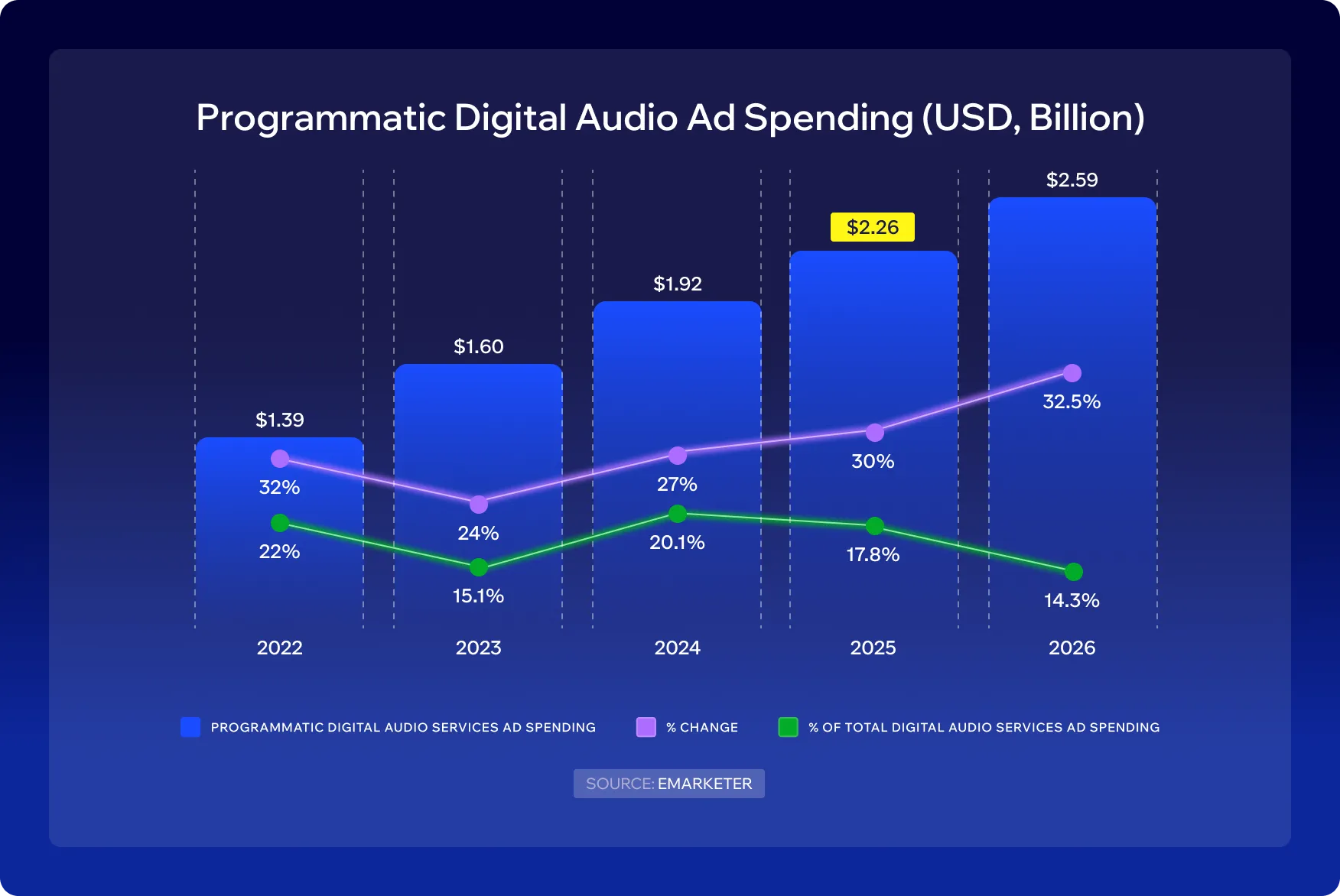
Source: EMARKETER
Core business challenge
Audio businesses need to manage inventory across many shows, genres, listener locations, devices, and listening contexts while preserving a seamless listening experience. As networks grow, they also need a scalable way to connect their inventory with relevant demand and understand performance across their content portfolio.
How the SSP helps
An SSP for audio publishers can help classify inventory by program, genre, device, market, audience context, and placement type. It can connect eligible audio inventory to compatible programmatic demand and provide performance analysis.
For example, a podcast network could compare demand and revenue across different show categories to determine which types of content attract stronger advertiser interest.
Potential outcomes
More useful visibility into demand by show category and audience context.
Stronger inventory packaging across podcast and streaming portfolios.
More consistent reporting by device, market, and content type.
A scalable monetization layer for growing audio networks.
Capabilities to prioritize
Audio support where relevant.
Contextual and content-level classification.
Device and geography reporting.
Demand-integration flexibility.
Low-latency operational performance.
Revenue and audience-data exports.
9. Travel and hospitality: turning high-value traffic into advertising revenue
Business model and inventory
Online travel agencies, hotel groups, airline ecosystems, accommodation platforms, destination guides, booking platforms, and travel marketplaces attract users across different stages of the travel journey. Their inventory may span inspiration and editorial content, destination pages, search and comparison environments, booking experiences, and post-booking interactions.
Core business challenge
Travel demand changes significantly by season, destination, geography, device, and booking stage. Operators need to understand which environments carry advertising value while ensuring that monetization does not interfere with important search, comparison, and conversion journeys.
How the SSP helps
An SSP can organize inventory by destination, travel context, content stage, device, geography, booking environment, and traffic source. It can help analyze demand patterns across seasonal and high-intent segments and identify which types of inventory generate stronger monetization results.
For example, a travel platform might treat destination inspiration pages differently from booking-related pages, where advertising could have a greater impact on conversion. This makes it possible to build a more effective monetization strategy around the user journey.
Potential outcomes
Better understanding of inventory value by stage of the travel journey.
More precise segmentation of inspiration, comparison, booking, and post-booking environments.
An incremental advertising revenue stream from high-value site and app traffic.
Improved visibility into seasonal demand shifts.
Capabilities to prioritize
Contextual and location-based inventory classification.
Web and app support.
Seasonal and market-level reporting.
Demand-source flexibility.
Data exports for commercial analysis.
10. Financial and FinTech publishers: monetizing valuable niche audiences
Business model and inventory
Financial-news sites, investment platforms, personal-finance publishers, market-data providers, FinTech content hubs, and trading communities often attract specialized audiences in highly contextual environments. Their inventory may include financial news, market analysis, educational content, data pages, and other specialist media environments.
Core business challenge
These businesses need to monetize specialized audiences while maintaining advertising-partner quality, audience trust, and appropriate controls around sensitive financial topics. A broad, undifferentiated monetization strategy may not provide enough control over premium or particularly sensitive content environments.
How the SSP helps
An SSP can organize inventory by content type, market context, audience environment, geography, device, and placement. It can also support partner rules and reporting that help maintain greater control over which demand sources can access particular supply segments.
For example, a financial publisher could separate general personal-finance content from specialist market-data environments and evaluate demand, CPMs, and partner performance independently.
Potential outcomes
More structured monetization of niche, high-value audience environments.
Better reporting by finance topic, content type, and placement.
Stronger partner governance for sensitive or premium inventory.
More transparent demand and revenue analysis.
Capabilities to prioritize
Granular contextual classification.
Partner eligibility and quality controls.
Placement-level reporting.
Data governance and access controls.
Brand-safety workflows.
Revenue analytics by market and device.
11. B2B and professional media: monetizing specialized audiences
Business model and inventory
Trade publications, professional communities, SaaS media, industry forums, research platforms, job boards, specialist content hubs, and B2B publisher networks serve clearly defined professional audiences. Their inventory can include editorial content, industry reports, newsletters, community environments, job listings, and other specialist digital properties.
Core business challenge
B2B operators may have smaller audiences than mass-market publishers, but their inventory can carry significant value because of its professional context. They need to package this supply clearly, demonstrate its value to relevant buyers, and avoid diluting specialist environments with poorly matched demand.
How the SSP helps
An SSP can organize inventory around industry verticals, professional contexts, content categories, company types, locations, and engagement environments. Performance reporting can then help identify which contexts attract demand and which inventory segments generate the strongest results.
For example, a technology publication could distinguish software-development content from broader business coverage and evaluate demand for each category separately.
Potential outcomes
More structured packaging of specialist professional inventory.
Better reporting for vertical-specific content environments.
Improved visibility into demand for high-value niche audiences.
A foundation for a differentiated B2B monetization product.
Capabilities to prioritize
Contextual classification.
Granular reporting.
Inventory segmentation by content and professional context.
Flexible data and analytics workflows.
Role-based access and branded reporting where relevant.
12. Community and user-generated content platforms: scaling as users and content grow
Business model and inventory
Community platforms, forums, niche social networks, user-generated-content apps, creator communities, review sites, and discussion platforms can monetize feeds, content-detail pages, discovery surfaces, community pages, and app placements. Unlike traditional publishers, these businesses may have constantly changing content and inventory as users create, interact with, and discover new material.
Core business challenge
These businesses need to scale monetization alongside users, content, and traffic while protecting trust, moderation standards, brand safety, and user experience. The diversity and speed of user-generated content can also make it difficult to apply a single monetization rule across the entire platform.
How the SSP helps
An SSP can classify inventory by content environment, platform, placement, device, geography, and relevant policy or quality categories. It can also help manage demand access according to moderation and quality requirements, making it possible to treat different supply segments differently.
For example, a community platform could apply broader demand access to established, brand-safe content environments while using stricter rules for newly created or higher-risk content categories.
Potential outcomes
More structured monetization across dynamic, fast-growing content environments.
Better visibility into performance and quality by placement or content type.
More control over demand access and policy enforcement.
Infrastructure that scales alongside user and traffic growth.
Capabilities to prioritize
Inventory and content classification.
Quality and policy controls.
Granular reporting.
Mobile and web support.
Scalable architecture.
Partner-management flexibility.
How to match your business model to the right SSP setup
The SSP use cases above show that there is no single setup that is equally suitable for every publisher. Here are the steps you should take before starting to look for the right platform.
Start with your inventory
The first step is to understand exactly what you are trying to monetize today and what you expect to monetize in the future:
Which formats do you earn from today?
Which channels are likely to become important over the next 12-24 months?
Do you need web, mobile web, in-app, video, CTV, audio, or multi-format support?
Which inventory segments require different reporting, quality rules, or monetization strategies?
Which environments are premium, sensitive, high-intent, or especially important for user experience?
The goal is to identify where different parts of your supply require different monetization logic.
Map your demand and partner strategy
Once you understand your supply, consider how you want to connect it with demand.
Which demand sources matter most in your vertical and target markets?
How much control do you need over partner eligibility, access, reporting, and quality?
Are you trying to reduce reliance on a limited set of demand pathways?
Which standards must your partners and technology providers meet?
What level of transparency does your finance, AdOps, and commercial team need?
This is particularly important for businesses operating at scale or across multiple markets.
Define your control and brand requirements
The next task is to determine how the SSP should fit into your own product and operations.
Is a provider-branded interface sufficient, or do you need a branded experience?
Is there a need for separate portals, reports, or permissions?
Will the platform remain an internal tool, or will it become part of your commercial product?
Does your business need custom workflows, regional configurations, or tailored reporting?
How much operational ownership can your team manage?
For businesses that want to build their own branded programmatic environment, white-label infrastructure (like a white-label SSP or a white-label ad exchange) can provide the underlying technology while allowing much greater control over the workflows.
Test infrastructure and data depth
Finally, evaluate whether the platform can support the scale and operational complexity of the business – not only today, but as your business grows.
Can the platform support current traffic and peak-load conditions?
Does it offer usable reporting at different levels?
Can it integrate with analytics, BI, data, and operational workflows?
What is the implementation and migration process?
How does the provider handle support, updates, latency, incident response, and future scalability?
Data depth deserves particular attention. Revenue numbers alone rarely explain why performance changes. You may need to connect revenue and CPM data with bid activity, fill rate, latency, inventory characteristics, and partner performance to make effective optimization decisions.
Where Attekmi fits
For businesses looking for ultimate control over processes, a third-party programmatic advertising platform is often not enough. This is where platforms like, for instance, a white-label SSP, a white-label ad exchange solution, or a white-label ad server come to the rescue.
At Attekmi, we offer white-label programmatic infrastructure that enables you to bypass the limitations of custom AdTech development but still join the market on your own terms. Whichever industry you operate in, you can count on:
Fast market entry.
UI personalization.
Custom on-request feature development.
Configurable workflows.
Scalable infrastructure.
Integration flexibility.
Transparent reporting.
Tools for continuous ad revenue optimization.
Since the system is fully customizable, it is adjusted to your specific requirements and allows you to monetize effectively. Whether you need an SSP for ad networks, CTV, retail, or any other vertical, our solution is here to drive your business growth.
Conclusion
Supply-side platforms are no longer relevant only to traditional publishers selling web display inventory. The same underlying technology can support very different supply operations, from mobile apps and gaming to CTV, audio, retail media, marketplaces, financial publishers, and user-generated-content platforms.
Choosing the right SSP requires understanding which inventory needs to be monetized, how demand relationships should be managed, what level of control is required, and how deeply the platform needs to integrate with existing data and workflows.
In case you have more complex requirements, a white-label SSP can be the best choice. While providing the underlying programmatic infrastructure, it allows you to build a branded, configurable environment around your specific business model.
Ready to launch your own monetization platform? Let’s talk.
FAQ
Common SSP examples include platforms used by digital publishers, mobile apps, CTV and streaming services, audio networks, retail-media businesses, gaming companies, marketplaces, and other businesses that monetize digital advertising inventory. The specific SSP setup depends on the formats, traffic, demand partners, and level of control the business requires.
SSPs are used across digital publishing, news and media, mobile apps and gaming, CTV and streaming, retail media, online marketplaces, sports and entertainment, audio and podcasting, travel, financial media, B2B publishing, and community platforms. Essentially, any business managing digital advertising inventory can potentially use SSP technology.
Yes. SSP technology can support both in-app and CTV inventory, although the technical implementation, integrations, supported formats, and auction requirements differ from those of web advertising.
Retail media networks can use an SSP to organize and monetize onsite advertising inventory across product pages, category pages, search-adjacent environments, apps, and other owned channels. It can help classify inventory by commerce context, connect eligible demand, apply controls, and provide reporting on the value of different retail environments.
A white-label SSP can make sense when a business needs a branded, configurable programmatic environment rather than simply using a provider's hosted interface. It is particularly relevant when the platform will become part of the company's commercial offering or requires custom workflows, permissions, reporting, integrations, or regional configurations.


'%3e%3cpath%20d='M415.5%20380.133C415.5%20554.655%20911.5%20609.133%20714%20818.633C447%20850.133%20200%20677.655%20200%20503.133C200%20328.611%20341.478%20187.133%20516%20187.133C690.522%20187.133%20415.5%20205.611%20415.5%20380.133Z'%20fill='%231A4CFF'/%3e%3c/g%3e%3cg%20filter='url(%23filter1_f_654_7533)'%3e%3cpath%20d='M819.862%20539.146C969.42%20389.588%20963.912%20273.412%201000.6%20310.096C1037.28%20346.78%201059.92%20590.588%20910.362%20740.146C760.804%20889.704%20503.861%20847.646%20447.362%20760.146C348.862%20547.146%20670.304%20688.704%20819.862%20539.146Z'%20fill='%23052AAE'/%3e%3c/g%3e%3cg%20filter='url(%23filter2_f_654_7533)'%3e%3cpath%20d='M647.331%20285.725C443.031%20230.983%20408.998%20311.131%20358.6%20243.729C295.498%20194.631%20571.852%2052.1078%20776.152%20106.85C980.452%20161.592%201072.5%20405.139%201024.97%20497.82C889.759%20689.623%20851.631%20340.467%20647.331%20285.725Z'%20fill='%231B4DFF'/%3e%3c/g%3e%3c/g%3e%3cdefs%3e%3cfilter%20id='filter0_f_654_7533'%20x='0'%20y='-12.8672'%20width='960.465'%20height='1035.25'%20filterUnits='userSpaceOnUse'%20color-interpolation-filters='sRGB'%3e%3cfeFlood%20flood-opacity='0'%20result='BackgroundImageFix'/%3e%3cfeBlend%20mode='normal'%20in='SourceGraphic'%20in2='BackgroundImageFix'%20result='shape'/%3e%3cfeGaussianBlur%20stdDeviation='100'%20result='effect1_foregroundBlur_654_7533'/%3e%3c/filter%3e%3cfilter%20id='filter1_f_654_7533'%20x='228.938'%20y='103.27'%20width='998.816'%20height='935.965'%20filterUnits='userSpaceOnUse'%20color-interpolation-filters='sRGB'%3e%3cfeFlood%20flood-opacity='0'%20result='BackgroundImageFix'/%3e%3cfeBlend%20mode='normal'%20in='SourceGraphic'%20in2='BackgroundImageFix'%20result='shape'/%3e%3cfeGaussianBlur%20stdDeviation='100'%20result='effect1_foregroundBlur_654_7533'/%3e%3c/filter%3e%3cfilter%20id='filter2_f_654_7533'%20x='149.441'%20y='-105.473'%20width='1087.81'%20height='860.301'%20filterUnits='userSpaceOnUse'%20color-interpolation-filters='sRGB'%3e%3cfeFlood%20flood-opacity='0'%20result='BackgroundImageFix'/%3e%3cfeBlend%20mode='normal'%20in='SourceGraphic'%20in2='BackgroundImageFix'%20result='shape'/%3e%3cfeGaussianBlur%20stdDeviation='100'%20result='effect1_foregroundBlur_654_7533'/%3e%3c/filter%3e%3c/defs%3e%3c/svg%3e)