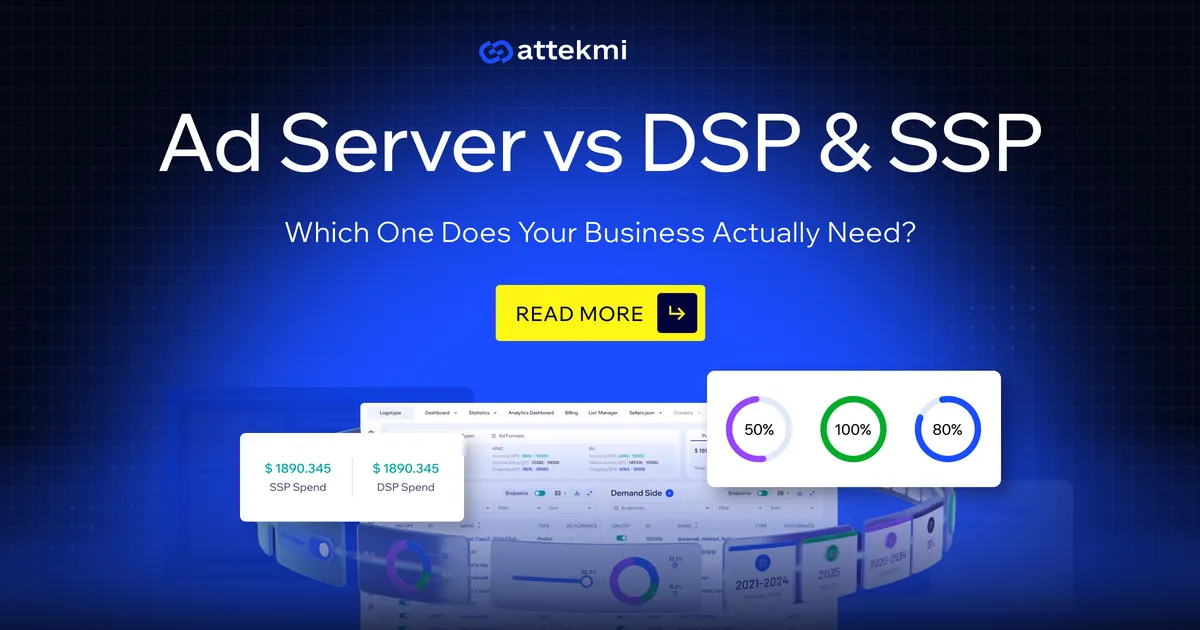
DSPs act as buy‑side brains, SSPs as sell‑side control panels, and ad exchanges as the neutral auction layer between them. This trio shapes how transparent and profitable a programmatic stack can be. White‑label platforms like Attekmi add another layer of control by letting operators own marketplace logic and presentation.
Introduction
Programmatic advertising is the automated buying and selling of ad impressions through data‑driven auctions, replacing manual IO‑only workflows with real‑time decisions. In the US alone, programmatic ad spending is forecast to exceed USD 200 billion, meaning most campaigns now run through programmatic pipes rather than manual IOs.
Behind every impression, there is a stack of systems like DSPs, SSPs, ad exchanges, ad servers, and marketplaces. These communicate in under 200 milliseconds to decide which creative wins and at what price. Each layer has its incentives, fee structures, and levers. For CTOs, Heads of Product, and monetization leaders, understanding this programmatic advertising platform overview is a must; if you do not clearly see who controls what, it is extremely difficult to make informed decisions on stack design, white‑label infrastructure, or a long‑term monetization strategy.
Understanding the core components of a programmatic advertising platform
What is a DSP (demand-side platform)?
A DSP is a buy‑side platform used by advertisers, brands, and agencies to plan and activate campaigns across multiple publishers and exchanges. As such, a DSP lets buyers:
Define audiences, frequency caps, and brand safety thresholds.
Set budgets, pacing, and bid strategies across channels like web, app, CTV, and DOOH.
Optimize toward performance metrics like CPA, ROAS, completion rates, or incremental lift.
DSPs connect to SSPs and ad exchanges via RTB protocols, ingest bid requests enriched with context and user signals, and decide whether to bid and at which price. They shape demand behavior but typically have little direct influence over how publishers package or price inventory, as this lives on the sell side.

What is an SSP (supply-side platform)?
An SSP is a sell‑side platform used by publishers, app owners, and broadcasters to expose inventory to multiple demand sources while retaining control over how that inventory is sold. Through an SSP, operators:
Configure floors, line items, and deal types (open auction, PMP, programmatic guaranteed).
Manage access rules for different buyers and channels.
Maintain yield strategies across formats, devices, and geos, often with automated floor and path optimization.
In some stacks, SSPs and exchanges overlap, as many SSPs run exchange‑like marketplaces, and some ad exchanges provide SSP functionality. Overall, SSPs are themed around publisher control over supply; exchanges focus on the marketplace where that supply meets demand.

What is an ad exchange?
An ad exchange is a neutral marketplace where supply and demand meet via RTB auctions. Basically, it:
Receives bid requests from SSPs and ad servers.
Runs auctions across integrated DSPs and other buyers.
Returns the winning bid and creative to the serving stack.
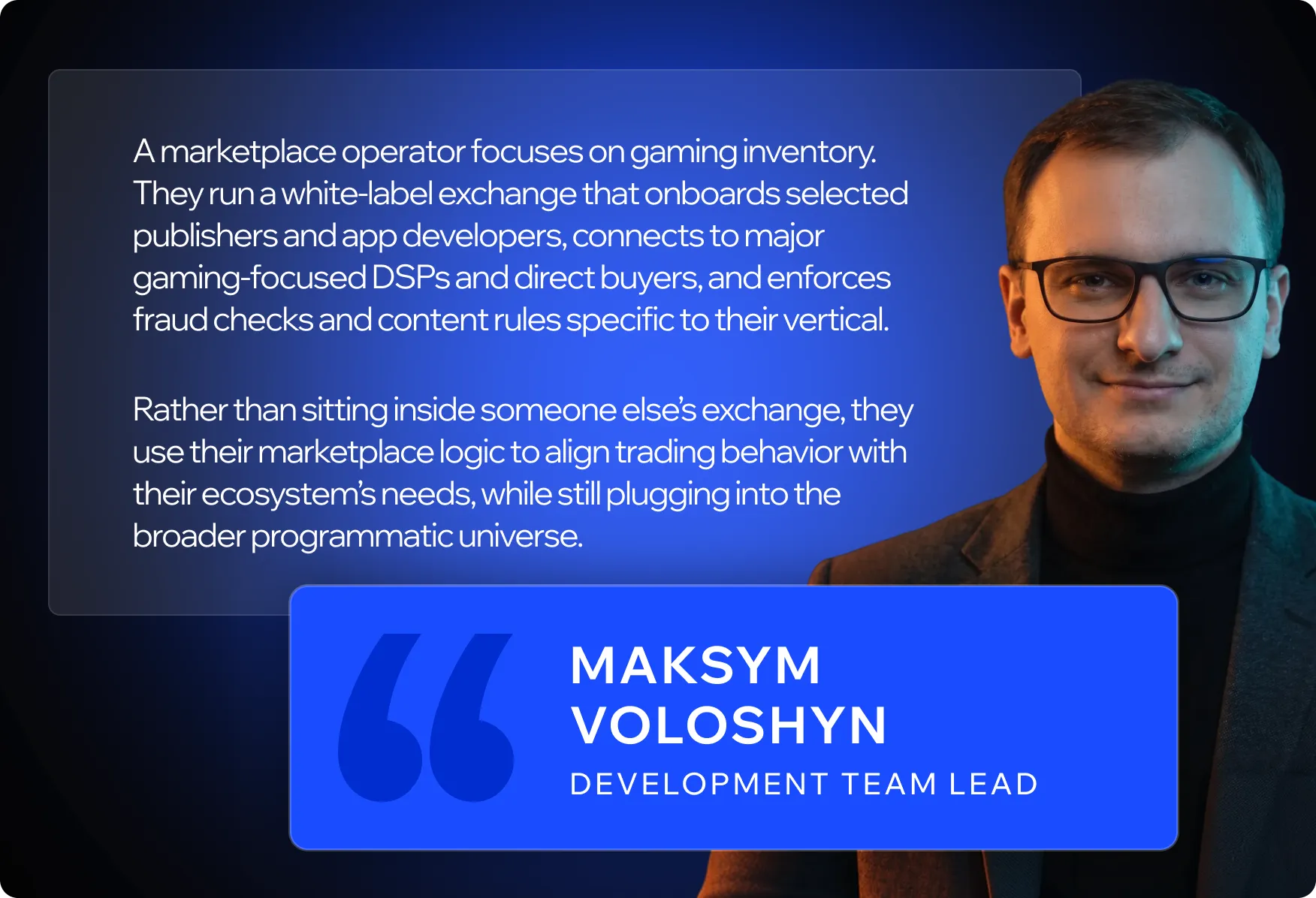
Since exchanges sit at the center of trading, they have a disproportionate impact on transparency, fee structures, and path efficiency. This is why white‑label ad exchange infrastructure is rising: operators license the underlying exchange technology but run their marketplace under their brand with their own rules, margins, and partner mix.
How programmatic monetization flows through DSPs, SSPs, and ad exchanges
A publisher use case: from page view to auction
Let’s consider a global publisher running header bidding across web and CTV.
A user loads a page or opens an app.
The publisher’s ad server (SSP) generates bid requests that include context, device, and placement information.
Via header bidding, those requests are sent simultaneously to multiple DSPs and exchanges (client‑side, server‑side, or hybrid, depending on architecture).
DSPs evaluate each request against campaign targeting and budgets, then bid in real time.
Each exchange runs an auction and returns winning bids to the publisher’s stack.
The ad server chooses the final creative based on internal priorities (e.g., direct as opposed to programmatic, CTV or display) and renders it.
Publisher control is built into how the SSP/ad server is configured: which partners are called, which floors are used, which header bidding architecture is chosen, and how paths are prioritized. The demand logic of who pays what and why lives inside DSPs and the buyer’s strategies. If the publisher sees high bid density but low net CPMs, they may tighten SSP rules, adjust floors, or route more inventory through a white‑label exchange that exposes more granular segments and clearer economics.
Dive deeper into the top strategies publishers can use to drive revenue with white‑label AdTech.
An agency use case: running omni-channel programmatic on DSPs
A mid‑size agency might manage campaigns across web, mobile, and CTV purely through one or more DSPs. From their perspective:
“Supply” looks like inventory pools, curated marketplaces, or deal IDs.
They rarely touch SSPs or exchanges directly.
Their decisions focus on audience, creative, pacing, and performance KPIs.
Still, understanding SSPs and exchanges matters. Supply quality, auction transparency, and fee structures all influence the real value of impressions. If an agency’s key clients rely on specific exchanges or white‑label marketplaces, that knowledge becomes part of the optimization of media plans. For instance, an agency notices strong performance on CTV deals sourced through a particular white‑label marketplace. They can move more funds there with confidence, as they know that the supply path is cleaner than generic open exchange traffic and that the marketplace selects publishers and upholds quality.
A hi-tech ad network use case: owning the exchange layer
Now consider an ad network that has outgrown pure plug‑and‑play SSP integrations. Rather than relying solely on external marketplaces, it operates its own white-label ad exchange and ad server.
With this setup, the operator can:
Define partner onboarding rules, deal packaging, and quality thresholds, including IAB category settings and traffic type policies.
Control fees and margins via features such as adaptive and range margins, aligning economics with partner expectations and internal ROI targets.
Use DSPs as demand sources while owning the marketplace logic, schema configuration, and traffic routing across desktop, mobile web, in‑app, and CTV.
Attekmi’s exchange and ad server solutions are designed specifically for this “owning the layer” scenario: they provide the underlying RTB, targeting, integration, and reporting capabilities, while allowing the operator to brand and configure the platform as their marketplace. Operators can tailor traffic types, ad formats, targeting rules, margin logic, and QPS plans to their business, then connect the platform to DSPs and partners that fit their go‑to‑market strategy.
In our ExplorAds case study, the company launched self‑branded exchanges on top of Attekmi’s infrastructure and achieved a 487% ROI, with payback in the first month. They doubled revenue within four months by scaling media trading through their marketplace rather than relying solely on third‑party SSPs.
Comparing DSPs, SSPs, and ad exchanges across key dimensions
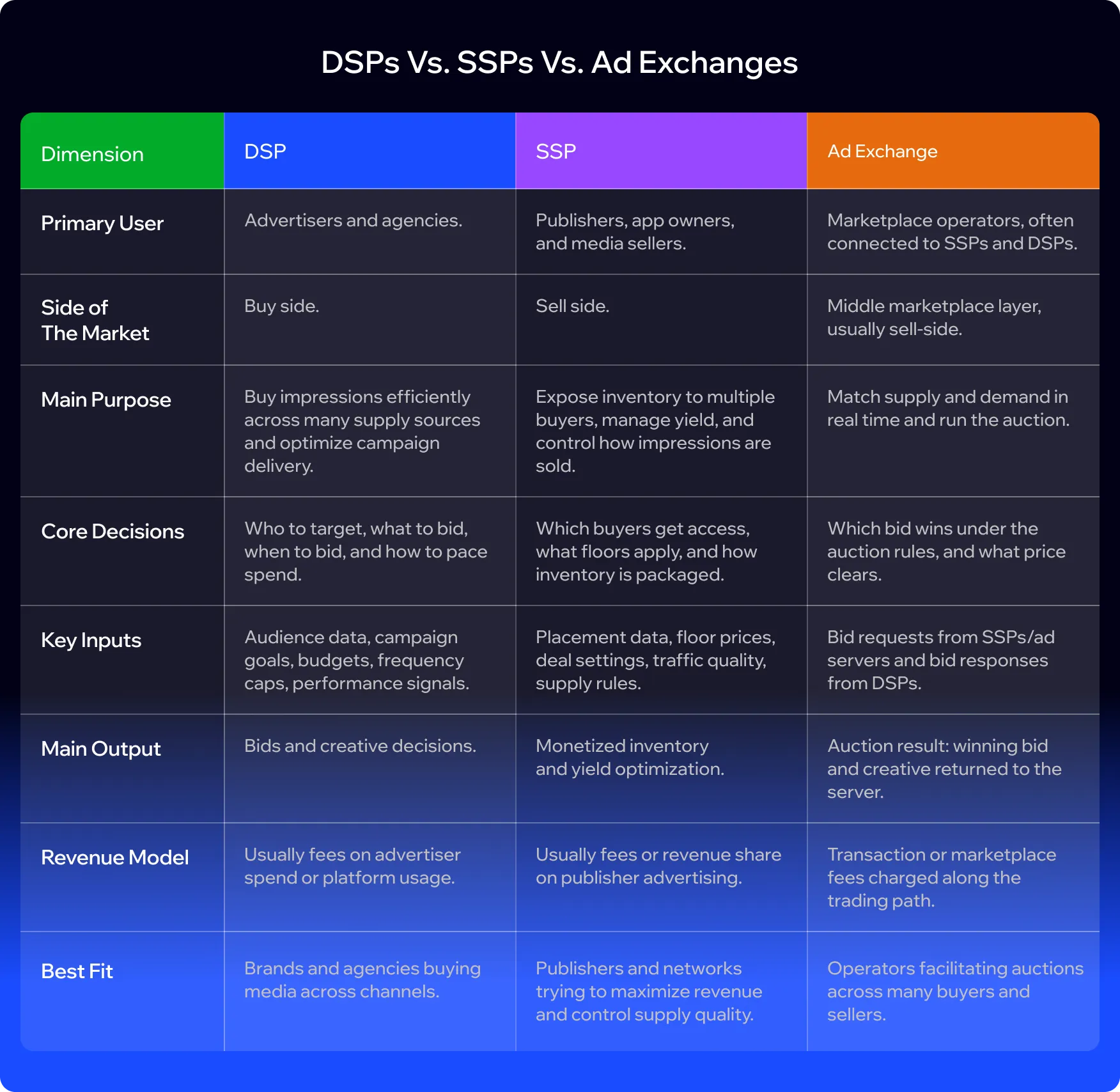
To simplify the acronym landscape, the table below shows how DSPs, SSPs, and ad exchanges differ by role, user, economics, and decision‑making logic.
Revenue potential and fill (publisher and network perspective)
In terms of monetization, DSPs bring budgets and optimization strategies, SSPs decide how you expose, package, and price inventory, and ad exchanges control how auctions run and which demand paths stay open.
A publisher can improve net revenue by tightening SSP rules, such as blocking low‑quality buyers and adjusting floors, and then routing a portion of high‑value traffic into a white‑label ad exchange they control. Inside that exchange, the publisher configures granular targeting, custom PMP structures, and margin logic aligned with its business model, while, for instance, Attekmi’s analytics let the team track profit by region, device, and format in real time.
Efficiency and automation
Manual workflows can’t keep pace with modern inventory volumes and omnichannel complexity. DSPs, SSPs, and exchanges automate campaign decisions and auctions, reducing operational overhead on both sides.
For an ad monetization platform publisher, automation on the SSP/exchange side cuts trafficking and reporting overhead, while DSP automation improves bidding and optimization. When operators add programmable exchange layers (e.g., a configurable Attekmi marketplace with Prebid Server integrations and RTB endpoints), they further reduce the need for custom one‑off integrations with each partner and can scale into new traffic types like CTV and in‑app more cleanly.
Targeting, data, and personalization
Targeting is implemented differently across components:
DSPs: audience segments, first‑party and third‑party data, contextual and behavioral rules.
SSPs/exchanges: supply classifications like placements, sizes, content categories, device types, geos, and traffic types.
As operators mature, they often move from broad “site‑wide” monetization to more granular segmentation. Attekmi’s solutions enable targeting by traffic type, ad format, size, geo, publisher ID, connection type, and more, making it easier to define specific supply tiers within a single programmatic ad marketplace.
Transparency, control, and fees
Fee structures and transparency also vary widely as:
DSPs typically charge buyers based on media spend or platform usage.
SSPs and exchanges charge publishers based on revenue or usage.
Hosted platforms may wrap multiple fees in ways that are hard to untangle.
Operators increasingly turn to white‑label programmatic advertising platforms to regain visibility: owning the exchange and ad server layers means clearer economics, configurable margins, and better insight into fee cascades along the supply chain.
Choosing the right programmatic architecture for your business
Factors to consider
When designing or revising your stack, consider:
Publishers:
Inventory scale, format diversity, markets, and partner complexity.
Need for header bidding, CTV, and advanced quality controls across regions.
Agencies/advertisers:
Access to inventory across channels, data integrations, and measurement.
Preference for DSPs and curated marketplaces that expose clear supply paths and support new premium formats.
Ad networks/marketplace operators:
Desire to own a programmatic advertising platform for enterprises rather than just connect external vendors.
Need for white‑label SSP/exchange layers, custom reporting, and the ability to define their own rules around access, pricing, and quality.
Key questions for your programmatic stack
Quick checklist
Are you a publisher scaling multiple sites/apps with diverse formats and markets?
Yes
No
Do you need header bidding, CTV support, and strict quality controls across regions?
Yes
No
As an agency/advertiser, do you have unified access to cross‑channel inventory, data, and measurement?
Yes
No
Do your preferred DSPs and curated marketplaces provide clear supply paths and premium formats?
Yes
No
As an ad network/marketplace, do you want to own the platform rather than just plug into others?
Yes
No
Do you need white‑label SSP/exchange layers, custom reporting, and your own rules for access, pricing, and quality?
Yes
No
Each factor ties back to DSP, SSP, and exchange choices: who you trust for demand, who you rely on for sell‑side control, and where you place your product and pricing logic.
When a white-label programmatic platform like Attekmi is the best choice
White‑label platforms make the most sense when operators want to consolidate control rather than stitch together a patchwork of third‑party tools. A growing publisher or media group that runs multiple sites and apps can use a white‑label setup to unify supply and marketplace rules, rather than juggling fragmented SSP connections.
A hi‑tech ad network can productize its marketplace for partners instead of living entirely inside external SSPs, using Attekmi’s exchange tiers to run a fully branded ecosystem. An enterprise such as a retailer, telecom, or media company can launch a proprietary programmatic offering on top of its first‑party data while keeping auction logic and fees under its own governance, especially for CTV and omnichannel campaigns.
Attekmi WLS solution gives these operators SSP/exchange‑grade capabilities under their domain and brand, with configurable targeting, multiple integration types (RTB, VAST, JS tags, Prebid Server, Prebid.js), fraud protection, advanced analytics, and QPS scaling options to match their growth.
Hybrid approaches: combining hosted tools and white-label infrastructure
Most stacks are hybrid. So it is common to:
Use external DSPs for demand and campaign execution.
Maintain hosted SSP connections for certain traffic segments or regions.
Run a white‑label ad exchange for private marketplaces, premium formats, or strategic partner ecosystems.
It usually looks like this: you start with hosted SSPs and managed solutions, introduce a white‑label exchange for a subset of inventory, then gradually expand that owned infrastructure as internal capabilities and partner appetite grow.
Conclusion
As header bidding continues to evolve, CTV and omnichannel monetization grow, and privacy pressures reshape data flows, the lines between these components will continue to blur. What remains constant is the need for clarity: who controls bids, who controls packaging and pricing, and where you can take ownership of the marketplace itself.
For operators ready to become platform owners, white‑label infrastructures like Attekmi’s ad exchange and ad server stack offer a way to build a scalable, transparent, and ultimately more profitable programmatic architecture under a trusted brand.
Want to set up your white‑label ad exchange? Get in touch with the Attekmi team today.
FAQ
A DSP is a buy‑side platform that advertisers and agencies use to decide where and how to bid on impressions, while an SSP is a sell‑side platform that publishers use to expose inventory, manage floors and deals, and optimize yield across demand partners.
An ad exchange sits between DSPs and SSPs as a real‑time marketplace, receiving bid requests from the sell‑side stack, running auctions across integrated DSPs and buyers, and returning winning bids and creatives to the serving infrastructure.
Publishers should consider a white‑label exchange when they need more control over partner access, fee structures, and auction logic than hosted SSPs allow – especially if they operate multiple properties or want to build their own marketplace offering for partners.
Agencies and brands still rely on DSPs for activation, but they can benefit indirectly when their key publisher or network partners run white‑label marketplaces with clearer supply paths, stronger quality controls, and more transparent economics.
Attekmi provides ready‑to‑use and white‑label ad exchanges, ad server solutions, custom AdTech development, fraud protection integrations, multi‑format and multi‑traffic support, analytics dashboards, and operational services such as AdOps training and outstaffing. This combination lets operators build and scale their own branded programmatic marketplaces rather than relying solely on hosted tools.


'%3e%3cpath%20d='M415.5%20380.133C415.5%20554.655%20911.5%20609.133%20714%20818.633C447%20850.133%20200%20677.655%20200%20503.133C200%20328.611%20341.478%20187.133%20516%20187.133C690.522%20187.133%20415.5%20205.611%20415.5%20380.133Z'%20fill='%231A4CFF'/%3e%3c/g%3e%3cg%20filter='url(%23filter1_f_654_7533)'%3e%3cpath%20d='M819.862%20539.146C969.42%20389.588%20963.912%20273.412%201000.6%20310.096C1037.28%20346.78%201059.92%20590.588%20910.362%20740.146C760.804%20889.704%20503.861%20847.646%20447.362%20760.146C348.862%20547.146%20670.304%20688.704%20819.862%20539.146Z'%20fill='%23052AAE'/%3e%3c/g%3e%3cg%20filter='url(%23filter2_f_654_7533)'%3e%3cpath%20d='M647.331%20285.725C443.031%20230.983%20408.998%20311.131%20358.6%20243.729C295.498%20194.631%20571.852%2052.1078%20776.152%20106.85C980.452%20161.592%201072.5%20405.139%201024.97%20497.82C889.759%20689.623%20851.631%20340.467%20647.331%20285.725Z'%20fill='%231B4DFF'/%3e%3c/g%3e%3c/g%3e%3cdefs%3e%3cfilter%20id='filter0_f_654_7533'%20x='0'%20y='-12.8672'%20width='960.465'%20height='1035.25'%20filterUnits='userSpaceOnUse'%20color-interpolation-filters='sRGB'%3e%3cfeFlood%20flood-opacity='0'%20result='BackgroundImageFix'/%3e%3cfeBlend%20mode='normal'%20in='SourceGraphic'%20in2='BackgroundImageFix'%20result='shape'/%3e%3cfeGaussianBlur%20stdDeviation='100'%20result='effect1_foregroundBlur_654_7533'/%3e%3c/filter%3e%3cfilter%20id='filter1_f_654_7533'%20x='228.938'%20y='103.27'%20width='998.816'%20height='935.965'%20filterUnits='userSpaceOnUse'%20color-interpolation-filters='sRGB'%3e%3cfeFlood%20flood-opacity='0'%20result='BackgroundImageFix'/%3e%3cfeBlend%20mode='normal'%20in='SourceGraphic'%20in2='BackgroundImageFix'%20result='shape'/%3e%3cfeGaussianBlur%20stdDeviation='100'%20result='effect1_foregroundBlur_654_7533'/%3e%3c/filter%3e%3cfilter%20id='filter2_f_654_7533'%20x='149.441'%20y='-105.473'%20width='1087.81'%20height='860.301'%20filterUnits='userSpaceOnUse'%20color-interpolation-filters='sRGB'%3e%3cfeFlood%20flood-opacity='0'%20result='BackgroundImageFix'/%3e%3cfeBlend%20mode='normal'%20in='SourceGraphic'%20in2='BackgroundImageFix'%20result='shape'/%3e%3cfeGaussianBlur%20stdDeviation='100'%20result='effect1_foregroundBlur_654_7533'/%3e%3c/filter%3e%3c/defs%3e%3c/svg%3e)