RTB offers open, auction-based access to inventory at scale, while PMPs provide selected buyers with controlled access, and programmatic guaranteed reserves inventory at fixed terms. Header bidding and open bidding are technical mechanisms that connect demand to these deal types, enabling publishers to balance competition, control, yield, and predictability.
Programmatic advertising has transformed digital media buying by automating the process of buying and selling ad inventory through technology platforms and data-driven decisions. However, the term “programmatic” does not describe a single model. It includes several approaches, such as real-time bidding (RTB), private marketplaces (PMPs), and programmatic guaranteed (which falls under the broader category of programmatic direct).
Understanding the differences matters for both publishers and advertisers – otherwise, it can be challenging to build an effective monetization or media-buying strategy, especially when layering header bidding and open bidding on top.
In this guide, we will clarify the RTB vs PMP vs header bidding differences. Rather than simply defining each model, we will look at how they work operationally, what limitations they involve, and when each approach makes the most sense. Read on to learn more.
Core programmatic buying models: RTB, PMP, programmatic guaranteed
While all three models use programmatic technology, they differ in how inventory is accessed, whether delivery is guaranteed, etc. Let’s review them one by one in detail.
Real‑time bidding (RTB) – open auctions
Real-time bidding (RTB) refers to open auctions where any buyer can compete for available ad impressions through ad exchanges. When an impression becomes available, participating buyers submit bids based on the value of that particular opportunity, and the auction (taking place within the exchange) determines which bid wins.
If we quickly compare preferred deals vs private auctions vs RTB, RTB makes up 60-65% of programmatic transactions, and it is also the most popular model on the ad exchange market, with a share of 52.3% (as of 2025):
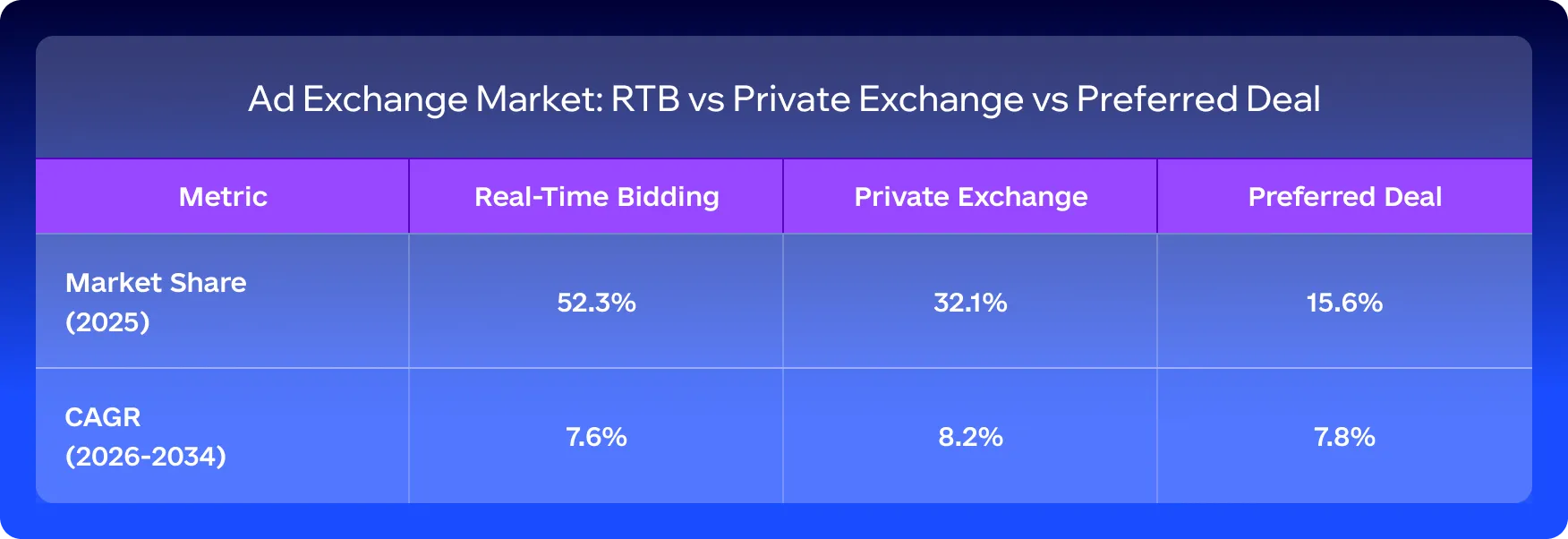
Source: Market Intelo
The main characteristics of open RTB include:
Non-guaranteed, unreserved inventory: Publishers make inventory available without promising it to a particular buyer.
Auction-based pricing: Buyers compete for impressions, typically subject to publisher-defined floor prices and other auction rules.
Broad access and large scale: A large pool of advertisers can compete, making RTB particularly useful for performance campaigns, audience targeting, and retargeting.
For example, a publisher may have display impressions left after direct and other sales have been fulfilled. Instead of leaving this remnant inventory unsold, the publisher can make it available through open auctions, where multiple buyers bid for each impression in real time.
Private marketplaces (PMP) – private auctions and preferred deals
Private marketplaces (PMPs) are invite-only auctions that allow publishers to offer specific inventory to a limited group of advertisers or agencies.
It is important not to confuse PMPs with preferred deals (which are a type of programmatic direct):
Preferred deals: A publisher offers a selected buyer first-look access to specific inventory at a pre-agreed fixed price. The buyer gets priority, but the deal is non-guaranteed – the buyer is not obligated to purchase a specific volume, and the publisher does not guarantee delivery.
PMPs: Multiple invited buyers compete for the publisher's inventory in a closed auction. Unlike an open auction, participation is limited to selected demand partners, while the inventory remains non-guaranteed.
For example, a publisher could package premium placements and make them available through a PMP to a short list of trusted brands. These buyers get access to the inventory before it is potentially exposed to the broader open auction, while the publisher maintains auction-based competition or preferred pricing.
Programmatic guaranteed – automated reserved deals
Programmatic guaranteed is a type of programmatic direct in which a single buyer and seller agree in advance on the price, volume, timing, and specific inventory to be delivered. The transaction is executed using programmatic technology, but there is no auction involved.
The key characteristics include:
Guaranteed volume and price: The buyer commits to purchasing a defined amount of inventory, while the publisher commits to delivering it at the agreed price.
Reserved inventory: The inventory is allocated to the deal rather than being left available for competing buyers.
Automated execution: Technology automates processes such as trafficking, targeting, reporting, and delivery, even though the commercial terms have been negotiated in advance.
Predictable planning: The model is particularly useful for brand campaigns, sponsorship-like packages, and budgets that require predictable delivery.
For instance, a brand might agree to purchase a guaranteed CTV package from a broadcaster: let’s say 5 million impressions at a fixed CPM over a specific campaign period. This way, the brand can have confidence in ad delivery, while a media owner benefits from guaranteed inventory monetization.
Keep in mind that you should not compare programmatic guaranteed vs programmatic direct. Programmatic direct is an umbrella term for guaranteed and preferred deals. In 2024, around 4 in 10 dollars spent on programmatic advertising in the USA was spent via private marketplace, preferred deals, or automated guaranteed. The remaining 60% was spent on open RTB marketplaces.
How header bidding and open bidding fit into the picture
Now that you are familiar with the main programmatic models, let’s take a closer look at the technology behind the media buying and selling processes and compare open bidding vs header bidding.
Header bidding – client/server-side auction routing
Header bidding allows publishers to invite multiple demand sources to submit bids before the ad server makes its final decision. It can run client-side, typically through a wrapper such as Prebid, or server-side, where auction activity is handled outside the browser. In the first quarter of 2022, 70% of online publishing websites and 16% of the top 100,000 websites in the USA used header bidding.
Header bidding is often leveraged for RTB and PMP auctions for non-reserved inventory. In contrast to the classic waterfall model, where demand sources bid sequentially, header bidding creates fairer conditions for advertisers, increases competition, and enables media owners to drive higher income. This is possible because demand sources bid simultaneously.
For example, if a publisher uses a header bidding setup, some sources may compete in the open RTB auction, while others may participate through PMP Deal IDs.
Open bidding – server-side alternative inside ad servers
Open bidding is a server-side auction mechanism built into an ad server. A well-known example is Google Open Bidding, which allows selected demand partners to participate in an auction managed within the ad-server environment.
Compared with client-side header bidding, open bidding moves more of the auction logic away from the browser. This can reduce browser-side complexity and help improve page performance and latency, while also giving publishers more control over participating demand sources within the ad server.
For example, a publisher using Google Ad Manager might compare a Prebid-based header bidding setup with Open Bidding for multi-partner RTB. With Prebid, demand sources can be connected through the publisher's header bidding wrapper, while Open Bidding routes participating partners through the ad server. Both approaches can create competition among demand sources, but they differ in where and how that competition is technically managed.
RTB vs PMP vs header bidding: where they overlap and differ
The easiest way to avoid confusion is to separate commercial deal types from technical implementations:
RTB/open auctions and PMP/private auctions describe the type of programmatic transaction and who can compete.
Header bidding and open bidding describe technical mechanisms for connecting demand sources and routing bids into the publisher's decision-making process.
Programmatic guaranteed is different because the inventory is reserved for a specific buyer at an agreed price and volume. There is no auction involved.
Deal or Buying Model | Possible Technical Implementation | How Competition Works |
RTB | Header bidding, Google’s Open Bidding | Multiple buyers compete |
PMP | Header bidding, Google’s Open Bidding | Selected buyers compete |
Programmatic Guaranteed | Deal ID | No auction; inventory is reserved |
Comparing RTB, PMP, and programmatic guaranteed
Basically, it is nearly impossible to say which programmatic model is better. Everything depends on your goals and the inventory you are planning to monetize. For instance, closed RTB auctions (PMPs) offer greater control and transparency. In turn, if we compare an invite‑only auction vs open exchange, the latter option enables wider demand access, but control is limited.
Control, transparency, and brand safety
First and foremost, here are the differences between an open RTB auction vs private marketplace vs programmatic guaranteed in terms of control, brand safety, and transparency:
RTB: Offers the broadest access to inventory. More buyers can compete for an impression, which creates strong demand and targeting opportunities, but publishers have less control over exactly which buyer wins each impression. In turn, buyers may have less certainty about the context surrounding an individual impression.
PMPs: Provide a greater degree of control because publishers choose which buyers can participate and can package specific inventory for a defined audience, placement, or context. Buyers also get more transparency about what they are purchasing.
Programmatic guaranteed: Provides the highest level of control and predictability. A publisher reserves specific inventory for a particular buyer under agreed terms, while still using programmatic technology for execution and delivery.
Imagine that you are comparing different programmatic buying options for premium inventory. You may initially make that inventory available through open RTB. Over time, you may decide to move the ad space into a PMP and provide access to a group of trusted brands. Later, after you identify the top-performing advertisers, you may decide to negotiate guaranteed deals with them, which can be especially relevant for high-value inventory.
Pricing, yield, and risk
As for programmatic guaranteed vs RTB vs PMP differences in terms of pricing, revenue, and risk, they are as follows:
RTB: Prices are determined dynamically by auction competition. This can generate strong yield for mid-tail inventory, particularly when multiple buyers value the same impression. However, publishers cannot predict exactly how much each impression will generate, while advertisers may face fluctuating costs as market demand changes.
PMPs: Usually higher CPMs than within an open auction. Publishers can access higher-value demand while retaining some flexibility because delivery is not guaranteed. For buyers, PMPs can provide more exclusive access without requiring the commitment associated with a guaranteed campaign.
Programmatic guaranteed: The buyer and publisher agree on a fixed CPM and volume in advance, providing predictable spend and delivery. This is valuable when an advertiser needs stable reach or a publisher wants predictable revenue from premium inventory. However, media owners cannot re-auction those reserved impressions to capture a higher price.
From the advertiser's perspective, the choice lies between opportunistic buying and predictable access. RTB enables maximum flexibility and scale, with prices determined by real-time competition. PMPs offer more exclusive inventory without a guaranteed commitment. Programmatic guaranteed is all about predictable delivery and pricing for a defined inventory package.
From the publisher's perspective, RTB maximizes competition. In turn, PMPs enable connections with potentially higher-quality demand while retaining flexibility. As for programmatic guaranteed, there is no flexibility involved, but inventory monetization is easier to predict.
Scale vs relationship depth
Last but not least, it is important to consider such factors as scale and relationship depth:
RTB: Usually the strongest option when scale is the priority (e.g., performance and retargeting campaigns). Buyers seeking broad reach can access large amounts of inventory without establishing individual relationships with every publisher. For publishers, the open auction provides access to a broad pool of demand.
PMPs: Allow publishers to establish basic relationships with buyers by defining who can access particular inventory. The scale is less broad than in the case of RTB, but much broader than in the case of programmatic guaranteed.
Programmatic guaranteed: The deepest relationship layer (which also limits scale). Such deals are designed for campaigns where the buyer and publisher have agreed on a specific package, price, and delivery commitment.
For example, if you are a news publisher, you can use RTB to monetize the large volume of everyday article impressions. With PMPs, you can package premium contextual or high-viewability inventory. In turn, with programmatic guaranteed, you can support premium homepage campaigns.
Here is another example – the CTV niche. RTB can provide scalable reach across available inventory. PMPs can give advertisers access to selected audiences or premium content. Programmatic guaranteed can secure a defined number of impressions across a broadcaster's high-value programming.
Let’s also review the case of niche B2B. RTB can monetize inventory at scale, while PMPs can connect specific industry advertisers with relevant audiences. Programmatic guaranteed is particularly useful when you, as a publisher, have a limited amount of highly valuable inventory and want to sell it directly to a strategic advertiser.
Programmatic guaranteed vs header bidding: when to use each
Now let’s review programmatic guaranteed vs header bidding to identify the best scenarios for each model.
When programmatic guaranteed makes sense
Here are the use cases for programmatic guaranteed:
High-value premium placements or CTV inventory: Limited inventory, such as prime CTV programming, premium homepage placements, or major video packages, can be sold at predetermined terms rather than exposed to fluctuating auction demand.
Brand campaigns requiring predictable delivery: Advertisers that need guaranteed reach, specific context, or agreed campaign volumes can secure those outcomes in advance, while publishers can count on predictable income.
Long-term buyer relationships: When a publisher and advertiser have an established relationship, the advertiser can commit a budget while the publisher commits a defined amount of inventory.
The main advantage is that programmatic guaranteed combines the predictability of a direct deal with the automation of programmatic technology. Instead of manually trafficking every campaign, the parties can use Deal IDs, ad-server integrations, automated targeting, and programmatic delivery to execute the agreed terms.
When header bidding (and open bidding) is the right tool
As for header bidding, the common use cases are as follows:
Broad competition is required: Publishers want multiple demand partners to compete for each impression.
Yield optimization is the priority: Bringing more demand sources into the auction can help publishers identify which buyer is willing to pay the most for a particular impression.
Inventory is mid-tail or non-reserved: For placements that do not justify a guaranteed commitment, auction-driven pricing provides flexibility.
Instead of relying on a single demand source or sequential waterfall, publishers can expose an impression to multiple partners and compare their bids more efficiently.
Combined strategies: using both for different inventory layers
In practice, you can combine different approaches to ensure effective monetization:
Top premium inventory: Programmatic guaranteed (or preferred) deals secure high-value demand and predictable revenue.
Mid-premium inventory: PMPs combine controlled access with auction competition.
Remnant inventory: RTB via header bidding or open bidding maximizes scale and demand competition.
Choosing the right mix for your business
How to choose the right model? Here are several questions that you should answer to define your strategy.
Key questions for publishers
What proportion of inventory is truly premium vs. mid-tier vs. remnant? High-value placements, premium CTV content, and scarce audiences may justify programmatic guaranteed or PMP deals, while mid-tier and remnant inventory can benefit from the scale and competition of open RTB.
How important are revenue predictability and relationship depth vs. scale and flexibility? Programmatic guaranteed can provide predictable revenue and strengthen relationships with strategic buyers, but it limits the publisher's ability to respond to sudden increases in auction demand. PMPs offer a middle ground, while RTB maximizes flexibility and access to demand at scale.
What technical capabilities already exist? A publisher should consider whether they have the infrastructure to support client- or server-side header bidding, open bidding, multiple integrations, Deal IDs, and appropriate reporting. The technical setup can influence which deal types are practical to operate and how efficiently different demand sources can compete.
Key questions for advertisers and agencies
Are your goals more brand-focused or performance-driven? Brand campaigns often benefit from greater control over context, premium environments, and predictable reach, making PMPs and programmatic guaranteed attractive. Performance and retargeting campaigns may require greater scale and audience availability, making open RTB a natural fit.
How much control do you need over context, publisher relationships, and pricing structures? If appearing alongside specific content, reaching a defined audience, or establishing a direct relationship is important, a PMP can provide more control than an open auction. If the campaign requires predictable inventory and delivery, programmatic guaranteed may be more appropriate.
When should you push for programmatic guaranteed vs. PMP vs. open RTB? RTB is a good choice when scale, flexibility, and audience reach are the priorities. PMPs can be a way to go when there is a need for more controlled access to specific publishers or inventory without committing to guaranteed volume. Programmatic guaranteed works perfectly when the campaign requires predictable delivery, agreed pricing, premium inventory, or a strategic publisher relationship.
How Attekmi can support different programmatic models
At Attekmi, we understand the importance of monetization flexibility – you need different models to drive income effectively. That is why we offer a wide variety of integration types for both demand and supply sides:
OpenRTB 2.6
VAST to RTB
VAST to VAST
VAST to All
JS tags
Header bidding
Connectors for specific demand and supply integrations
PMP Deals
In combination with a full range of traffic types and ad formats, advanced optimization capabilities, and targeting and filtering settings, these integrations provide you with freedom of action and the ability to monetize with maximum efficiency.
Conclusion: making sense of RTB, PMP, and programmatic guaranteed
RTB, PMP, and programmatic guaranteed are not competing models that require publishers or advertisers to choose just one. They are complementary approaches, each suited to different inventory, campaign objectives, and levels of control. RTB provides scale and auction-driven flexibility, PMPs add greater control and access to selected inventory, while programmatic guaranteed delivers predictable pricing and reserved volume.
The most effective strategy is often to combine them. Publishers can use programmatic guaranteed for their most valuable inventory, PMPs for controlled premium demand, and open RTB for scalable monetization of the remaining supply. Advertisers can similarly use each model according to whether they prioritize guaranteed reach, premium access, or broad audience scale.
Ready to learn more about Attekmi’s solutions? Let’s talk.
FAQ
RTB typically refers to open auctions where buyers can compete for available inventory, while a PMP restricts participation to selected advertisers. Both can use auction-based pricing, but PMPs provide greater control over who can access the inventory and how it is packaged.
Programmatic guaranteed combines the reserved inventory, fixed pricing, and predictable delivery of a traditional direct buy with the automated execution of programmatic technology. Unlike standard RTB, there is no open auction involved because the buyer and publisher agree on the price and volume in advance.
Header bidding is a technique that lets publishers connect multiple demand sources to an auction, often through client-side or server-side setups, while open bidding is an auction mechanism integrated into an ad-server environment. Both can facilitate competition for RTB and PMP demand; the key difference is how and where the auction is technically managed.
Programmatic guaranteed makes more sense when premium inventory is scarce, and a buyer requires predictable reach, volume, pricing, or specific placements. Header bidding is better when the publisher wants multiple buyers to compete dynamically rather than reserving the inventory for a specific buyer.
Yes. A sufficiently capable programmatic platform can support open RTB, PMP deals, and programmatic guaranteed, although the exact functionality depends on its integrations and deal-management capabilities. This allows publishers to use different transaction models across inventory layers while managing them through a common infrastructure.


'%3e%3cpath%20d='M415.5%20380.133C415.5%20554.655%20911.5%20609.133%20714%20818.633C447%20850.133%20200%20677.655%20200%20503.133C200%20328.611%20341.478%20187.133%20516%20187.133C690.522%20187.133%20415.5%20205.611%20415.5%20380.133Z'%20fill='%231A4CFF'/%3e%3c/g%3e%3cg%20filter='url(%23filter1_f_654_7533)'%3e%3cpath%20d='M819.862%20539.146C969.42%20389.588%20963.912%20273.412%201000.6%20310.096C1037.28%20346.78%201059.92%20590.588%20910.362%20740.146C760.804%20889.704%20503.861%20847.646%20447.362%20760.146C348.862%20547.146%20670.304%20688.704%20819.862%20539.146Z'%20fill='%23052AAE'/%3e%3c/g%3e%3cg%20filter='url(%23filter2_f_654_7533)'%3e%3cpath%20d='M647.331%20285.725C443.031%20230.983%20408.998%20311.131%20358.6%20243.729C295.498%20194.631%20571.852%2052.1078%20776.152%20106.85C980.452%20161.592%201072.5%20405.139%201024.97%20497.82C889.759%20689.623%20851.631%20340.467%20647.331%20285.725Z'%20fill='%231B4DFF'/%3e%3c/g%3e%3c/g%3e%3cdefs%3e%3cfilter%20id='filter0_f_654_7533'%20x='0'%20y='-12.8672'%20width='960.465'%20height='1035.25'%20filterUnits='userSpaceOnUse'%20color-interpolation-filters='sRGB'%3e%3cfeFlood%20flood-opacity='0'%20result='BackgroundImageFix'/%3e%3cfeBlend%20mode='normal'%20in='SourceGraphic'%20in2='BackgroundImageFix'%20result='shape'/%3e%3cfeGaussianBlur%20stdDeviation='100'%20result='effect1_foregroundBlur_654_7533'/%3e%3c/filter%3e%3cfilter%20id='filter1_f_654_7533'%20x='228.938'%20y='103.27'%20width='998.816'%20height='935.965'%20filterUnits='userSpaceOnUse'%20color-interpolation-filters='sRGB'%3e%3cfeFlood%20flood-opacity='0'%20result='BackgroundImageFix'/%3e%3cfeBlend%20mode='normal'%20in='SourceGraphic'%20in2='BackgroundImageFix'%20result='shape'/%3e%3cfeGaussianBlur%20stdDeviation='100'%20result='effect1_foregroundBlur_654_7533'/%3e%3c/filter%3e%3cfilter%20id='filter2_f_654_7533'%20x='149.441'%20y='-105.473'%20width='1087.81'%20height='860.301'%20filterUnits='userSpaceOnUse'%20color-interpolation-filters='sRGB'%3e%3cfeFlood%20flood-opacity='0'%20result='BackgroundImageFix'/%3e%3cfeBlend%20mode='normal'%20in='SourceGraphic'%20in2='BackgroundImageFix'%20result='shape'/%3e%3cfeGaussianBlur%20stdDeviation='100'%20result='effect1_foregroundBlur_654_7533'/%3e%3c/filter%3e%3c/defs%3e%3c/svg%3e)