The skyrocketing popularity of programmatic TV advertising is evident in many ways, including the variety of ad types. Thus, CTV advertising examples include but aren’t limited to video, audio, display, and companion ads. But what about other benefits? What are the key challenges? How does CTV advertising work?
In this guide, we clarify the CTV marketing meaning, dive deep into the types of TV advertising, explore the advantages, and not only. Read on to discover how CTV advertising can enhance your strategy and help you drive conversions.
Key Takeaways
CTV advertising enables precise, programmatic targeting across internet-connected devices.
Formats include interactive, skippable, audio, and display ads, improving engagement.
Benefits include better ROI, granular analytics, and real-time performance tracking.
CTV outperforms linear TV with advanced personalization and cross-device retargeting.
Ad fraud is rising — secure solutions like Attekmi ensure safety and compliance.
What is connected TV?
What is CTV advertising? Let’s find out the CTV meaning first. CTV stands for Connected TV – it is a device that enables video content streaming. The most obvious example is a smart TV connected to the Internet, although gaming consoles and gadgets like the Roku Streaming Stick are also on the list of CTV examples.
What is connected TV advertising?
Now that the CTV definition is clear, let’s finally answer the question, “what is CTV in advertising”. Connected TV is like a video entertainment hub that allows you to watch regular TV, satellite TV, and stream Internet-based media all on the same device. In 2024, US adults were projected to spend, on average, nearly two hours daily using CTV devices.
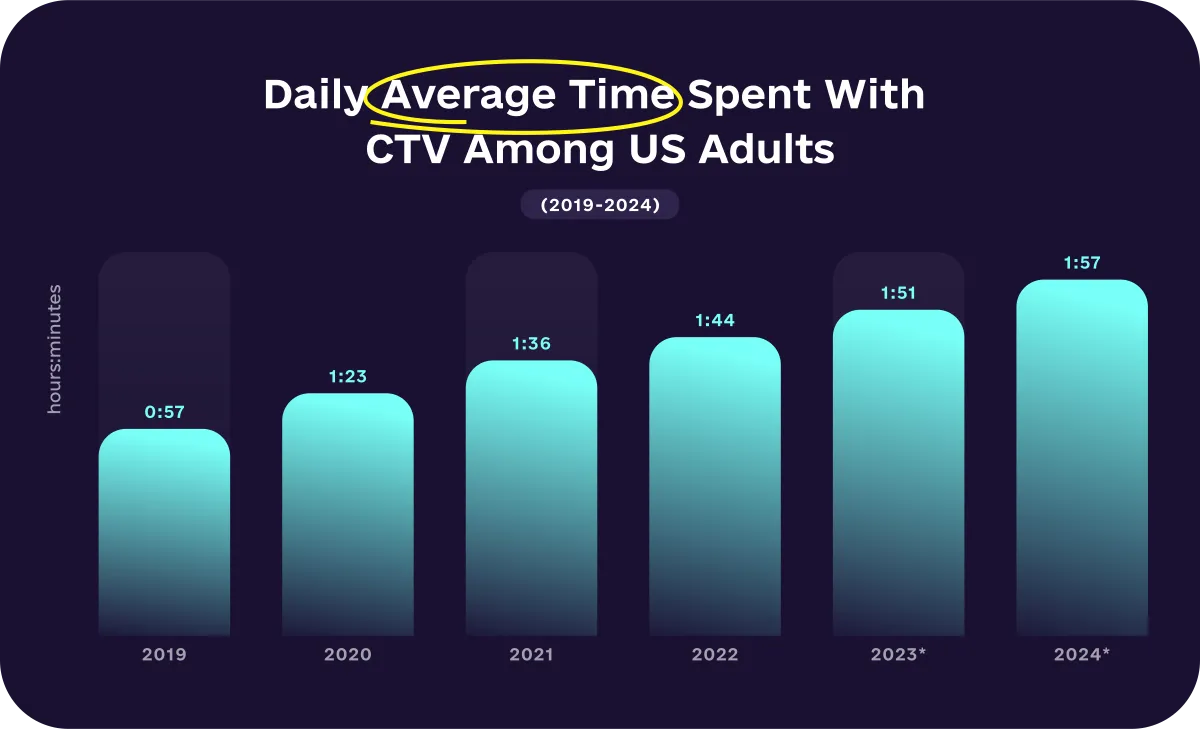
People are increasingly turning to CTV because of its convenience and improved entertainment value. 88% of US households have at least one Internet-connected TV device, while the number of CTV users exceeds 110 million among Gen Z and Millennials.
This number can’t help but draw the attention of brands and advertisers. They include this channel in their marketing strategy because CTV allows for reaching solvent audiences with improved targeting solutions and delivers better campaign results than linear TV advertising. And as regular TV viewing declines further, CTV will become one of the most prolific advertising channels in the coming years.
How connected TV advertising works
Since you are already familiar with the CTV advertising meaning, let’s discover how CTV advertising works.
Programmatic CTV advertising explained
Connected TV does not operate like traditional television; hence, displaying ads on CTV works quite differently and may demand a digitally inclined approach. The Internet enables connected TV, suggesting that the programmatic ad approach will be the most effective method to publish CTV ads – especially as programmatic video ads trends continue to shape how brands connect with viewers across streaming platforms.
Programmatic advertising enables the automated purchase and display of digital advertisements. You do not need to manually search for channels to display your ads with programmatic systems.
Thanks to a data-driven approach and real-time bidding, your ads are automatically served to the right audience. In this scenario, programmatic ad technology assists in purchasing ad inventories specifically designed for connected TV devices.
Also, programmatic CTV advertising enables marketers to serve custom ads for different audiences. In this case, different ads can be displayed to various individuals who are viewing the same show broadcast on separate devices.
How CTV ads are delivered
Programmatic technology streamlines the process of ad delivery in CTV digital marketing:
An ad impression becomes available, and the information about it is sent to an SSP (supply-side platform).
A bid request is sent to a DSP (demand-side platform).
Bids are placed.
The real-time bidding auction starts on the ad exchange platform.
After the winning bid is identified, the ad is sent to the media owner and displayed to a user. The whole process takes less than a second.
Note that large platforms like Netflix also offer their own advertising solutions.
The steps you need to take
To launch programmatic CTV campaigns, you should first choose an effective DSP that supports CTV advertising. The next key steps are as follows:
Create your ad: Come up with a commercial (make sure it’s catchy) and upload it to the selected platform.
Set up targeting: Go through the targeting settings and provide as many details about your audience as possible. The more targeted the campaign is, the better results it delivers.
Set your budget: Specify your budget and launch the campaign. Note that programmatic connected TV advertising platforms often have bid optimization features that you can benefit from.
Analyze and optimize: Monitor the performance of your campaigns continuously to adjust your strategy accordingly.
Go omnichannel: To ensure the campaign’s success, it’s essential to reach users across multiple channels and devices. Prepare creatives that would match your CTV ads to build brand awareness.
8 types of connected TV ads
Smart TV advertising can be interactive, skippable, or non-skippable.
Interactive ads boost viewer engagement by encouraging audiences to interact with an ad by clicking links, scanning QR codes, etc.
Skippable ads allow viewers to omit an advertisement after a few seconds. The time may vary, but naturally, it’s 3 or 5 seconds. Advertisers don’t pay if users skip an ad, but pay when they watch a certain percentage of the ad.
Non-skippable ads don’t allow for moving to the streaming content instantly, and viewers have to watch an advertisement till the end. It takes approximately 15-30 seconds.
These are a few connected TV examples. Let’s delve into more details and consider the most popular CTV ad types.
Instream or linear video ads
This type of CTV advertising emerges when users consume video content in the digital space. Instream ads may resemble traditional TV ads since they are aired in three formats when users watch movies or TV shows: pre-, mid-, and post-rolls.
Pre-roll ads emerge before the main video content. Sometimes, viewers can skip an ad after several seconds or watch the full version of the advertisement before they can access their desired content.
Mid-roll ads interrupt the show or movie in the middle of streaming long content, just like a commercial break on linear TV.
Post-roll ads show up at the end of the streamed video.
Non-linear ads
Non-linear video ads, also known as overlay ads, display over the screen concurrently with the video playback and without interrupting streaming. These are small static images, texts, videos, or animated media with call-to-action buttons or clickable links that deliver improved engagement with an audience.
Picture-in-picture ads, or a ‘Double Box’ format, are a type of nonlinear CTV video overlay advertising. Streaming content plays in the small window simultaneously with advertisements.
Companion ads
Another CTV ads example, companion ads, may appear in parallel with linear or nonlinear ads. Companion ads display in different forms, from static images and text to rich media and creatives wrapping around the screen.
Advertisers use companion ads to be visible to viewers when they consume content. This type of ad minimizes the disruption of content viewing and enhances a flawless user experience.
Display ads
The interface is another place where static or animated banners are delivered across CTV platforms. Display ads appear in the menu section, home screen, inline placement, etc.
Display ads on CTV provide the same experience as display ads on the web without interfering with streaming.
Audio ads
These are audio-only ads that play during audio streaming services on CTV platforms. They are effective for reaching viewers who listen to music or podcasts.
Dynamic ad insertion in CTV (DAI)
DAI technology allows advertisers to serve personalized advertisements to individual viewers based on their profile and viewing behavior. This enables highly targeted and relevant ad experiences.
360-degree videos
These immersive videos allow viewers to interact with the content by changing their perspective. They are especially effective for showcasing products or immersive storytelling.
Augmented reality (AR) ads
AR ads incorporate augmented reality elements into the viewing experience, allowing viewers to interact with digital objects or information overlaid on their screens.
The abundance of CTV advertising demonstrates that advertisers can engage with viewers in multiple ways and test the most effective types of ads. What are the benefits of connected TV advertising?
Key benefits of CTV advertising
When it comes to linear TV vs connected TV, CTV provides advertisers with more advanced targeting and the ability to track and optimize campaign performance, making it a more effective advertising option.
Access to a wider and more engaged audience
Advertisers prefer connected TV to linear TV because the ads projected on CTV channels have more views than ads on linear TV. Besides, the CTV audience is better engaged with ads because of the convenience and varying entertainment options. This means that an increasing number of targeted viewers will see and interact with a CTV ad.
Optimized ad spend
What does CTV mean in advertising in terms of cost-effectiveness? CTV ads are 53% less expensive and more efficient than traditional TV ads. A CTV ad displayed on one device might reach numerous individuals simultaneously. This is a more efficient marketing approach than displaying ads on mobile devices, and CTV ad measurement helps verify and optimize this efficiency by tracking real reach and performance.
Precise targeting
Granular targeting capabilities allow CTV advertising to outcompete other marketing channels in efficiency. Smart TVs and other CTV devices offer personalized user experiences based on first-party data, including language preference, location, or other information. This data can be harnessed for more precise and insightful targeting.
Support for multiple ad formats
By displaying ads on CTV, advertisers can test different ad formats to know which is best for a particular campaign. Marketers can try static images, graphics, interactive video ad formats, etc., to find the most engaging for their audience. Most of these formats raise user involvement as they make it possible for ads to interact with the audience. This greatly promotes brand-user relationships, brand recall, and enhanced customer satisfaction.
Campaign performance measurement and tracking
With linear TV ads, tracking and measuring ad performance is impossible. However, this is not the case with CTV advertising. On the CTV programmatic platform, marketers can measure their campaign performance (impressions, completion rate, etc.) and track user engagement.
Interactive and responsive advertising
Connected TV advertisements can be broadcast when viewers are most receptive. For instance, ads can be delivered to target viewers when certain events are airing. For example, sports lovers can be targeted in a game final. Also, people can interact with ads by sending messages, choosing options on creative, or clicking prompts. What is interactive advertising? Interactive ads offer the advantage of higher engagement and conversion rates.
How to increase CTV ad reach with a proven strategy?
CTV measurement and attribution in a cookieless world
CTV advertising does not rely on cookies. Since viewers typically consume CTV content through smart TVs, streaming devices, and apps rather than web browsers, AdTech companies rely on alternative signals and measurement techniques.
Household-level attribution. Since multiple viewers often share the same streaming CTV, advertisers often measure exposure at the household level using IP addresses, device IDs, or logged-in user data from streaming platforms.
Probabilistic matching. These models analyze signals such as IP addresses, device types, viewing patterns, and time-of-day behavior to estimate whether different devices belong to the same household or user.
Cross-device attribution. Viewers often watch ads on a TV but complete actions on another device, such as a smartphone or laptop. AdTech platforms connect these interactions through identity graphs, which allows advertisers to measure how CTV exposure influences user behavior across different screens.
Incrementality measurement. Incrementality testing compares the behavior of exposed audiences with a control group that did not see the ad. This helps determine whether the campaign actually drove additional conversions or whether the users would have converted anyway.
However, some challenges are still here. Signal fragmentation, privacy regulations, and inconsistent device identifiers can limit measurement accuracy. In addition, the lack of standardized reporting across platforms often makes it difficult to compare performance between streaming services.
Modern AdTech solutions rely on privacy-safe identity frameworks, clean rooms, and aggregated data models. These approaches allow you to analyze campaign performance while protecting user privacy and, as a result, advertise on CTV more effectively.
3 best practices for CTV advertising
The following practices seek to enhance ad campaigns on the CTV platforms.
Track results
Various ad types deliver different results, so advertisers can A/B test and streamline their ads. The CTV space offers multiple opportunities to monitor ad campaign performance in real time and adjust it instantly for better results.
Go for programmatic
87.2% of US CTV ad spending (including YouTube) is programmatic. Advertisers and brands use programmatic CTV advertising platforms to meet their targeted consumers, optimize campaigns, and boost ROI with precise data.
Set up frequency capping
CTV users can see the same ad across multiple platforms during a short period of time. Frequency capping allows for properly allocating the ad budget and minimizing possible irritation from the repetitive ad display. This CTV feature limits the number of views for every viewer and thus boosts ad performance and engagement.
Challenges in CTV advertising
As for the challenges related to CTV advertising, they are as follows.
The risk of fraud
CTV is an appealing space not only for advertisers but also for fraudsters. In 2022, malicious activity in the CTV space spiked by 69% compared to the previous years. So, CTV ad fraud is a big challenge for industry players and stands for invalid traffic presented by counterfeit clicks, impressions, and conversions.
This malicious activity compromises the return on media investment and leads to a decrease or total loss of revenue. Ad fraud occurs on sites and apps, or can be caused by malicious bots.
Website fraud is presented in the form of non-human traffic, impression laundering, and hidden ads.
Background and spoofed apps, hidden ads, and performance manipulation take place on mobile devices like phones and tablets.
Bot fraud is software that intentionally generates ad views and clicks to pump out money from advertisers.
The question "What is bot traffic?" does not always imply something negative. There are some "good" bots as well. Another good piece of news is that AdTech companies can detect and minimize the effect of fraudulent schemes on ad displays by cooperating with trusted partners. Working with Attekmi solutions, you can use an integrated ad fraud detection system.
Ecosystem fragmentation
CTV ad inventory is spread across an entire range of platforms, devices, apps, and media owners, which makes the ecosystem fragmented. As a result, reach can become duplicated or simply inefficient.
Leveraging ID-based targeting is a way to reach specific users or audience segments and deliver personalized ads with increased precision. Adopting the supply-path optimization practices can help as well.
Lack of standardized measurement
Unfortunately, there are no universal metrics – each platform reports them differently. Therefore, it can be hard to measure reach and other results, as well as to adjust your strategy accordingly.
With cross-device attribution, you can track how ads delivered via CTV devices impact actions on other gadgets like laptops or smartphones. This ensures a more comprehensive view of a customer journey. Besides, keep an eye on the outcome-based KPIs, like, for instance, the number of new customers. This will help you understand if you are achieving your business objectives.
Privacy, consent, and regulatory compliance in CTV advertising
Privacy regulations keep getting stricter, while users are getting more and more concerned about their privacy. Considering the connected TV advertising definition, here are the key things to keep in mind:
General Data Protection Regulation (GDPR) regulates the collection, storage, and processing of personal data of users within the EU. Similarly, the California Consumer Privacy Act (CCPA) gives consumers the right to know what data companies collect and to opt out of the sale or sharing of their personal information.
Consent is typically collected when users create accounts with streaming services, log into apps, or configure privacy settings on their devices. Many platforms implement consent management frameworks integrated directly into their applications, allowing viewers to control advertising preferences and data-sharing permissions.
CTV devices are often shared within households, which makes it difficult to associate consent or preferences with an individual viewer. For example, one household member may accept personalized advertising while another may not. Because of this shared-device environment, many CTV platforms rely on household-level consent models rather than individual-level permissions.
AdTech companies increasingly rely on privacy-first approaches. These include limiting the use of personally identifiable information, using aggregated or pseudonymized data, and leveraging contextual targeting instead. Secure data collaboration environments, such as data clean rooms, also help advertisers measure campaign performance.
Keep up to date with Attekmi
At Attekmi, we understand that the key to success in this rapidly changing landscape lies in staying highly up-to-date. That’s why Attekmi solutions support all kinds of traffic types and ad formats, including connected TV advertising (CTV).
Stay tuned for the most relevant and up-to-the-minute news and updates on the CTV industry and not only. Our commitment to delivering the latest industry insights ensures you’re well-equipped to navigate the dynamic world of technology.
Summing up
What is CTV in marketing? CTV means benefits for advertisers, including precise targeting and multiple ad formats. It’s all about benefits for advertisers, including precise targeting and multiple ad formats. The owners of Attekmi solutions can also take full advantage of CTV media trading in their marketplaces. Our products support an entire set of formats (CTV is on the list), so there is no need for you to build such functionalities from scratch. Instead, you can start earning money through media trading after only one week.
Does Attekmi look like the right choice? Let’s talk!
FAQ
Content genre influences viewer attention and audience demographics, which directly impacts ad performance. For example, live sports often generate high engagement and real-time attention, while lifestyle, drama, and family programming attract specific audience segments. Aligning ads with relevant genres improves contextual relevance, brand recall, and overall campaign effectiveness.
Industries with strong visual storytelling often benefit the most from CTV advertising. These may include automotive, retail, entertainment, consumer electronics, travel, and financial services. CTV combines reach with digital targeting and measurement, allowing brands to engage high-intent audiences.
Audience segmentation, diversification of creatives, and data-powered decision-making can streamline CTV ad campaigns.
Trends in CTV AdTech develop along with cutting-edge technologies and include addressable TV advertising, advanced measurement, interactive CTV ads, data privacy, and cross-channel integration, reflecting the evolving landscape’s data-driven and interactive nature.


'%3e%3cpath%20d='M415.5%20380.133C415.5%20554.655%20911.5%20609.133%20714%20818.633C447%20850.133%20200%20677.655%20200%20503.133C200%20328.611%20341.478%20187.133%20516%20187.133C690.522%20187.133%20415.5%20205.611%20415.5%20380.133Z'%20fill='%231A4CFF'/%3e%3c/g%3e%3cg%20filter='url(%23filter1_f_654_7533)'%3e%3cpath%20d='M819.862%20539.146C969.42%20389.588%20963.912%20273.412%201000.6%20310.096C1037.28%20346.78%201059.92%20590.588%20910.362%20740.146C760.804%20889.704%20503.861%20847.646%20447.362%20760.146C348.862%20547.146%20670.304%20688.704%20819.862%20539.146Z'%20fill='%23052AAE'/%3e%3c/g%3e%3cg%20filter='url(%23filter2_f_654_7533)'%3e%3cpath%20d='M647.331%20285.725C443.031%20230.983%20408.998%20311.131%20358.6%20243.729C295.498%20194.631%20571.852%2052.1078%20776.152%20106.85C980.452%20161.592%201072.5%20405.139%201024.97%20497.82C889.759%20689.623%20851.631%20340.467%20647.331%20285.725Z'%20fill='%231B4DFF'/%3e%3c/g%3e%3c/g%3e%3cdefs%3e%3cfilter%20id='filter0_f_654_7533'%20x='0'%20y='-12.8672'%20width='960.465'%20height='1035.25'%20filterUnits='userSpaceOnUse'%20color-interpolation-filters='sRGB'%3e%3cfeFlood%20flood-opacity='0'%20result='BackgroundImageFix'/%3e%3cfeBlend%20mode='normal'%20in='SourceGraphic'%20in2='BackgroundImageFix'%20result='shape'/%3e%3cfeGaussianBlur%20stdDeviation='100'%20result='effect1_foregroundBlur_654_7533'/%3e%3c/filter%3e%3cfilter%20id='filter1_f_654_7533'%20x='228.938'%20y='103.27'%20width='998.816'%20height='935.965'%20filterUnits='userSpaceOnUse'%20color-interpolation-filters='sRGB'%3e%3cfeFlood%20flood-opacity='0'%20result='BackgroundImageFix'/%3e%3cfeBlend%20mode='normal'%20in='SourceGraphic'%20in2='BackgroundImageFix'%20result='shape'/%3e%3cfeGaussianBlur%20stdDeviation='100'%20result='effect1_foregroundBlur_654_7533'/%3e%3c/filter%3e%3cfilter%20id='filter2_f_654_7533'%20x='149.441'%20y='-105.473'%20width='1087.81'%20height='860.301'%20filterUnits='userSpaceOnUse'%20color-interpolation-filters='sRGB'%3e%3cfeFlood%20flood-opacity='0'%20result='BackgroundImageFix'/%3e%3cfeBlend%20mode='normal'%20in='SourceGraphic'%20in2='BackgroundImageFix'%20result='shape'/%3e%3cfeGaussianBlur%20stdDeviation='100'%20result='effect1_foregroundBlur_654_7533'/%3e%3c/filter%3e%3c/defs%3e%3c/svg%3e)