Launching an SSP costs far more than building a dashboard. You must fund auction logic, integrations, quality controls, infrastructure, reporting, and ongoing AdOps. Building delivers maximum ownership but demands the most time and capital; buying optimizes for speed; white-label infrastructure balances faster launch with branded control over rules, partners, and economics.
A six-figure budget can be enough to launch a basic ad network or SSP prototype, but can it cover a production-grade platform? Most likely, no. However, this does not stop the growth of the global SSP market that is forecasted to surpass $64 billion by 2033.
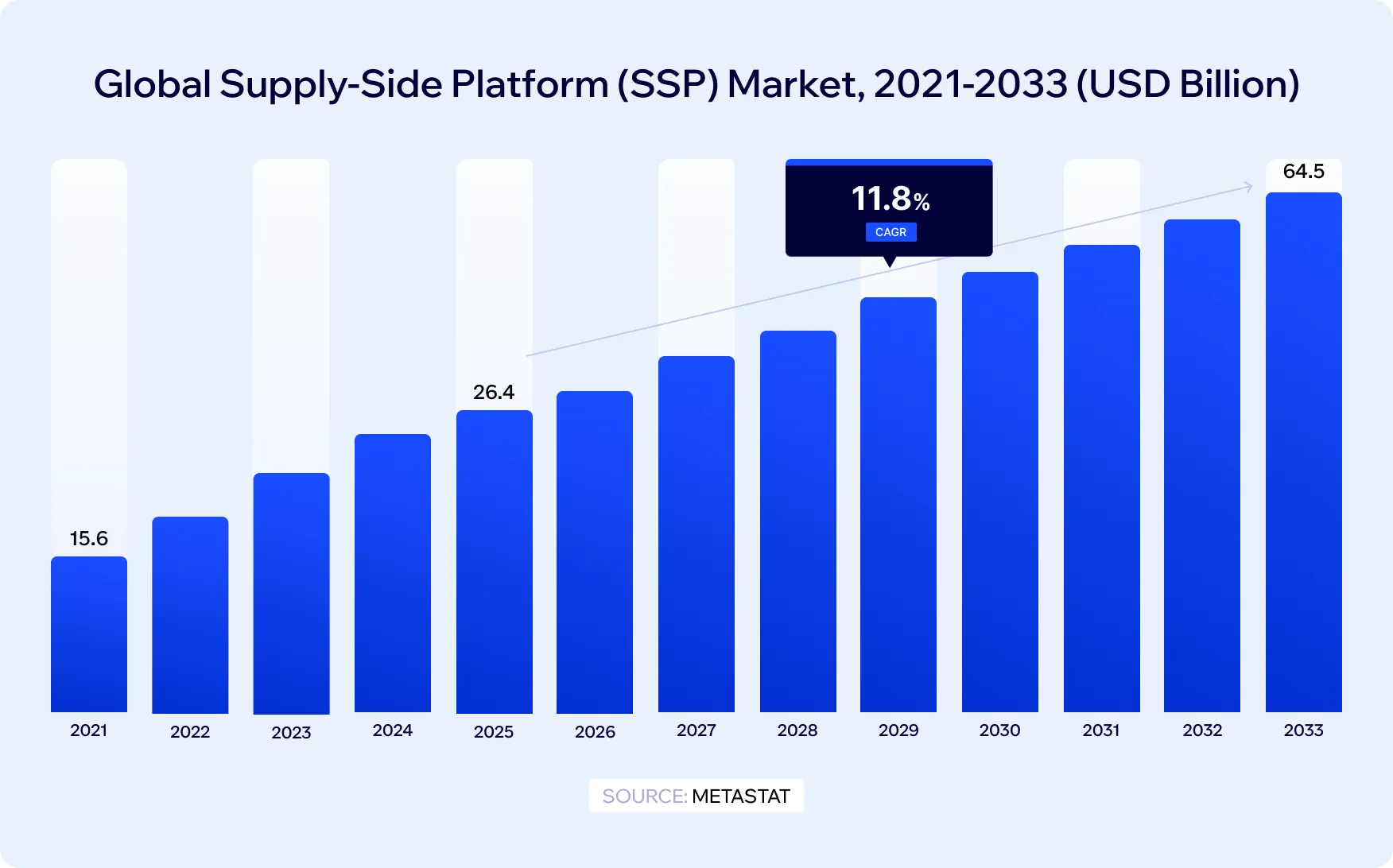
Source: Metastat
The core function of an SSP is straightforward – it enables businesses to monetize digital inventory programmatically. However, to perform reliably, the platform requires more than classic inventory controls. It also needs integrations with demand partners, fraud and traffic-quality functionalities, monitoring and alerting, data processing, privacy mechanisms, reporting infrastructure, etc.
If you are planning to build your own ad network or an SSP, there are several paths for you to choose from. You may build a platform from scratch, buy a hosted or self-serve solution, or prefer white-labeling. In this guide, we will compare these approaches and help you make a choice, so read on to discover which model is the best fit for your business.
First, let’s define what “launching an SSP” entails
AdTech solutions are complex, so before comparing different approaches, let’s clarify what capabilities an effective SSP requires.
The minimum capabilities of a production SSP
Typically, an SSP requires the following:
Supply onboarding: Onboarding publishers, apps, placements, domains, and app bundles while managing authorization and supply-access controls.
Inventory and deal management: Defining and organizing inventory by format, placement, audience, and other characteristics. A platform may also need to support inventory packages, PMP rules, and programmatic direct deals.
Bid-request generation and routing: Generating and routing bid requests through OpenRTB (RTB makes up 60-65% of programmatic transactions), tags, VAST, header bidding, or other connections. Additional essential capabilities are timeouts, throttling, and QPS management.
Auction and decisioning logic: Rules for prioritizing demand, determining pricing, applying margin logic, distributing traffic, and processing wins and losses. An SSP also needs to validate creative responses and ensure that the winning response can actually be delivered in the requested format.
Data, reporting, and reconciliation: The ability to track both operational (requests, bids, fill rate, etc.) and financial metrics. Reporting and discrepancy management capabilities are required as well.
Quality, privacy, and governance: This can include ads.txt, sellers.json, compliance with GDPR, TCF, CCPA, COPPA, and other regulations, supply-chain signals, traffic filtering, invalid-traffic controls, and creative or category restrictions.
Operations: Capabilities related to partner integrations, technical support, incident response, yield optimization, account management, and billing or revenue-share workflows.
Note that each capability introduces its own development, infrastructure, and other costs. A prototype may demonstrate, for instance, that an auction works, but a production SSP has to keep working reliably across large volumes of requests, multiple partners, different formats, and changing privacy and quality requirements.
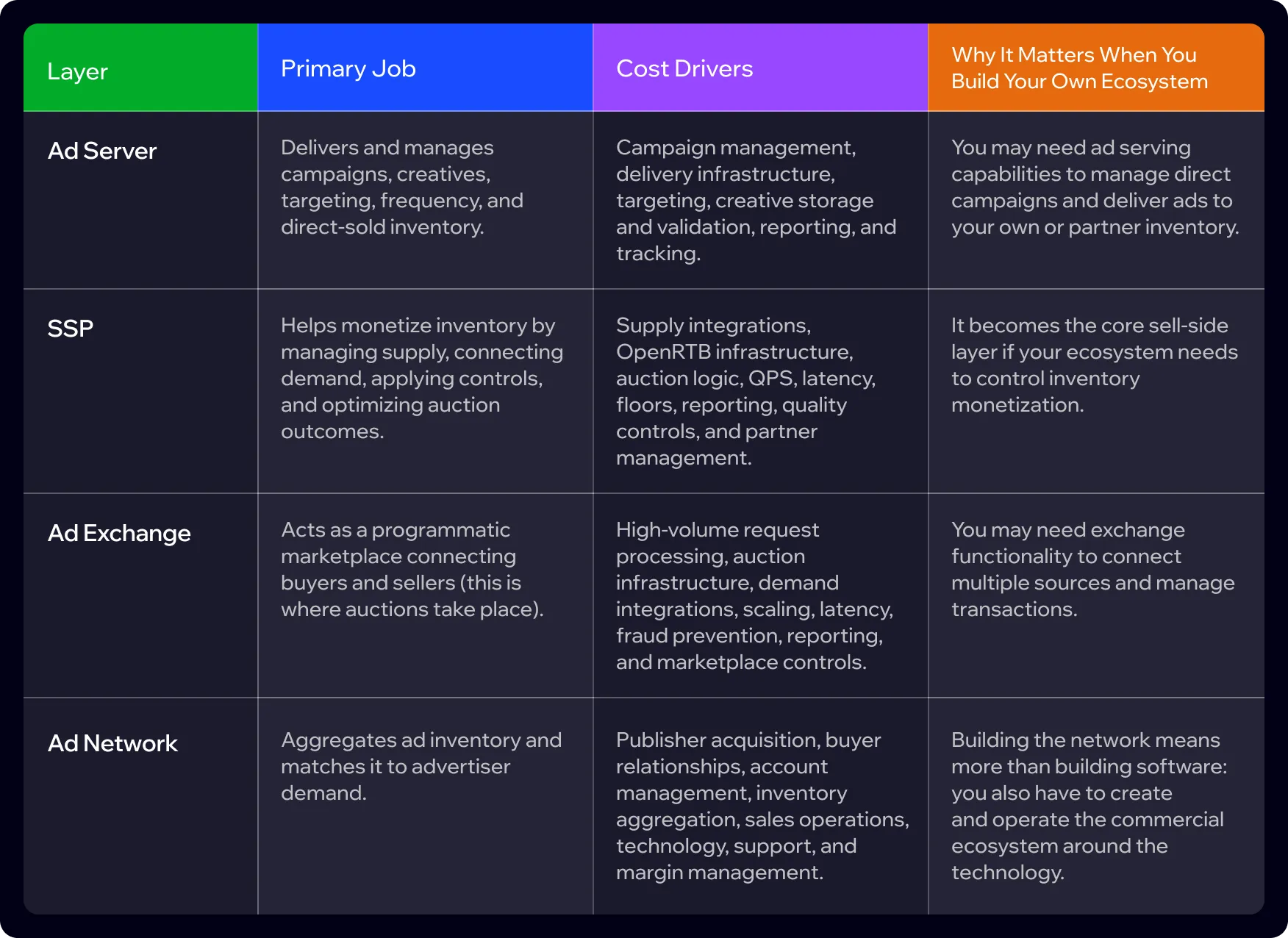
SSP, ad server, exchange, and ad network: where costs overlap
The term “SSP” is sometimes used broadly, even though an ad server, SSP, ad exchange, and ad network have different roles. In practice, their responsibilities can overlap.
The practical cost categories behind an SSP launch
If you plan to launch an SSP or, for instance, build an ad exchange, there are several cost categories to keep in mind, and some of them are challenging or even impossible to predict.
One-time launch cost
First and foremost, you need to consider the required initial investment:
Product discovery, architecture, and technical specification. You have to define workflows, user roles, auction logic, integrations, data flows, infrastructure requirements, and security boundaries. Architecture decisions made at this stage can have a major impact on future scalability and operating costs.
UX/UI and multi-tenant portal design. An SSP typically needs interfaces for managing publishers, inventory, deals, floors, reporting, etc. If the platform serves multiple customers, the portal also needs multi-tenant architecture and clear separation of data and configuration.
Core platform engineering, QA, load testing, and security review. This includes developing the platform's core services and then testing them under realistic conditions.
Demand and supply integrations, including custom adapters. Implementing standard protocols is usually not enough. Custom adapters, partner-specific requirements, authentication, testing, certification, and ongoing compatibility can all add to the initial cost.
Data migration or setup for existing publishers, campaigns, and reporting. If the SSP replaces an existing system, historical data, publisher configurations, campaigns, inventory definitions, and reporting structures may need to be migrated or recreated.
Legal/compliance review, partner contracts, onboarding documentation, and training. A commercial launch also requires contracts, privacy and compliance review, technical documentation, operational procedures, and training for internal teams and external partners.
Recurring operating costs
The platform creates an ongoing cost base that grows with both the complexity and scale of the business.
Engineering, DevOps/SRE, QA, product, and security maintenance. Production systems require continuous development, bug fixes, performance improvements, infrastructure management, security work, and compatibility updates.
Cloud compute, storage, observability, log processing, CDN/networking, and regional data-center needs. SSP infrastructure processes large volumes of requests and events, often requiring real-time monitoring and substantial log and analytics capacity. Costs can also increase when data needs to be stored or processed in specific regions for regulatory or contractual reasons.
RTB/QPS capacity and bandwidth. A platform may process more bid requests than impressions it ultimately monetizes, so compute, networking, and bandwidth costs can rise substantially as QPS grows.
Fraud, verification, privacy, identity, and data-provider costs. Third-party services may be required for traffic-quality analysis, creative verification, identity resolution, consent management, audience data, or other specialized functions.
AdOps, yield, customer success, support, and business-development staffing. You need someone to monitor supply and demand, investigate performance issues, optimize yield, support publishers and buyers, manage relationships, and develop new commercial partnerships.
Financial reporting, billing, collections, revenue share, and discrepancies. Programmatic transactions involve multiple parties and sources of reporting data, and the associated tasks create a recurring financial and operational workload.
Hidden costs that change the business case
Some of the most important costs do not appear in the initial development estimate:
The cost of latency. Slow bidder paths can reduce viable demand and revenue.
The cost of insufficient quality controls. Weak traffic filtering, creative controls, or supply-chain validation can expose an SSP to buyer blocklists, deductions, rejected traffic, and reputational damage.
The cost of maintenance. The programmatic ecosystem evolves continuously: OpenRTB specifications, privacy restrictions, new formats, etc. A platform that is technically complete at launch still requires continuous investment to remain competitive.
The cost of “free” hosted access. Revenue shares, opaque usage fees, data-export restrictions, limits on UI customization or partner ownership, and additional charges for support, custom integrations, or higher capacity can change the economics.
The cost of having no demand or supply plan. Building sophisticated auction infrastructure before establishing a realistic supply-and-demand model can leave you paying for capacity that does not generate enough revenue.
Build vs. buy vs. white-label: cost, control, and time-to-market
Now it is time to compare build vs buy AdTech models, as well as to review white-label SSP cost.
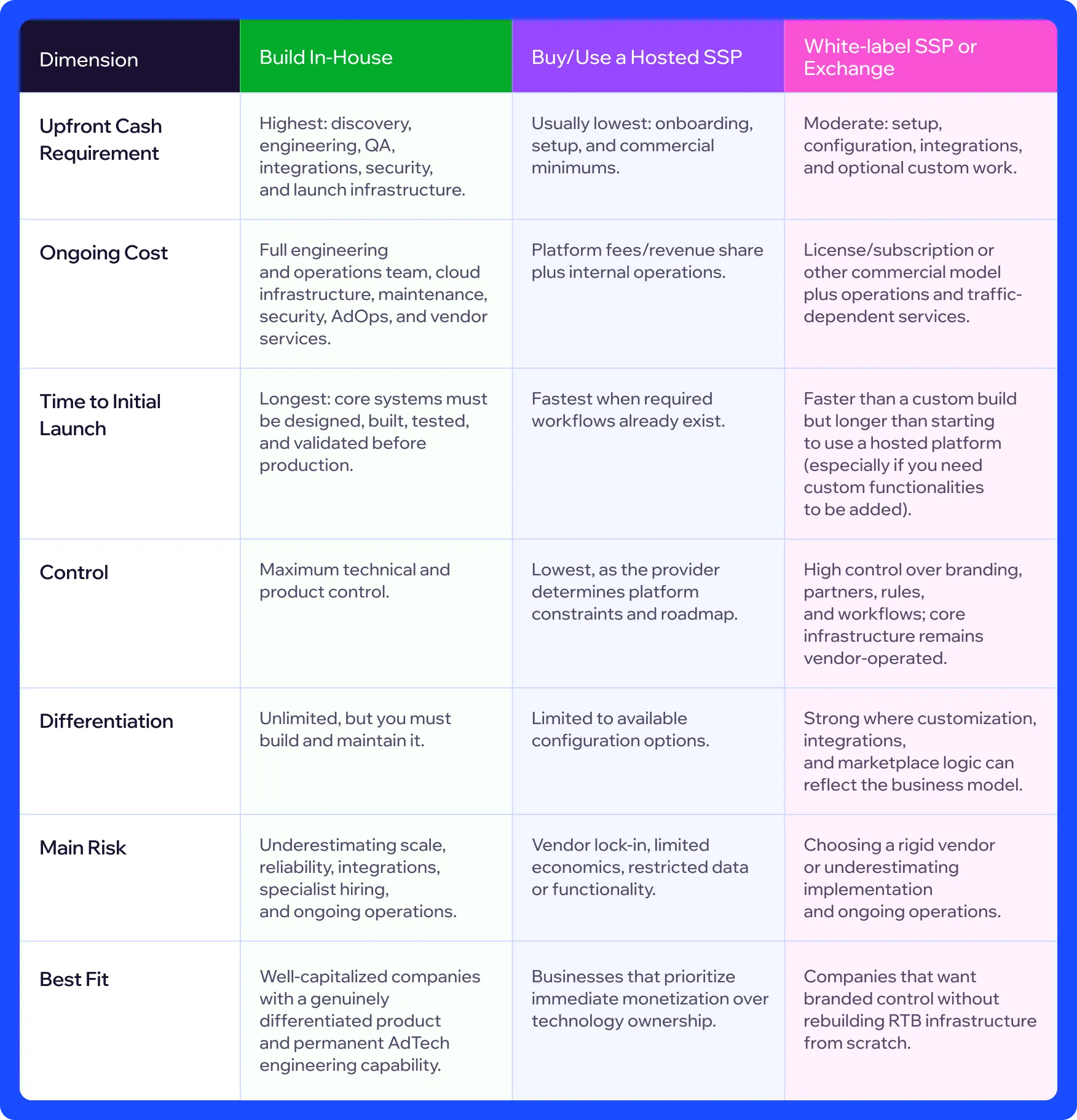
Path 1 – build an SSP from scratch
If you choose supply-side platform development from scratch, here are the things to keep in mind:
What you gain: You control the architecture, data model, product roadmap, auction logic, integrations, and the way the platform evolves over time.
What you fund: Senior backend/RTB engineers, frontend, data engineering, QA, DevOps/SRE, product, security/compliance, and ongoing AdOps. Once the platform is live, those people are responsible for keeping integrations working, managing capacity, improving performance, responding to incidents, and adapting the platform to changes in the programmatic ecosystem.
Directional external benchmark: Basically, building an AdTech solution from scratch can cost you from hundreds of thousands to several million dollars. We have explored the true cost of custom development and white-labeling in detail in one of our recent whitepapers – request your free copy and learn more about SSP development cost.
Timeline framing: A prototype or limited MVP can arrive much earlier, but production readiness requires performance and load testing, partner certification, privacy and compliance work, monitoring, security validation, and commercial onboarding. This can take months or even years.
Best use case: When you have a unique monetization model or a specialized, regulated, or vertical-specific requirement that available platforms cannot satisfy (and have the budget and commitment to maintain your own AdTech engineering capability for the long term).
Path 2 – buy a hosted or self-serve SSP
There are multiple solutions to choose from – currently, there are more than 1,500 SSPs, DSPs, and exchanges operating globally. However, as for buying a hosted or self-serve SSP, consider the following:
What you gain: The fastest route to a working supply stack. The provider manages the infrastructure, while you gain access to existing demand pathways, standard reporting, and established platform functionality.
What you give up: The provider determines the platform's architecture, product roadmap, available integrations, interface, and technical constraints. You may also have less control over data portability, partner relationships, auction behavior, or the economics of each transaction.
Cost model: The pricing model can take several forms, including setup fees, platform fees or minimums, revenue shares or take rates, traffic-based charges, and additional fees for support, data, integrations, or premium functionality. A low upfront price does not necessarily mean the lowest long-term cost.
Important nuance: A hosted platform can be the right choice if your goal is simply to monetize inventory. It becomes less compelling if you need to sell a branded marketplace product to partners.
Best use case: You need immediate operational capability and do not need to own a customer-facing platform or unique auction logic.
Path 3 – launch a white-label SSP / ad exchange
Whether you need a white-label SSP, a white-label ad exchange, or a white-label ad server platform, you save both time and money. White-labeling enables you to launch your solution much faster than in the case of custom development. Additionally, the level of control is much higher than what you can count on with hosted solutions.
What you gain: A branded, configurable platform without building core infrastructure from zero. Therefore, you can focus on more critical tasks: developing partnerships, designing monetization rules, creating custom workflows, and differentiating the marketplace.
What you still need: A real launch plan, onboarding, partner integrations, rules for pricing and quality, AdOps, business development, and ongoing optimization.
Cost model: Costs can vary according to the feature package, expected QPS, data center and infrastructure requirements, supported formats, integrations, custom development, support level, and traffic volume.
Attekmi WLS: Attekmi’s white-label monetization solution is fully customizable, from UI personalization to custom on-request feature development. You get the platform designed around your unique business needs. In addition, the platform supports all the essential formats (banner, video, audio, native, CTV) and environments (desktop, mobile web, in-app, CTV), advanced targeting and traffic filtering capabilities, a range of optimization functionalities, diverse integration types, etc.
Best use case: You want to build your own ad network, exchange, or monetization product under your brand and need control of partner setup and commercial logic faster than an in-house build allows.
A practical cost model for your business case
So, how much does it cost to build an ad network or an SSP? There is no universal answer, as the same technology can have very different economics depending on traffic volume, formats, integrations, and other factors. You should build a cost model around the specific platform you intend to operate. Here are the five key categories to consider:
Launch investment: Product discovery, architecture, initial setup or development, migration of existing data and configurations, testing, implementation, onboarding, and team training.
Platform/infrastructure: For an in-house build, this primarily means engineering payroll and the infrastructure required to run the platform. For a third-party or white-label solution, it may include licensing or subscription fees. In any case, account for cloud compute, storage, bandwidth, observability, logging, networking, and capacity needed to handle expected QPS.
Integration and quality: Budget for custom bidder and supply adapters as well as fraud scanning, verification, consent and privacy tools, identity services, data providers, and reporting.
Operating team: AdOps, yield management, account management, technical support, finance, and business development.
Contingency: Costs that are difficult to predict at the planning stage. For instance, you may face security or quality issues, or traffic can grow faster than expected. A contingency budget helps prevent these changes from turning into a funding problem during implementation.
H3: Ask these questions before you request quotes
Before requesting a quote from an AdTech vendor, you need to define the scope as accurately as possible. Here are the questions you should ask:
What supply do we already control, and what traffic volume/QPS profile can we realistically forecast? Request volume, peak QPS, geographic distribution, and expected growth all affect infrastructure requirements and pricing.
Which formats and environments do we need on day one? Define whether you need display, video, CTV, in-app (by the way, in-app generates 88% of mobile programmatic impressions), audio, native, or other formats. Supporting an additional environment can introduce different integrations, protocols, testing requirements, and operational workflows.
Which demand, supply, data, fraud, and identity partners must connect at launch? List known partners and keep in mind that custom adapters, certification, data mapping, and partner-specific requirements can affect both implementation time and cost.
Do we need an SSP, an exchange, an ad server, or a combined product? Clarify the actual business function before selecting technology.
Which rules must we own: floors, margins, traffic routing, access control, reporting, billing, or UI? Define which decisions you need to make independently and which can remain under the vendor's control.
Which geographies create privacy, hosting, localization, or data-residency requirements? Identify target markets. Regional privacy obligations, consent frameworks, data-storage requirements, language support, and local infrastructure can affect implementation and ongoing operating costs.
What team will own AdOps, partner onboarding, support, and yield after launch? Assign responsibility before launch. Even when the underlying infrastructure is outsourced, someone on the business side needs to manage partners, monitor performance, investigate issues, and optimize monetization.
What metrics define payback: gross margin, net revenue, fill, eCPM, win rate, retention, or time to onboard a partner? Agree on the crucial financial and operational metrics before comparing proposals.
The best fit for you
The right choice depends on what you want to own, how quickly the platform should be launched, how much differentiation you require, and many other factors. However, here are several suggestions for you.
Build when your differentiation lives in the core product
Custom development is the strongest fit when the technology itself creates a meaningful competitive advantage. This could mean proprietary auction or decisioning logic, unique data workflows, vertical-specific compliance requirements, a highly specialized user experience, or an advertising product that is deeply embedded into the company's broader technology stack.
Building internally also gives you maximum control over architecture, data flows, integrations, roadmap, and product behavior. That control can be valuable when you expect the advertising platform to evolve in ways that existing vendors cannot easily support.
If you decide to build your platform from scratch, consider Attekmi custom AdTech development services. Operating in the industry since 2018, our team is ready to build for you a supply-side platform, a demand-side platform, a data management platform, a customer data platform, an ad exchange, an ad server, or an ad network.
Buy when speed matters more than product ownership
This model is a practical choice when you want to monetize inventory quickly, have limited engineering resources, and do not expect the SSP itself to become a product offered to external partners. For instance, if you already have valuable inventory but lack resources to build your own programmatic marketplace infrastructure, a hosted solution can help you start driving income more or less quickly.
Choose white-label when you want to build your own ad network without reinventing RTB
Here are several scenarios when a white-label platform can be the best choice:
Growing publisher group: Multiple properties can use unified supply controls, publisher workflows, reporting, and partner access through a single branded environment. The group can centralize its programmatic operations while retaining control over how the inventory is packaged and sold.
Ad network or traffic mediator: A business that already has supply and demand relationships may use white-label technology while defining its own floors, margins, quality rules, traffic routing, partner access, and reporting. The technology becomes the operating layer for an existing commercial network.
Enterprise marketplace or retail-media operator: A company with valuable first-party data can use a branded programmatic layer to connect that data with advertising inventory. White-label infrastructure can provide the technical foundation while the business controls buyer access, pricing, permissions, and data flows.
Keep in mind that Attekmi WLS is fully customizable, which can help you gain an additional competitive advantage. Besides, Attekmi offers ready-to-use monetization platforms: Attekmi Core, Attekmi Scale, and Attekmi Enterprise. Therefore, whether you need only basic capabilities or require unique functionalities, we are here to bring your project to life.
Case studies: what faster platform ownership can look like
The figures below come from Attekmi’s published client case studies. Outcomes depend on each client’s traffic, partner mix, operating model, and implementation scope; they do not guarantee future performance.
After deploying Attekmi’s solution, Mobupps achieved ROI and profit growth, increased the number of partners, and tripled the QPS volume.
ExplorAds achieved payback in 1 month and increased both ROI and revenue.
House of Pubs reached 55% profit growth in 2 months and upscaled the platform from 10k to 20k QPS (within 2 months). Payback was achieved in 1 month.
Conclusion: choose the cost structure that matches your strategy
Building from scratch maximizes technical and product ownership, but it also creates never-ending engineering, infrastructure, security, and other tasks. Buying a hosted SSP can provide a faster path to monetization; however, that convenience comes with less control over the product, partner relationships, data, commercial rules, and future development.
White-label infrastructure can help you launch your own programmatic solution without recreating the entire RTB foundation from scratch. At the same time, you can retain control over partner relationships, commercial rules, supply and demand workflows, and the customer-facing experience.
To decide on the approach, you should define the inventory, traffic volume, formats, integrations, controls, compliance requirements, operating team, and level of product ownership you actually need. Once that scope is clear, the true cost becomes much easier to evaluate.
Ready to launch your programmatic infrastructure? Contact Attekmi.
FAQ
Building an SSP from scratch may cost from hundreds of thousands to several million dollars, depending on the required functionalities and other factors. Additionally, post-launch expenses include ongoing engineering, infrastructure, and operational costs.
Yes. A white-label SSP or exchange can provide the core RTB infrastructure while you focus on supply and demand relationships, pricing, quality rules, partner management, and your branded customer experience.
A hosted SSP gives you access to an existing monetization platform, with the provider retaining control over the technology, interface, and platform rules. A white-label SSP is designed to support your own branded operation, giving you greater control over partner setup, commercial logic, workflows, and customer experience.
Commonly overlooked costs include ongoing engineering and maintenance, cloud and bandwidth usage, QPS capacity, partner integrations, fraud and verification services, privacy and identity tools, AdOps, support, billing, and security work. Integration changes, traffic spikes, and new regulatory or format requirements can also result in unexpected expenses after launch.
Custom development makes more sense when your competitive advantage depends on proprietary decisioning, data workflows, specialized compliance, unique UX, or deeply embedded advertising functionality. It requires a long-term engineering and product commitment. White-label software is a good choice for businesses that want control over the commercial and customer-facing layers without building the entire RTB foundation themselves.


'%3e%3cpath%20d='M415.5%20380.133C415.5%20554.655%20911.5%20609.133%20714%20818.633C447%20850.133%20200%20677.655%20200%20503.133C200%20328.611%20341.478%20187.133%20516%20187.133C690.522%20187.133%20415.5%20205.611%20415.5%20380.133Z'%20fill='%231A4CFF'/%3e%3c/g%3e%3cg%20filter='url(%23filter1_f_654_7533)'%3e%3cpath%20d='M819.862%20539.146C969.42%20389.588%20963.912%20273.412%201000.6%20310.096C1037.28%20346.78%201059.92%20590.588%20910.362%20740.146C760.804%20889.704%20503.861%20847.646%20447.362%20760.146C348.862%20547.146%20670.304%20688.704%20819.862%20539.146Z'%20fill='%23052AAE'/%3e%3c/g%3e%3cg%20filter='url(%23filter2_f_654_7533)'%3e%3cpath%20d='M647.331%20285.725C443.031%20230.983%20408.998%20311.131%20358.6%20243.729C295.498%20194.631%20571.852%2052.1078%20776.152%20106.85C980.452%20161.592%201072.5%20405.139%201024.97%20497.82C889.759%20689.623%20851.631%20340.467%20647.331%20285.725Z'%20fill='%231B4DFF'/%3e%3c/g%3e%3c/g%3e%3cdefs%3e%3cfilter%20id='filter0_f_654_7533'%20x='0'%20y='-12.8672'%20width='960.465'%20height='1035.25'%20filterUnits='userSpaceOnUse'%20color-interpolation-filters='sRGB'%3e%3cfeFlood%20flood-opacity='0'%20result='BackgroundImageFix'/%3e%3cfeBlend%20mode='normal'%20in='SourceGraphic'%20in2='BackgroundImageFix'%20result='shape'/%3e%3cfeGaussianBlur%20stdDeviation='100'%20result='effect1_foregroundBlur_654_7533'/%3e%3c/filter%3e%3cfilter%20id='filter1_f_654_7533'%20x='228.938'%20y='103.27'%20width='998.816'%20height='935.965'%20filterUnits='userSpaceOnUse'%20color-interpolation-filters='sRGB'%3e%3cfeFlood%20flood-opacity='0'%20result='BackgroundImageFix'/%3e%3cfeBlend%20mode='normal'%20in='SourceGraphic'%20in2='BackgroundImageFix'%20result='shape'/%3e%3cfeGaussianBlur%20stdDeviation='100'%20result='effect1_foregroundBlur_654_7533'/%3e%3c/filter%3e%3cfilter%20id='filter2_f_654_7533'%20x='149.441'%20y='-105.473'%20width='1087.81'%20height='860.301'%20filterUnits='userSpaceOnUse'%20color-interpolation-filters='sRGB'%3e%3cfeFlood%20flood-opacity='0'%20result='BackgroundImageFix'/%3e%3cfeBlend%20mode='normal'%20in='SourceGraphic'%20in2='BackgroundImageFix'%20result='shape'/%3e%3cfeGaussianBlur%20stdDeviation='100'%20result='effect1_foregroundBlur_654_7533'/%3e%3c/filter%3e%3c/defs%3e%3c/svg%3e)