An ad server manages and delivers campaigns, a DSP helps advertisers buy targeted inventory, and an SSP helps publishers sell inventory through programmatic demand. You may use more than one, but each serves a distinct role. Choose based on whether your business buys media, monetizes supply, runs direct campaigns, or operates a marketplace.
Teams often compare an ad server vs DSP vs SSP as if they were competing alternatives. However, these platforms simply control different points in the programmatic advertising ecosystem. Thus, advertisers and agencies typically need DSP access. Publishers and app owners require SSP capabilities. Businesses managing direct campaigns usually need an ad server. In turn, complex advertising networks may combine all three.
Choosing the wrong type of AdTech infrastructure can leave you paying for capabilities that you do not really need or missing critical functionality that you require. In this guide, we review the differences between ad servers, DSPs, and SSPs, so read on to learn more and discover which solution is the right choice for your business.
What is the difference between an ad server, DSP, and SSP?
First and foremost, let’s compare the key programmatic platforms, including ad exchanges that enable the process of programmatic media buying and selling.
Platform | Primary user | Primary job | Main business outcome | Typical outputs |
Ad server | Publishers, networks, advertisers, agencies. | Stores creatives, decides which ad to serve, delivers campaigns, tracks results. | Reliable campaign delivery and greater campaign/inventory control. | Creative delivery, impressions, clicks, conversions, pacing, and reporting data. |
DSP (demand-side platform) | Advertisers and agencies. | Evaluates available impressions and bids on those that match campaign requirements. | Scalable and targeted media buying. | Bids, purchased impressions, audience/placement optimization, campaign performance. |
SSP (supply-side platform) | Publishers, app owners, ad networks, etc. | Packages inventory, connects demand, manages auctions and selling rules. | Higher yield, fill, pricing control, and supply transparency. | Bid requests, auction decisions, deal management, floor rules, revenue and yield data. |
Ad exchange | Supply and demand intermediaries. | Runs/coordinates real-time auctions between integrated buyers and sellers. | Marketplace liquidity and automated buyer-seller matching. | Bid requests, bids, winning bids, creative responses. |
What an ad server does
An ad server is primarily responsible for deciding what ad should be delivered, when it should be delivered, and how delivery should be measured. Depending on the setup, it can store creative assets and apply campaign priorities, targeting criteria, frequency caps, pacing rules, scheduling, and other delivery conditions. The global publisher ad server software market is expected to reach almost $29 billion by 2031.
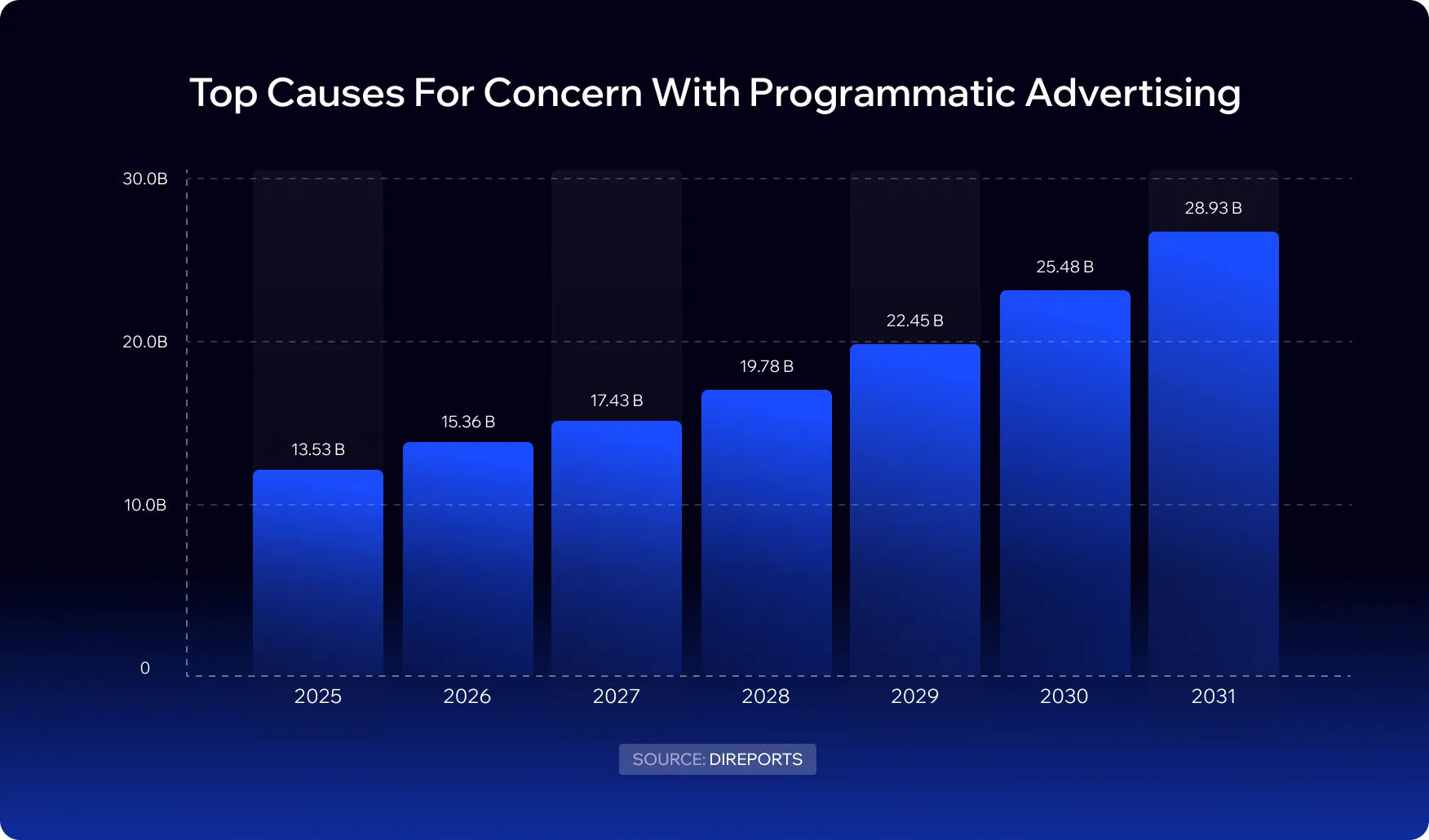
Source: DiReports
Once a placement requests an ad, the ad server can select an eligible creative and deliver it to a website, mobile app, video player, CTV environment, or another advertising placement. It can also record impressions, clicks, conversions, viewability, completion, and other performance events for reporting and optimization. Besides, an ad server can help publishers balance direct-sold campaigns, sponsorships, house campaigns, and programmatic demand.
Note that an ad server can integrate with SSPs, exchanges, and DSPs, but it does not replace them. A server cannot perform media buying or selling functions on its own – its key role is campaign and ad delivery management.
What a DSP does
A demand-side platform (DSP) operates from the buyer's perspective and connects to inventory through ad exchanges, direct integrations, and other buying paths. Using campaign requirements (budget, audience, geography, frequency, etc.), it evaluates available impressions to determine which ones are worth buying and how much to bid.
Optimization continues after the purchase. Depending on the campaign, a DSP may optimize toward reach, conversions, CPA, ROAS, viewability, contextual relevance, frequency, or other objectives. This allows buyers to manage large numbers of impressions and placements without evaluating every opportunity manually.
Basically, a DSP is a platform for advertisers and agencies – it enables them to access ad inventory at scale. The global demand-side platform market size exceeded $38 billion in 2025 and is forecasted to surpass $194 billion by 2034.
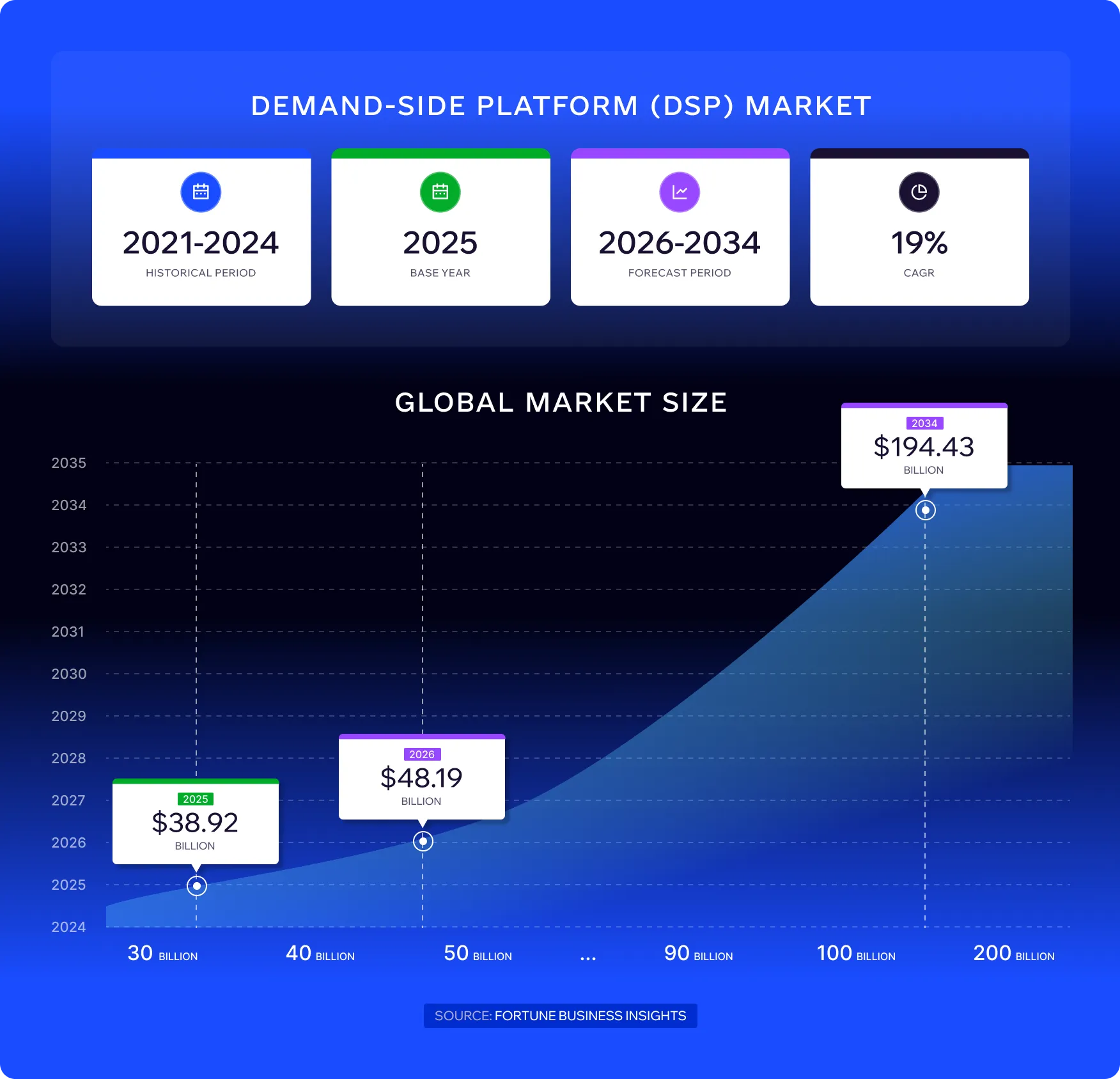
Source: Fortune Business Insights
In case you require a DSP, but third-party platforms cannot meet your needs, consider Attekmi’s custom AdTech development services. Our skilled team is ready to bring your unique project to life.
What an SSP does
A supply-side platform (SSP) enables media owners to sell their inventory. It creates bid requests, connects ad space with relevant demand, applies floors and access rules, and optimizes yield and fill. An SSP also provides reporting tools to help publishers understand inventory performance.
SSPs can support different forms of programmatic monetization, including open auctions, private marketplaces (PMPs), preferred deals, and programmatic guaranteed. Everything depends on the platform's capabilities and the publisher's setup.
SSPs are used not only for website monetization. Publisher groups, app and CTV owners, ad networks, retail-media businesses, and marketplaces can use SSP functionality because they manage supply that needs to be monetized. The global SSP market is forecasted to exceed $64 billion by 2033.
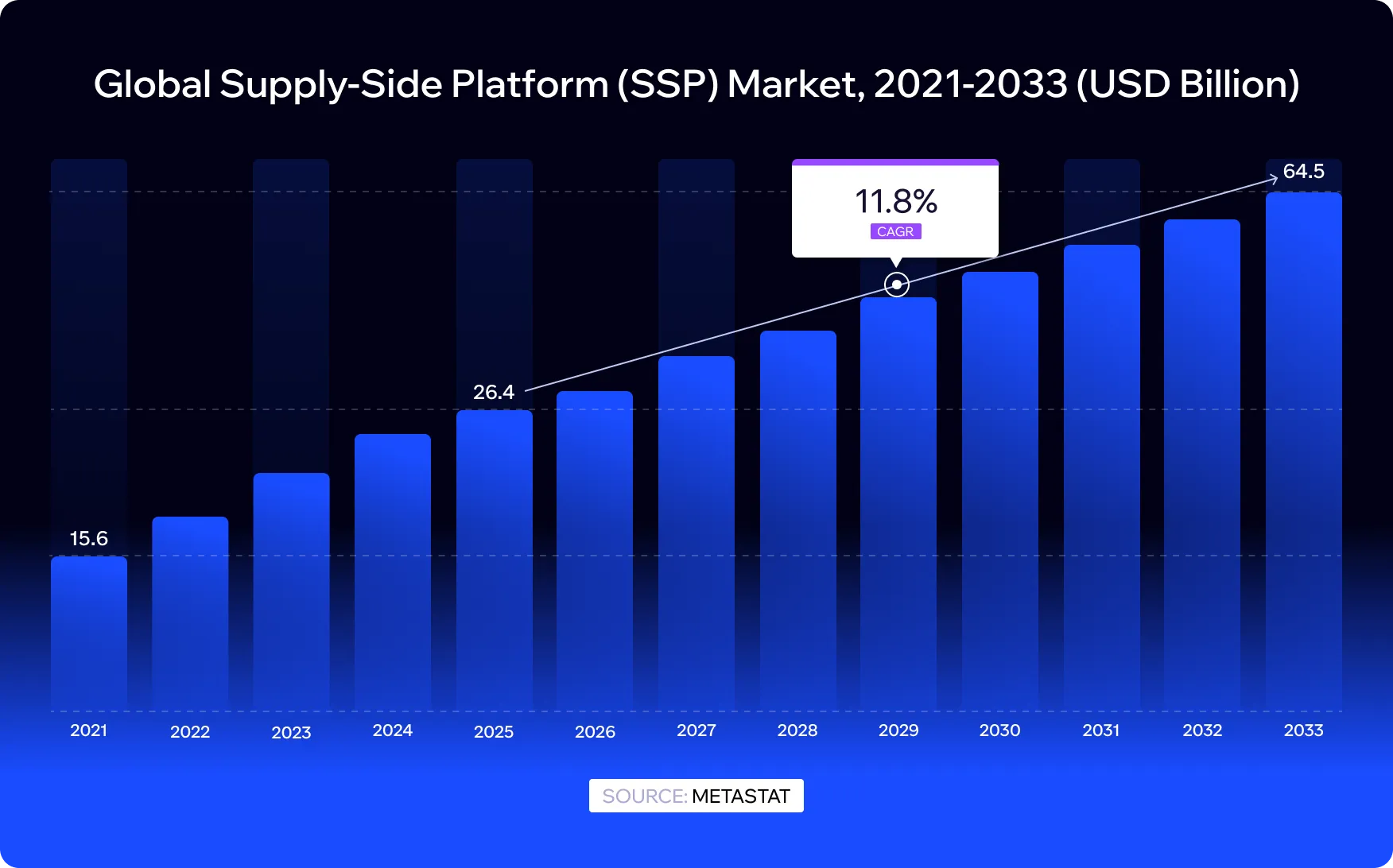
Source: Metastat
Note that an SSP manages the sell-side relationship and monetization of supply, while an ad exchange enables transactions between integrated buyers and sellers. However, in practice, an exchange can also be used for inventory monetization.
Keep in mind that we deliver custom AdTech development services and can build a supply-side platform for you. Alternatively, you may want to consider our white-label monetization solution. Apart from UI personalization, it offers custom on-request feature development, so you get the platform fully tailored to your requirements.
How an ad server, DSP, and SSP work together
Now, let’s review how the three platforms cooperate. Remember that an ad server, DSP, and SSP are not really competing pieces of technology. In the programmatic ecosystem, they operate at different stages of the same transaction.
A typical programmatic impression flow
An advertising opportunity is created – a user visits a publisher’s site, opens an app, or starts a video/CTV stream.
The publisher’s ad server determines what may compete for the placement. This may include programmatic demand, direct-sold campaigns, etc.
The SSP creates or forwards a bid request using placement, device, context, consent, and other relevant signals.
The SSP or exchange makes the opportunity available to connected DSPs.
Each DSP evaluates the opportunity against its advertisers' campaign requirements. It can consider factors such as audience targeting, context, device, geography, frequency, budget, etc.
The auction selects a bid according to the applicable rules.
The ad server delivers the eligible winning creative and records the outcome.
Should I use an ad server, DSP, or SSP?
The choice of technology depends on what exactly you aim to control. However, in some cases, you may need several tools. For instance, if you run an advertising network, you may use an ad server together with an SSP. Now, let’s review the separate use cases.
Use a DSP if you buy media for advertisers
Consider DSP access if you are:
An advertiser buying programmatic reach. A DSP can help you purchase impressions across multiple publishers and environments while applying audience, contextual, geographic, device, frequency, and performance criteria.
An agency managing multiple advertisers. Agencies can use DSP functionality to manage different clients, budgets, audiences, creatives, bidding strategies, and reporting requirements from a centralized system.
A retailer or brand with an in-house media-buying function. A DSP can provide the infrastructure needed to execute programmatic campaigns without relying on external platforms.
Use an SSP if you sell publisher or app inventory
SSP can be the right choice in the following scenarios:
A website, app, CTV service, or digital media owner selling inventory programmatically. An SSP can connect your available impressions with multiple demand sources and help manage yield, fill, floors, etc.
A publisher network managing multiple properties. An SSP can provide centralized controls for inventory, partners, floors, deal types, demand routing, and reporting.
A marketplace or retail-media operator packaging advertising supply. SSP functionality can help determine which buyers have access to inventory and how that inventory is priced, routed, and monetized.
Use an ad server if you need direct campaign and delivery control
The examples below illustrate the potential need for using an ad server:
A publisher selling sponsorships, direct IOs, premium placements, or programmatic guaranteed campaigns. The ad server can manage contractual delivery requirements, campaign priorities, pacing, targeting, frequency, and reporting.
An ad network managing campaigns for clients. An ad server can help traffic creatives, prioritize campaigns, apply targeting and frequency rules, monitor delivery, and provide performance reports.
A brand or agency that needs independent creative serving or campaign tracking. An ad server can provide a layer for managing creatives, tracking campaign events, and maintaining greater control over how campaigns are delivered and measured.
Do I need an ad server if I already have a DSP?
Having a DSP does not automatically eliminate the need for an ad server. The two platforms serve different purposes: a DSP manages media buying, while an ad server is responsible for creative delivery, campaign execution, and measurement.
If you are an advertiser using a DSP, an ad server can be useful when the business needs to host creatives, track delivery independently, apply third-party measurement, or consolidate reporting. As campaigns become more complex, separating the buying function from the ad-serving and measurement layer can provide greater operational control.
The same applies to the supply side. As a publisher, you may receive DSP-driven demand through an SSP or exchange while still relying on an ad server to determine how that programmatic demand competes with direct-sold campaigns, sponsorships, house ads, etc.
However, not every advertiser needs both solutions. The need becomes more relevant as the business adds multiple channels, direct deals (that represent around 21-29% of programmatic spend globally), independent measurement requirements, more complex creative workflows, or broader reporting needs.
Can a business use both a DSP and an SSP?
Actually, you can interact with both demand-side and supply-side technology, but the exact setup depends on your business model. Here are several examples:
Ad networks may work with publisher supply through SSP capabilities while connecting advertiser budgets through DSPs. In turn, an ad exchange facilitates the matching of eligible supply and demand.
Retail-media and marketplace operators can also have both supply- and demand-side requirements. For example, an operator may use supply-side functionality to package its own inventory while using DSP access to activate advertiser campaigns.
Agency and media businesses may use DSPs directly because their primary role is to purchase inventory for advertisers. They may work with SSPs and exchanges through partnerships without needing to own sell-side technology themselves.
At the same time, when one business has anything to do with both supply and demand, clear governance becomes especially important. Separate permissions, data boundaries, pricing rules, and reporting should make it clear which decisions are being made for buyers and which are being made for sellers.
When should I choose an ad server instead of a DSP?
You already know that you may need both an ad server and a DSP. However, are there situations when a server should be prioritized over a demand-side platform? Yes, and here are several examples:
You primarily sell and manage direct campaigns rather than buy third-party inventory.
You need campaign trafficking, targeting, frequency caps, pacing, priorities, and advertiser reporting.
You manage inventory across multiple sites, apps, videos, or publisher properties. An ad server can provide a centralized layer for controlling campaign delivery across different environments and placements.
You want programmatic demand to compete with direct deals under your own rules. For example, programmatic demand can be made available for an impression while higher-priority sponsorship or guaranteed campaigns retain their contractual delivery requirements.
You need a branded product or client-facing portal rather than an advertiser buying seat. This can be particularly important for ad networks and media businesses that want advertisers or internal teams to work through their own branded campaign environment.
Is an SSP only for publishers?
The short answer is no. The defining factor is not the company's label but whether it manages advertising inventory and needs technology to monetize that supply. A traditional publisher is the most obvious SSP user, but the same requirements can exist in other business models. For instance, a company may not describe itself as a publisher while still controlling valuable advertising placements and needing to determine which buyers can access them, under what conditions, and at what price.
An advertiser-only business generally does not need an SSP because it is purchasing inventory instead of selling it. However, an enterprise that sells sponsored listings, display placements, in-app inventory, CTV advertising, or other digital advertising opportunities may need SSP-like capabilities even if publishing is not its core business.
This is particularly relevant, for example, for retail-media networks and digital marketplaces. Their primary business may be retail or commerce, but once they begin packaging their own advertising supply for external buyers, they face many of the same monetization and governance requirements as classic publishers.
What is the best advertising platform for advertisers vs publishers?
Rather than looking for one universal advertising platform, you should match the technology to your requirements.
Advertisers and agencies generally need strong buying controls. Important capabilities include:
Audience and contextual targeting
Budget and bid management
Campaign optimization
Frequency controls
Supply-path transparency
Brand-safety and suitability controls
Measurement and attribution
Cross-campaign reporting
These requirements generally imply the need for DSP access. At the same time, an advertiser or agency may add separate ad-serving or measurement technology when there is a need for greater control over creatives, independent measurement, or campaign delivery across multiple buying channels.
In turn, publishers, app developers, and CTV owners need technology focused on monetizing their inventory. Critical functionalities are often as follows:
Supply and inventory controls
Access to diverse demand sources
Floor-price management
Deal and marketplace management
Yield and fill optimization
Quality and brand-safety controls
Revenue and performance reporting
Direct-campaign delivery
Support for web, app, video, and CTV environments
This usually points toward an SSP plus ad server stack. The SSP manages programmatic monetization, while the ad server provides better control over direct campaigns, priorities, delivery rules, and reporting. However, depending on the specific requirements, an SSP may be enough.
As for networks and platform owners, they may have requirements that go beyond standard DSP or SSP characteristics. In addition to buying or selling capabilities, they may need:
A branded interface and user experience
Publisher and advertiser onboarding
Flexible integration options
Auction and traffic controls
Custom routing and decisioning logic
Data and reporting infrastructure
Billing and reconciliation
User roles and permissions
Proprietary business rules
For these businesses, white-label or custom AdTech infrastructure may be the best choice. Instead of operating inside someone else's marketplace, the business can build a branded and configurable layer around its own supply, demand, partners, workflows, and commercial rules.
Conclusion: choose the function you need to own
To answer the question “which AdTech platform is right for my business?”, you should start with the function you need to control. A DSP serves the buy side, helping advertisers and agencies purchase and optimize media. An SSP serves the supply side, helping publishers and other inventory owners monetize their supply. Finally, an ad server manages campaign delivery, trafficking, and operational control.
Mature advertising businesses often combine these technologies because different parts of their operation require different capabilities. At the same time, few companies need to build every component from scratch. When the goal is to run a branded marketplace, own partner workflows, control auction and monetization logic, or productize AdTech capabilities, white-label infrastructure can be the best fit.
Need an AdTech platform tailored to your needs? Let’s talk.
FAQ
An ad server manages campaign delivery, creative serving, targeting, pacing, and reporting. A DSP helps advertisers and agencies buy and optimize ad inventory. An SSP helps publishers and other supply owners sell their inventory. Each solution controls a different part of the advertising transaction.
Choose based on the function your business needs to control: advertisers and agencies typically need DSP access, publishers and other supply owners may need SSP capabilities, and businesses managing direct campaigns often require an ad server. More complex businesses may use several of these technologies together.
Not necessarily. A separate ad server becomes more useful when you need independent creative serving, cross-channel tracking, third-party measurement, direct campaign management, or consolidated reporting beyond what your DSP provides.
Yes. Businesses such as ad networks, retail-media operators, and marketplaces may use or integrate with both to manage supply and access advertiser demand, although clear permissions, data boundaries, pricing rules, and governance are important.
No. An SSP is relevant to any business that manages advertising inventory and needs to monetize it, including apps, CTV services, retail-media networks, marketplaces, and other digital businesses. An advertiser-only business generally does not need an SSP.


'%3e%3cpath%20d='M415.5%20380.133C415.5%20554.655%20911.5%20609.133%20714%20818.633C447%20850.133%20200%20677.655%20200%20503.133C200%20328.611%20341.478%20187.133%20516%20187.133C690.522%20187.133%20415.5%20205.611%20415.5%20380.133Z'%20fill='%231A4CFF'/%3e%3c/g%3e%3cg%20filter='url(%23filter1_f_654_7533)'%3e%3cpath%20d='M819.862%20539.146C969.42%20389.588%20963.912%20273.412%201000.6%20310.096C1037.28%20346.78%201059.92%20590.588%20910.362%20740.146C760.804%20889.704%20503.861%20847.646%20447.362%20760.146C348.862%20547.146%20670.304%20688.704%20819.862%20539.146Z'%20fill='%23052AAE'/%3e%3c/g%3e%3cg%20filter='url(%23filter2_f_654_7533)'%3e%3cpath%20d='M647.331%20285.725C443.031%20230.983%20408.998%20311.131%20358.6%20243.729C295.498%20194.631%20571.852%2052.1078%20776.152%20106.85C980.452%20161.592%201072.5%20405.139%201024.97%20497.82C889.759%20689.623%20851.631%20340.467%20647.331%20285.725Z'%20fill='%231B4DFF'/%3e%3c/g%3e%3c/g%3e%3cdefs%3e%3cfilter%20id='filter0_f_654_7533'%20x='0'%20y='-12.8672'%20width='960.465'%20height='1035.25'%20filterUnits='userSpaceOnUse'%20color-interpolation-filters='sRGB'%3e%3cfeFlood%20flood-opacity='0'%20result='BackgroundImageFix'/%3e%3cfeBlend%20mode='normal'%20in='SourceGraphic'%20in2='BackgroundImageFix'%20result='shape'/%3e%3cfeGaussianBlur%20stdDeviation='100'%20result='effect1_foregroundBlur_654_7533'/%3e%3c/filter%3e%3cfilter%20id='filter1_f_654_7533'%20x='228.938'%20y='103.27'%20width='998.816'%20height='935.965'%20filterUnits='userSpaceOnUse'%20color-interpolation-filters='sRGB'%3e%3cfeFlood%20flood-opacity='0'%20result='BackgroundImageFix'/%3e%3cfeBlend%20mode='normal'%20in='SourceGraphic'%20in2='BackgroundImageFix'%20result='shape'/%3e%3cfeGaussianBlur%20stdDeviation='100'%20result='effect1_foregroundBlur_654_7533'/%3e%3c/filter%3e%3cfilter%20id='filter2_f_654_7533'%20x='149.441'%20y='-105.473'%20width='1087.81'%20height='860.301'%20filterUnits='userSpaceOnUse'%20color-interpolation-filters='sRGB'%3e%3cfeFlood%20flood-opacity='0'%20result='BackgroundImageFix'/%3e%3cfeBlend%20mode='normal'%20in='SourceGraphic'%20in2='BackgroundImageFix'%20result='shape'/%3e%3cfeGaussianBlur%20stdDeviation='100'%20result='effect1_foregroundBlur_654_7533'/%3e%3c/filter%3e%3c/defs%3e%3c/svg%3e)