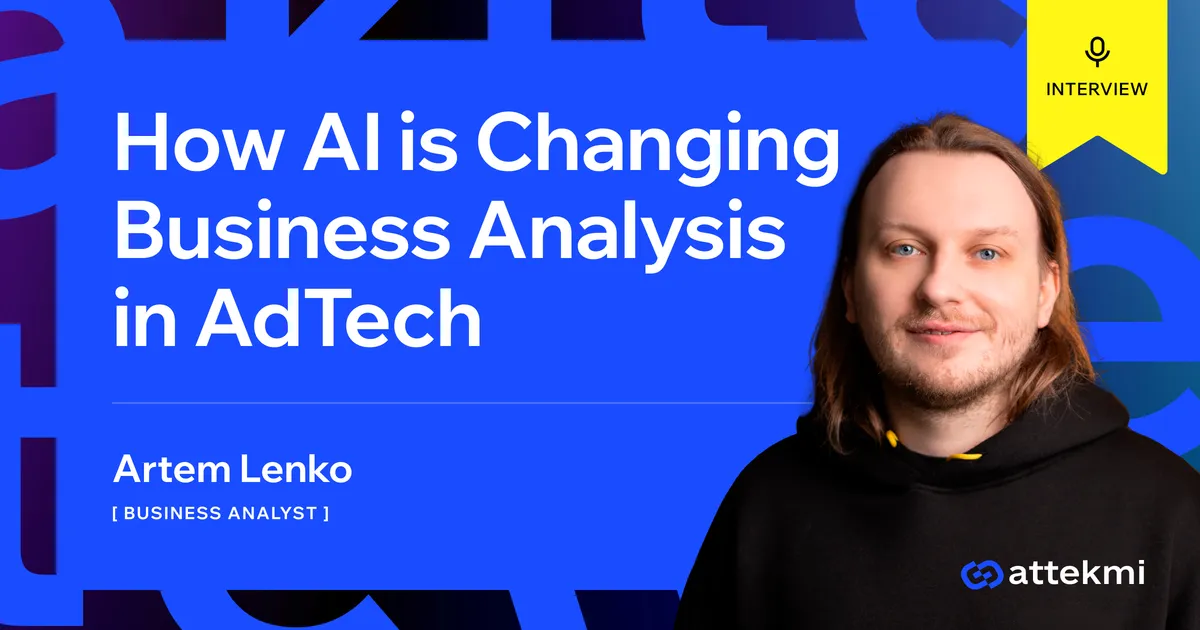
Artem Lenko, the BA at Attekmi, shared his thoughts on the role of AI in business analysis. According to Artem, while automating certain tasks and accelerating the overall process, AI should still be treated as a tool, not a replacement for a human expert. Therefore, critical thinking and domain knowledge remain a must for an effective business analyst.
AI keeps conquering the world – the market size of artificial intelligence worldwide is projected to rise by $1.39 trillion over the period from 2025 to 2032.
Obviously, AI also impacts different AdTech aspects, but its influence on business analysis is particularly interesting. AI can help process large amounts of information, identify patterns, summarize requirements, and generate hypotheses. Moreover, it can perform these and other tasks much faster than human experts. However, AdTech decisions rarely depend only on data. They also require business context, an understanding of complex programmatic systems, and the ability to question whether the data is telling the whole story.
So, how is AI actually changing the day-to-day work of Business Analysts in AdTech? Which tasks can it really improve? Where can it introduce new risks? What skills become more important as AI takes over more analytical work? We interviewed Artem Lenko, Attekmi’s Business Analyst, to discover answers to these and other questions, so read on to learn more.
Thank you for joining us today! So, from your experience, where is AI already making a difference in business analysis in AdTech? Do you use it in your job?
Well, there are two main things that AI is really good at, and they work not only in business analysis in AdTech. Virtually any expert in any industry can benefit from these AI capabilities. What are they? First of all, AI can automate repetitive tasks. Secondly, it can work with large volumes of data much more efficiently than humans.
If we apply these to business analysis in the AdTech industry, AI can be used as a tool for analyzing data, identifying patterns, comparing different datasets, summarizing information, generating initial hypotheses, and so on. It can be especially helpful when you have loads of metrics to look at and need to quickly understand whether something unusual is going on. I also find it useful for less analytical tasks, like organizing requirements or turning unstructured information into something easier to work with. That is what I use AI for sometimes, as well as for analyzing large amounts of data.
However, I do not treat AI like something that can make final decisions. Yes, it can speed up the analytical process (that is where it is making a difference), but I still need to understand business context, check the data, and decide whether the provided insights and recommendations actually make sense. I would say this is the approach any AdTech business analyst should follow. If you rely on AI blindly, something can go wrong really quickly.
Okay, so what about tasks that AI still struggles with? Is there anything that always requires human intervention or even completely manual work?
The efficiency of AI depends on data, and if there is something missing in the dataset, it starts struggling. I do not mean just missing pieces of information. I am talking about something that the data cannot really include. Most often, that is the context – in AdTech, it plays a really critical role. For example, a change in the same metric can depend on a publisher, traffic source, auction configuration, seasonality, and so on. AI can identify the change quickly, and it may even provide some suggestions on why it happened. However, AI does not really understand context. It lacks human intelligence and intuition. It only provides you with something to work with, and you do the rest.
This is especially relevant for strategic decisions. For example, I would never fully automate business decisions that can affect revenue or the way the platform operates.
“Any serious decision should be validated by a human. AI can prepare the analysis and suggest directions, but you should still be responsible for understanding the consequences and making the final decision.”
Artem Lenko, Attekmi’s BA
As for tasks that require completely manual work… Well, AI definitely cannot replace the knowledge of your team. Sometimes the most important piece of information is not in the dashboard or database – it is something that a project manager or a chief product officer knows because of the decision they have made recently. Being an effective business analyst implies regular direct communication with other team members, and that is something AI cannot be responsible for.
That is a good point. So you say that it is critical to verify an AI-generated insight before using it in a business decision. How do you usually do it?
The best way to deal with this is to treat everything generated by AI as a hypothesis, not as a ready-to-use conclusion. AI gives you something to start with, but you need to go back to the underlying data and check whether the finding is actually supported by it. I also try to reproduce the result independently, just in case.
After this, I usually look at the problem from several perspectives. Imagine the following scenario: a publisher faces a decline in revenue, and AI suggests that this happened because of a specific demand partner. If I were this publisher, I would not immediately think that this partner is underperforming. Instead, I would take a look at historical performance, traffic volume, CPM, fill rate, bid rate, and other relevant factors. I would also check whether the same change happened across all inventory or only within a particular segment.
The main principle here is that AI can help get a potential explanation faster, but the validation part still belongs to the business analyst. Before turning an AI-generated insight into a business recommendation, I need to be confident that the data supports it and that I have not overlooked another explanation. This approach works regardless of your role in the AdTech ecosystem. Whether you create AdTech solutions, monetize your inventory, or advertise programmatically, this is the model you should follow when using AI.
That is like the customer-centric approach we follow at Attekmi. We can assume what features our partners require, but to make the final decision and plan our next steps, we actually ask them what enhancements they need. We support our decisions with data, and you should do the same when using AI for business analysis.
If we sum up here, what is the biggest risk of relying too heavily on AI in business analysis?
For me, the biggest risk is becoming too confident in an answer simply because it sounds convincing. You know, AI is very good at producing clear and logical explanations, but being well-written does not automatically make them correct. Try making up an absurd theory and asking an AI tool to prove it. It can actually do this; the only problem is that you know that the theory was absolutely unrealistic, so the proof is unrealistic as well.
That is just a funny example, but in business analysis, things are more or less similar. AI can create answers that sound pretty reasonable, but the input data may be incomplete. Or, for instance, the context may be missing. As a result, an answer that looks trustworthy can be absolutely useless in reality. That is why AI still requires human oversight and judgement, especially when it comes to strategic decisions.
There is also a risk of optimizing the wrong thing. AI may recommend changes that can improve short-term performance, but create problems in the long run. So again, when AI is involved, human expertise is required. Instead of simply accepting the most convincing recommendation, you need to ask if the AI-generated suggestions can actually help you really solve the issue.
Do you think AI will eventually replace some traditional BA tasks? If so, which ones?
I think AI can automate some tasks, but it will not replace the entire role of business analyst in AdTech. This can be anything that is repetitive, follows a relatively predictable flow, and does not require too much human judgement. Let’s say these tasks can include organizing data, preparing standard reports, summarizing meetings, detecting anomalies, and so on. Basically, AI already deals with these processes, but I guess it will become more sophisticated in the future.
Maybe AI will also take over more of the initial analytical work. For instance, instead of going through a range of dashboards, a business analyst could start with an AI-generated overview of the changes, and then focus on investigating the most critical ones. But this is still only partial automation. A skilled AdTech business analyst does not simply create reports – this is something AI can do. The real value comes from understanding the business problem, questioning assumptions, and tuning analysis results into actionable decisions. These tasks are pretty hard to automate effectively. If you entrust AI with them, there are simply too many risks involved.
If AI takes over more routine analytical work, what becomes more important for a business analyst?
AI can analyze a dataset, generate a report, or identify a pattern in a few seconds. Therefore, analytical skills on their own are not a sufficient competitive advantage for a business analyst, even though having them still matters. If AI is responsible for routine analysis, critical thinking and domain expertise become much more important. Thus, over 70% of BA experts say that AI has a positive impact on their careers but mention that human skills play a more significant role than ever.
“The AdTech environment is really complex, and you must understand how all of its components work together. Otherwise, you might get a technically correct answer from AI but completely misunderstand its business implications.”
Artem Lenko, Attekmi’s BA
You need to know what to ask, which information matters, and whether the answer actually makes sense. Basically, you must be able to use AI as a tool effectively. Over the years, artificial intelligence has been on the list of the hottest advertising technology trends. If you do not know how to use it, you are already falling behind.
In your opinion, is it possible to be an effective AdTech business analyst if you never use AI?
Sure. To be an effective business analyst in AdTech, you need analytical and critical thinking, industry knowledge, communication skills, and the ability to understand business problems. These were important before AI, and remain important today.
However, the problem is that without AI, you are slower. You spend too much time on repetitive tasks. Moreover, you can miss something – the probability of human error is always there. For instance, there are two analysts with similar levels of experience and knowledge. One of them uses AI, and the other one does not. The expert leveraging AI in advertising technology analysis can focus on those tasks that really need human intervention. In turn, an analyst who prefers to do everything on their own will spend most of the time exploring datasets.
Thus, I do not think that using AI is a mandatory requirement for being a good business analyst. However, I would say that knowing how to leverage it effectively is becoming an important professional skill. But remember, the goal is not to use AI for everything. You must understand where it can make your work better or more efficient.
What do you think business analysis in AdTech will look like in, for instance, three to five years?
Well, I expect more sophisticated AI-powered advertising technology for all the market participants: marketers, media owners, and others. As for business analysis, I guess it will become more AI-assisted. More automation, more effective performance… Basically, these are the key benefits of AI in digital advertising, and, as a business analyst, I expect them to play a more significant role.
I also think the interaction with analytical tools will become more conversational. Maybe I would be able to ask a system a series of questions and get really detailed answers: what changed, where it changed, which areas I should investigate first, and so on. But again, I do not think that the role of business analyst will disappear – I actually think that the human part of this role will become more valuable.
When AI can generate ten possible explanations in seconds, someone still needs to determine which one is credible, understand the business consequences, challenge the assumptions, and decide what action is the right choice. The BA of the future may spend less time producing analysis and more time interpreting, questioning, and making decisions based on it.
More interviews with our experts are on the way, so stay tuned!
Searching for a fully customizable monetization platform? Just contact Attekmi.