
CTV and OTT advertising costs are often measured from the advertiser’s perspective, but publishers and ad exchange operators need to focus on actual earnings. Gross CPM, fill rate, intermediary fees, technical costs, and demand quality all influence net revenue. Greater control over programmatic infrastructure and monetization rules can help operators optimize performance and profitability.
CTV and OTT advertising are often discussed from the advertiser’s perspective: spending, CPM rates, campaign performance, etc. However, for publishers, streaming platforms, SSPs, and ad exchange operators, the key question is not simply how high a CPM is, but how much revenue actually remains after inventory is monetized and applicable costs are deducted.
A high CPM does not necessarily mean high publisher earnings. Fill rate, demand quality, revenue-sharing arrangements, and technical expenses also influence results.
In this guide, we will explore how CTV advertising cost is formed (as well as for OTT), what affects revenue, and how operators can evaluate monetization profitability. In addition, we will clarify the benefits of having greater control over AdTech infrastructure, which is highly relevant for businesses with more complex CTV ad monetization setups. Read on to learn more.
CTV vs. OTT advertising: what are the differences in pricing?
By 2027, global CTV ad spend is projected to surpass $38 billion. The OTT advertising market size is forecasted to exceed $213.78 billion by 2031.
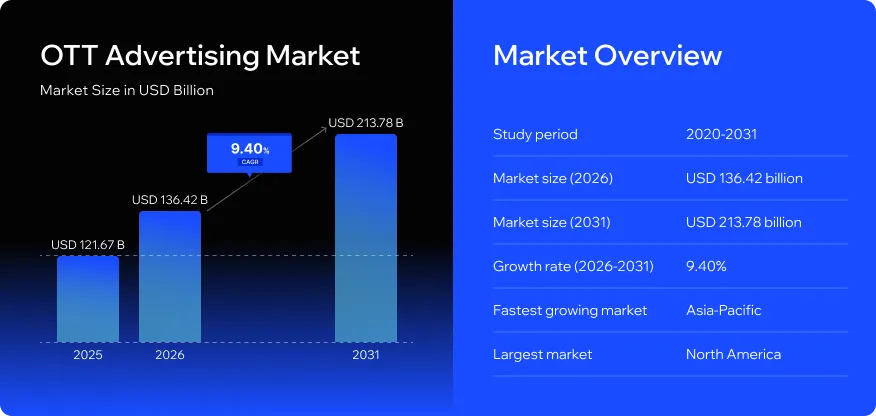
Source: Mordor Intelligence
CTV and OTT are often used interchangeably, but there are still certain differences to keep in mind. Let’s clarify them first.
CTV and OTT advertising explained
Connected TV (CTV) refers to devices connected to the Internet and capable of streaming digital content. This includes smart TVs, streaming devices, gaming consoles, etc. CTV advertising is delivered within a TV-like viewing environment.
In turn, over-the-top (OTT) is a broader term that describes content delivered over the Internet. OTT content can be consumed on connected TVs, but also on smartphones, tablets, laptops, and desktop computers.
So, CTV and OTT advertising are closely related, but they are not the same thing. CTV is a part of the broader OTT ecosystem. For example, a streaming service may distribute the same ad-supported content across a smart TV, mobile app, and web browser, but the advertising inventory available in each environment can have different characteristics. The available ad formats, audience characteristics, session length, device environment, and level of measurement can all affect how buyers value inventory and how effectively you can monetize it.
Common CTV and OTT advertising pricing models
The main OTT and CTV advertising pricing and commercial models are as follows:
CPM: Cost per 1,000 advertising impressions. Commonly used to price programmatic CTV inventory.
eCPM: Effective revenue per 1,000 impressions, useful for evaluating video ad monetization (and not only) performance.
Revenue share: A commercial arrangement in which revenue is distributed between participating parties according to agreed terms.
Fixed technology fees: Charges for access to advertising infrastructure or services.
Hybrid arrangements: Combinations of usage-based fees, revenue share, or fixed charges.
Keep in mind that CPM and eCPM are about the economics of advertising inventory. In turn, revenue share, technology fees, and hybrid arrangements describe the commercial relationship with AdTech providers. For instance, you can have a strong gross CPM but a considerably lower net return once technology-related costs are applied.
How much does CTV and OTT advertising cost?
CTV inventory is considered premium, but actual rates depend on a range of factors. Let’s take a closer look.
Average CTV and OTT CPM rates
There is no universal CTV or OTT advertising price. CPMs can vary significantly depending on the market, inventory type, audience, deal structure, and level of targeting. For instance, directly negotiated inventory and open programmatic inventory often have different pricing structures. Besides, a reported CPM usually represents the advertiser’s cost, not the amount a publisher ultimately receives.
For example, YouTube ads can be both CTV and OTT, depending on where a user is watching content. Here are some of the CPM rates by niche, as of 2026.
Niche | US CPM Range | UK CPM Range | Global Average | Top-End CPM |
Finance and investing | $15-$50 | $10-$35 | $8-$20 | $80+ |
Insurance | $20-$45 | $12-$30 | $6-$15 | $60+ |
Legal/law | $18-$40 | $10-$28 | $6-$14 | $55+ |
Software/SaaS | $12-$35 | $8-$22 | $5-$12 | $45+ |
Real estate | $10-$30 | $7-$20 | $4-$10 | $40+ |
Business/entrepreneurship | $8-$25 | $5-$16 | $3-$9 | $35+ |
Health and medical | $8-$20 | $5-$14 | $3-$8 | $30+ |
Tech/reviews | $5-$18 | $4-$12 | $2-$7 | $25+ |
Education/tutorials | $4-$14 | $3-$10 | $2-$6 | $20+ |
Fitness/welness | $4-$12 | $3-$8 | $2-$5 | $18+ |
What factors influence CTV advertising costs?
The main pricing factors are as follows:
Geography.
Content and inventory quality.
Ad placement.
Targeting signals.
Demand competition.
Seasonality.
Supply path transparency.
For publishers and SSP operators, these factors also affect how inventory should be packaged and priced. Instead of applying one price across all CTV supply, you can differentiate inventory by geography, content environment, device, audience, placement, or deal type. You can then use demand performance to determine which combinations consistently generate competitive bids.
Where CTV advertising revenue goes between buyer and publisher
Impressions can have relatively high advertiser CTV CPM rates without generating the same amount of revenue for the publisher. The difference comes from the structure of the supply chain and the commercial terms between the parties involved.
How money moves through the CTV advertising supply chain
In short, a typical programmatic CTV transaction looks like this:
An impression becomes available. This happens, for instance, when a user is watching a show on a streaming platform and reaches a commercial break.
The bid request is sent. A real-time bidding request contains all the essential information, e.g., household identity, device details, etc.
The auction starts. Demand-side platforms evaluate the request and place bids when relevant.
The winning ad is identified. It is then delivered to the user. Everything happens within milliseconds.
Revenue is allocated. The resulting programmatic CTV advertising revenue is distributed according to the commercial agreements between the participants.
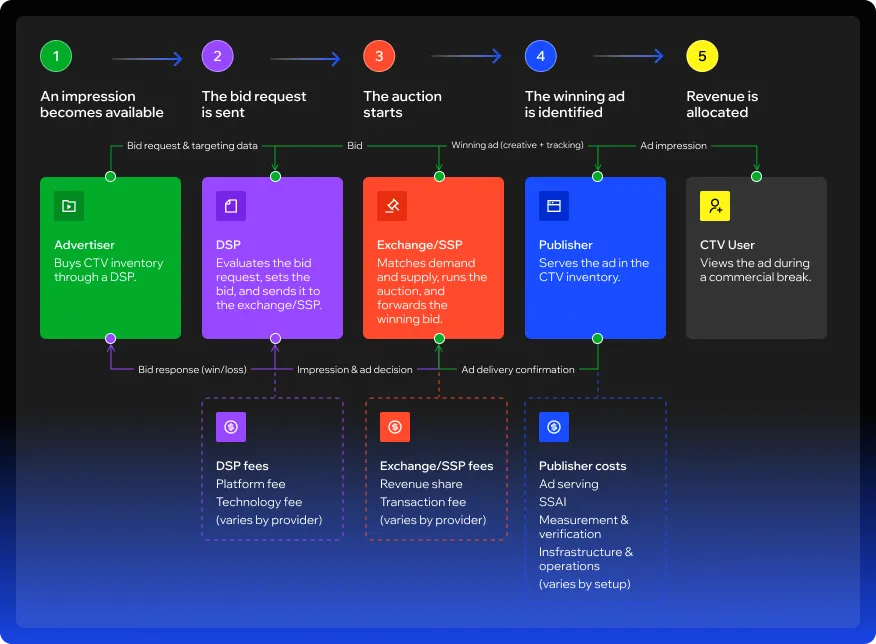
Note that supply paths vary. For example, apart from an SSP, a DSP, and an ad exchange, there may be intermediaries involved. As a result, there is no fixed percentage of an advertiser's CPM that you should expect to retain. The number of intermediaries, commercial model, negotiated fees, and technology setup impact the final publisher revenue share.
SSP fees, ad exchange fees, and revenue sharing
The main deductions or commercial arrangements that can affect your revenue include the following:
SSP or exchange revenue-sharing agreements.
Intermediary transaction fees.
Platform or technology charges.
Additional costs associated with specific integrations or services.
Differences between fees deducted from media revenue and separately billed technology expenses.
Note that actual arrangements vary by provider, inventory volume, deal structure, technology stack, and negotiated contract terms.
Additional costs of CTV and OTT monetization
Operational costs can also affect profitability:
Video ad serving.
Server-side ad insertion (SSAI).
Data transfer and streaming infrastructure.
Measurement and verification services.
Traffic-quality and fraud-prevention tools.
Reporting and data processing.
Technical maintenance and AdOps.
Not every participant pays every cost – some services may be included in an existing agreement. For example, you may already have SSAI infrastructure in place, while an SSP may provide certain functionality as part of its platform fee.
Example: how much does a publisher keep from a $25 CPM?
Let’s take a look at a hypothetical transaction to clarify the difference between gross and net CTV ad revenue. Imagine the following:
Gross media CPM at the defined sell-side starting point is $25.
SSP/exchange deduction is 15%, which means $3.75.
Additional service cost is $1 (per 1,000 monetized impressions).
Therefore, net contribution is $20.25 per 1,000 monetized impressions.
$25.00 − ($25.00 × 15%) − $1.00 = $20.25
This is an illustrative calculation, not an industry-average fee structure or Attekmi pricing. The goal of this example is to explain that you, as a publisher, do not receive the same amount an advertiser pays to buy your inventory.
How to calculate CTV and OTT advertising revenue
Analyzing CPM is critical, but it does not tell the whole story. To evaluate monetization performance properly, you need to go beyond CPM.
Key metrics for CTV monetization
Here is what you should pay attention to:
Available ad opportunities: Potential inventory that can be monetized.
Fill rate: The proportion of eligible opportunities filled with ads, based on a defined measurement methodology.
CPM: The cost or value per 1,000 impressions.
eCPM: Effective revenue per 1,000 impressions (learn more about eCPM calculation).
Net revenue: Revenue remaining after specified deductions.
Revenue per available opportunity: A measure that accounts for both filled and unfilled inventory.
Ad completion rate: The proportion of eligible video ad plays completed, using the relevant measurement definition.
It is important to evaluate these metrics together and, where possible, segment them by device, geography, deal type, and other characteristics. This can reveal where inventory is generating strong gross prices but weak overall monetization.
CTV advertising revenue calculation example
Here comes another example. Imagine a publisher with:
1,000,000 available ad opportunities.
80% CTV fill rate.
$25 gross CPM.
15% revenue deduction.
These numbers result in the following:
Monetized impressions: 1,000,000 × 80% = 800,000.
Gross revenue: 800,000 ÷ 1,000 × $25 = $20,000.
Revenue deduction: $20,000 × 15% = $3,000.
Revenue after deduction: $17,000.
The $25 gross CPM applies to the 800,000 impressions that were actually monetized. When the same $17,000 is spread across all 1,000,000 available opportunities, including the 200,000 that remained unfilled, the publisher generates:
$17,000 ÷ 1,000,000 × 1,000 = $17 per 1,000 available opportunities
Higher CPM alone does not guarantee stronger monetization performance. You should also consider how much inventory is actually filled and how much of the resulting revenue it retains.
How CTV and OTT monetization costs differ across regions
For effective monetization, local demand and operational conditions should be kept in mind. For instance, a CPM that looks attractive in one market may not be achievable elsewhere due to the differences in advertising demand and infrastructure.
Comparing CTV advertising economics in the US, LATAM, and APAC
Let’s compare three major regions:
US. Established programmatic demand, strong competition for premium inventory, and sophisticated buyer requirements. You need robust technology and well-integrated connections to compete effectively. In 2025, the penetration rate of smart TVs in the United States amounted to 82%.
LATAM. Differences between individual national markets, local demand availability, partner relationships, and currency considerations. Local partnerships and access to relevant demand are often critical. In 2024, Latin America reached 163 million smart TVs installed. Brazil’s 89 million monthly viewers are the biggest audience outside the US, averaging 4.5 daily viewing hours.
APAC. Diverse programmatic ecosystems, varying local integrations, and country-specific market and regulatory requirements. Local integrations and market-specific support can have a direct impact on monetization performance. CTV advertising is forecasted to reach around $21 billion in APAC by 2031.
LATAM and APAC should not be treated as single advertising markets with universal CPM benchmarks. Even within the same region, two publishers with similar inventory can achieve different results depending on their country, content, audience, demand relationships, and technical setup.
How to compare SSPs for regional CTV monetization
Here is a checklist on finding the right CTV SSP:
Availability of relevant demand integrations in target markets. Does the SSP have access to demand sources that are active in the markets where you have inventory?
Support for CTV and OTT formats. Can the platform handle the required video formats, devices, streaming environments, and programmatic transaction types?
Regional inventory and partner reporting. Can you track performance by country, inventory source, device, content environment, demand partner, etc.?
Configurable pricing and auction controls. Can you adjust floors, deal settings, and other controls by market or inventory segment?
Infrastructure capacity and latency. Can the platform handle the required request volume while maintaining response times appropriate for CTV auctions and ad delivery?
Fees and revenue-sharing structures. Are the provider's commercial terms transparent? Can you estimate the potential net revenue?
Local privacy and data-handling requirements. Does the setup support the privacy, consent, data-processing, and other regulatory requirements applicable to each target market?
Support for regional expansion. Can the platform accommodate additional countries, demand partners, integrations, and inventory as the business expands?
There is no universally best SSP for every regional CTV operation. The right setup depends on your inventory, business model, partner relationships, and target geography.
Technical factors that affect CTV and OTT monetization costs
CTV monetization depends not only on the price buyers are willing to pay, but also on whether the technology can actually turn available inventory into delivered, measurable impressions.
VAST integrations and video ad delivery
VAST (Video Ad Serving Template) provides a standardized way for ad-serving systems to communicate video advertising information to compatible players. The IAB Tech Lab describes VAST as an XML-based specification that transfers important ad metadata from an ad server to a video player and defines expected player behavior when executing VAST responses.
For CTV, this is particularly important because the advertising ecosystem can include publishers, streaming platforms, ad servers, SSPs, exchanges, SSAI providers, and different types of video players. The systems involved need to support compatible versions and implementations of the relevant specifications so that an eligible ad can move from the demand side to the viewer successfully.
Technical incompatibility can directly affect monetization. For example, a malformed VAST response, unsupported creative, missing required information, or failure to respond correctly can prevent an ad from being displayed.
For you, that can mean a lost monetization opportunity. An impression that could have generated revenue instead goes unfilled. Therefore, proper VAST integration is not simply a matter of technical compliance.
Ad serving, SSAI, and infrastructure costs
Video ad serving is responsible for managing the delivery and tracking of advertising within the viewing experience. In streaming environments, server-side ad insertion (SSAI) can be used to attach ads to the content before it reaches the viewer's device.
The technical architecture can affect the resources required to process, deliver, monitor, and troubleshoot advertising. SSAI, for example, may require additional processing and infrastructure for ad selection, media handling, stitching, and stream delivery.
Ad pod configuration is another consideration. A streaming service may need to fill multiple ad positions within a commercial break while maintaining the expected duration, sequencing, creative requirements, and viewer experience. Poorly configured pods can create delivery problems, excessive ad repetition, or unfilled positions.
There is no single architecture that automatically guarantees higher revenue. The objective is to balance three things:
Delivery reliability: Can eligible ads be selected, delivered, and measured successfully?
Operating costs: What infrastructure, processing, bandwidth, and maintenance resources are required?
Demand: Can the system access enough relevant demand without introducing unnecessary technical overhead?
QPS, latency, and demand routing
Queries per second (QPS) describes how many advertising requests a platform processes over a given period. Capacity must be considered in terms of both average traffic and peak requirements.
Latency is equally important. In a real-time auction, demand partners need to return responses within the available decision window. If a bid arrives after the applicable timeout, it may not be eligible for the auction even if the buyer would otherwise have paid a good price. This makes timeout configuration and demand-partner response times relevant to both monetization and infrastructure efficiency.
At the same time, sending every possible request to every available demand partner is not always efficient. Excessive or poorly targeted request distribution can increase processing, network, and partner-related costs without generating proportional revenue.
Traffic filtering and demand routing can help manage this problem. For example, an SSP or exchange can apply rules that determine which demand partners receive particular requests based on geography, device, content, inventory characteristics, etc. This can reduce unnecessary traffic while directing relevant opportunities toward demand sources that are more likely to respond.
Note that it is important to evaluate platform capacity against actual traffic patterns, peak-load requirements, partner response times, and the economic value of the requests being processed. In CTV, technical efficiency is connected to monetization efficiency.
How privacy and supply transparency affect CTV monetization
Privacy requirements and supply-chain transparency can influence CTV monetization at both the technical and commercial levels.
Privacy-compliant CTV targeting under GDPR and CCPA
CTV advertising may involve device identifiers, audience signals, contextual information, and measurement data. Applicable privacy requirements influence how personal data can be collected, processed, and shared.
The GDPR establishes requirements for processing personal data in the European Economic Area. GDPR requires consent to be freely given, specific, informed, and unambiguous, with the ability to withdraw it.
The CCPA, as amended by the CPRA, operates differently. Among other rights, California residents can opt out of the sale or sharing of personal information, including sharing for cross-context behavioral advertising, and can use an opt-out preference signal where applicable.
These frameworks should not be treated as interchangeable versions of the same requirement. A CTV operator serving European users and California residents may need different processes for consent, opt-outs, data disclosures, and downstream signal handling.
Privacy choices can also affect monetization. However, industry frameworks can help standardize some of these workflows. For example, IAB Europe's Transparency & Consent Framework (TCF) provides a mechanism for facilitating compliance with certain provisions of the ePrivacy Directive and the GDPR.
However, you still need appropriate technical controls and data-handling workflows. These may include:
Identifying what user or device information is collected.
Determining which parties receive or process that information.
Maintaining appropriate consent and opt-out workflows.
Passing applicable privacy signals to downstream partners.
Restricting data use when a user's choice requires it.
Documenting data-processing relationships and responsibilities.
Monitoring changes in applicable privacy requirements and industry specifications.
Supply chain transparency and inventory quality
Buyers also need to know whether the CTV inventory they are purchasing is authorized and how it reaches the market:
Ads.txt: Allows you to publicly identify advertising systems that are authorized to sell your inventory.
App-ads.txt: Extends the same concept to app-based inventory, including applications distributed through connected TV app stores and other app environments.
Sellers.json: Allows buyers to identify the entities represented by seller IDs and distinguish direct sellers from intermediaries.
OpenRTB SupplyChain object (schain): Communicates the sellers and resellers involved in a particular bid request, helping buyers understand the supply path.
Supply transparency can have a commercial effect. If buyers have greater confidence that inventory is accurately represented and comes through an authorized path, the inventory may be easier to monetize. In turn, inconsistent seller information, unclear supply paths, or inaccurate inventory descriptions can motivate buyers to filter out such opportunities.
However, transparency mechanisms should not be treated as a complete solution. Additional traffic quality controls and fraud prevention measures are still necessary.
How to improve CTV and OTT advertising profitability
To improve profitability, you need to look at the entire monetization process. A more profitable setup usually comes from better fill, more efficient demand connections, lower infrastructure costs, or a combination of these factors.
Monitor net revenue instead of CPM alone
CPM is not the only metric to keep an eye on. Monitor the following:
Gross vs. net revenue: Track the amount generated before and after relevant fees and connected TV advertising costs.
Fill rate and effective revenue: A high CPM with low fill may generate less total revenue than a lower CPM with stronger demand coverage.
Revenue by inventory source and demand partner: Identify which demand sources contribute the most value.
Technology and operational costs: Account for expenses such as ad serving, infrastructure, data processing, measurement, traffic filtering, and other applicable services.
Performance by format, placement, and region: Compare pre-roll, mid-roll, ad pods, device types, countries, and other inventory segments separately.
Optimize demand connections and auction settings
Adding more demand partners does not automatically create more competition or revenue. You should regularly:
Review demand partner performance: Compare bid rates, win rates, clearing prices, fill, net revenue, latency, and error rates.
Identify inefficient or redundant request paths: If several connections provide similar demand with little incremental value, routing all of them may create unnecessary complexity.
Evaluate bid floors: Higher floors can increase the price of individual impressions, but they can also reduce the number of eligible bids and lower fill. Floors should be tested against total revenue.
Apply partner eligibility and inventory rules: Rules can be based on geography, device, content, format, deal type, or other relevant inventory characteristics.
Measure the impact of changes: Compare auction performance before and after changing floors, routing rules, partner access, or other settings.
Improve infrastructure and operational efficiency
Configurable programmatic infrastructure plays a critical role, as it enables you to enhance your monetization strategy. Therefore, pay attention to the following:
Request routing: Send traffic to the demand sources most likely to provide competitive bids.
Latency and errors: Monitor response times, timeouts, failed requests, and other technical issues.
Infrastructure capacity: Size and adjust processing capacity around normal traffic as well as peak demand periods.
Low-performing traffic sources: Examine inventory sources that generate large request volumes but produce weak fill, low revenue, etc.
Detailed reporting: Break performance down by source, partner, region, device, format, placement, etc.
When a white-label ad exchange makes sense for CTV and OTT monetization
Using a third-party platform can be a good starting point. However, as your operations grow, you may want to consider a white-label solution.
Limitations of standard hosted monetization setups
Here are the factors that may motivate you to switch to your own platform:
A platform's existing integrations may not cover every demand source, supply type, or technical workflow you want to support.
You may need more flexibility around bid floors, partner eligibility, traffic routing, auction logic, or inventory segmentation than a standard setup provides.
Standard reporting may not offer the level of granularity needed to analyze specific traffic sources, demand partners, markets, formats, or revenue components.
You may have to adapt your workflows to the capabilities and priorities of the platform provider.
At the same time, these limitations vary significantly between providers.
Benefits of white-label programmatic infrastructure
A white-label SSP or a white-label CTV ad exchange can help overcome the limitations listed above:
You can operate programmatic infrastructure under your own brand.
Integrations can be configured around your specific monetization model.
You can implement rules for pricing, inventory access, traffic routing, partner eligibility, etc.
More detailed access to trading and inventory data helps evaluate performance more effectively.
Technology capacity and configuration can be adapted to traffic volumes, geographic expansion, supported formats, and operational needs.
A more configurable platform can make it easier to introduce new inventory types or regional supply and demand relationships.
Operating a white-label platform does not automatically guarantee stronger demand or higher CPMs. However, you have much greater control over the processes, so it becomes easier for you to ensure more effective yield optimization.
Why Attekmi is a good fit
Attekmi’s white-label monetization solution is fully customizable, from UI personalization to custom on-request feature development. It gets tailored to all your requirements. Apart from this, you can count on the following:
Support for CTV, desktop, mobile web, and in-app environments.
Support for CTV, banner, video, audio, and native ad formats.
All the integration types you need, including VAST to RTB, VAST to VAST, and VAST to All.
Advanced targeting and traffic filtering settings.
Fraud detection and prevention mechanisms.
Compliance with GDPR, CCPA, and other regulations.
An individual approach to every partner.
Proactive support service.
If you need a monetization platform aligned with your business model but do not want to invest in time-consuming development from scratch, Attekmi WLS can be the best choice.
Conclusion
CTV and OTT advertising costs cannot be evaluated through CPM alone. You need to consider how much inventory is actually monetized, the fill rate, applicable platform and technology fees, and the operational costs required to deliver and manage the inventory. Regional market conditions, demand quality, auction settings, and technical infrastructure can also significantly affect the final result.
This way, net publisher ad revenue should be at the center of CTV and OTT monetization analysis. Consistent reporting and a detailed view of revenue, costs, demand performance, and technical efficiency can help you make better commercial and infrastructure decisions.
For businesses requiring more control over these decisions, white-label programmatic advertising infrastructure can be the right option. Solutions like Attekmi WLS provide greater flexibility over integrations, trading rules, reporting, and workflows as CTV and OTT operations expand.
Ready to start monetizing your CTV inventory more effectively? Let’s talk.
FAQ
CTV advertising CPM rates vary by market, inventory quality, buying method, and audience targeting. For instance, for YouTube ads in the finance and investing niche, the global average is $8-$20, while the top-end CPM is over $80. In the US, the CPM for the same industry ranges between $15 and $50. In turn, for the UK, the range is $10-$35.
Not necessarily. OTT includes streaming content delivered across devices such as smartphones, computers, tablets, and connected TVs, while CTV refers specifically to viewing on connected television devices. Pricing depends more on audience, content, format, market, and buying method.
The amount depends on the gross advertising revenue, contractual revenue shares, platform and exchange fees, and other applicable monetization costs. For example, if a publisher generates $25 CPM and a 15% fee is deducted, $21.25 remains before any additional expenses.
Key factors include geography, content and inventory quality, audience targeting, ad placement, seasonality, and competition among demand partners. For publishers, fill rate, fees, and operational costs also determine whether a high CPM translates into stronger net revenue.
A white-label ad exchange may make sense when a business needs more control over demand integrations, auction rules, partner configurations, reporting, or expansion into new markets and advertising formats. The decision should depend on whether this flexibility addresses specific operational or commercial needs, since white-label infrastructure does not automatically guarantee higher CPMs, lower costs, or better demand access.