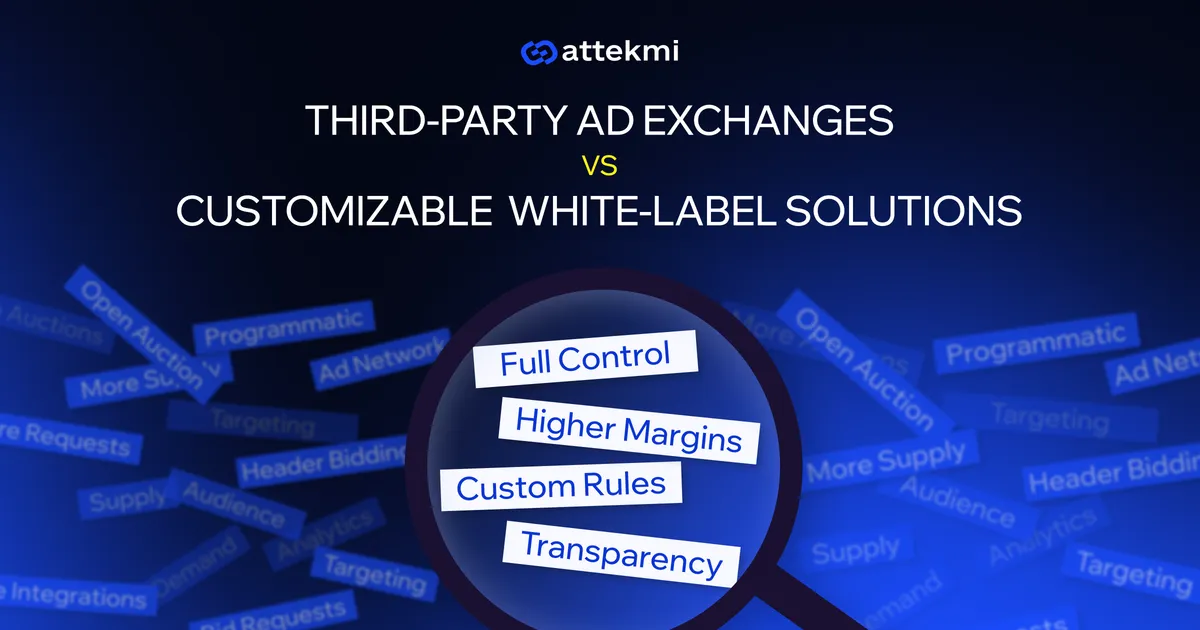
The global ad exchange landscape includes large third-party platforms, regional and vertical exchanges, and emerging white-label marketplaces. Third-party exchanges offer fast access to demand with less operational overhead, while white-label exchanges provide greater control over margins, data, auction rules, branding, and partner relationships.
Ad exchanges are programmatic marketplaces where digital advertising supply and demand meet. Through real-time bidding (RTB) auctions, they connect publishers and SSPs with DSPs, agencies, and other buyers, helping determine which ad is served to a user and at what price.
Today, the global ad exchange landscape is dominated by a few major platforms. At the same time, the market is evolving as businesses increasingly explore white-label ad exchanges that give them greater control over their monetization infrastructure. As competition grows, owning such a solution can become a strategic alternative to relying on third-party platforms.
In this article, we will have the global ad exchange landscape explained. We will clarify the differences between third-party and white-label exchanges, and examine the factors you should consider when choosing the platform. Read on to learn more.
The global ad exchange landscape in 2026
First and foremost, let’s explore the global ad exchange landscape. As we already mentioned, there are several global businesses leading the industry; however, there are also regional and vertical platforms. Additionally, the number of white-label solutions entering the market keeps increasing.
Market size, growth, and major tiers
The global ad exchange market reached more than $27 billion in 2025 and is forecasted to surpass $51 billion by 2034. The expected CAGR is 7.8%.
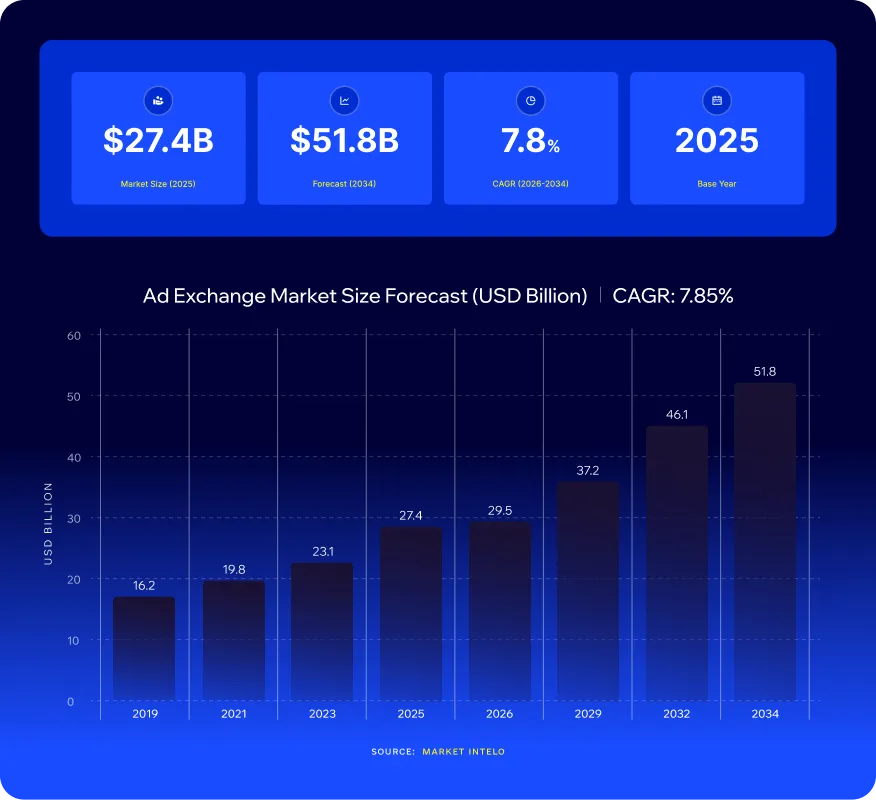
Source: Market Intelo
One of the factors explaining this growth is the increasing investments in programmatic advertising, where ad exchanges play a critical role. Thus, in 2024, global programmatic ad spend reached around $595 billion and is projected to approach $800 billion by 2028.
Within this landscape, ad exchanges can be divided into three tiers:
Tier 1: Global exchanges. These are large, internationally scaled platforms with extensive publisher and buyer relationships, broad geographic coverage, and deep integrations across the programmatic ecosystem.
Tier 2: Regional and vertical exchanges. These platforms focus on specific markets, formats, or inventory types. They may specialize in areas such as mobile, CTV/OTT, gaming, audio, native advertising, or particular geographic regions.
Emerging tier: Private and white-label exchanges. Instead of joining an existing exchange as a participant, publishers, media groups, and ad networks can operate an exchange under their own brand. White-label technology provides the underlying infrastructure while allowing the business to build its own marketplace, establish its own supply and demand relationships, and retain greater control over how the ecosystem operates.
How third‑party ad exchanges work
A third-party ad exchange is a centrally operated, multi-sided marketplace where numerous publishers and buyers transact through the same technology platform. When a publisher makes an impression available, the exchange facilitates the auction, sends the opportunity to eligible demand sources, receives bids, applies the relevant auction rules, and returns the winning ad for delivery. Note that publishers and ad networks use the exchange, but they do not own the marketplace itself.
The main advantage of third-party exchanges is that publishers can gain access to established demand without building and maintaining their own infrastructure. Besides, such solutions provide pre-existing integrations with DSPs, SSPs, buyers, verification providers, and other components of the programmatic ecosystem. For organizations that want to monetize inventory without taking on significant technology and operational overhead, this can be an efficient approach.
What is a white‑label ad exchange?
Basically, white-label exchanges do the same work as third-party platforms. The key difference lies in ownership.
Definition and core concepts
A white-label ad exchange is a customizable RTB marketplace that a business operates under its own brand using licensed technology. Instead of joining a third-party marketplace as another participant, you get the infrastructure needed to run your own programmatic exchange while retaining control over how it is presented, configured, and monetized. Do not confuse a white-label solution with a private ad exchange / private RTB marketplace. Private marketplaces (or PMPs) operate on an invitation-only basis. Premium media owners utilize them to sell their inventory to approved advertisers. Such marketplaces have a 32.1% market share.
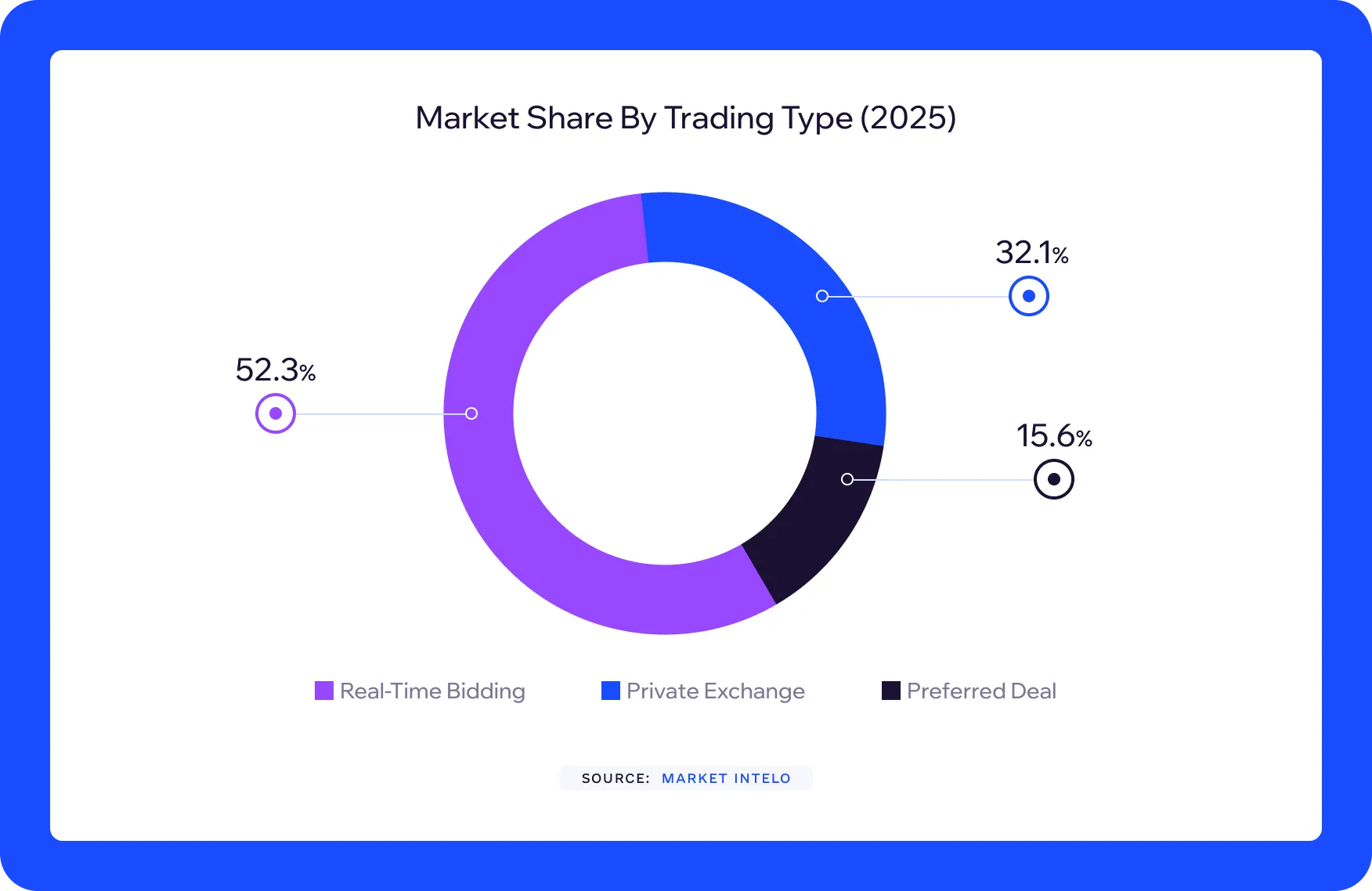
Source: Market Intelo
Obviously, white-label exchanges can also be called “private”, but in a different way. Such platforms give businesses greater control over several areas:
Brand and user experience: The exchange can operate under your company's name, domain, interface, and positioning rather than being presented as a third-party product.
Rules and economics: You can have greater influence over auction rules, fees, revenue shares, inventory access, floors, and other monetization parameters.
Demand relationships: You can determine which DSPs, agencies, buyers, and other demand partners are connected and under what conditions.
Data flows: You establish how inventory, audience, bid, and performance data are collected, shared, and reported across the marketplace.
Product differentiation: The exchange can be packaged as a distinct commercial offering – for example, a specialized regional exchange.
White‑label ad exchanges in the global landscape
In the global ad exchange ecosystem, the demand for white-label solutions keeps increasing. The main reason behind this is that businesses strive for greater control over their processes and search for ways to enhance their competitive advantage.
For example, a company can connect selected demand to its exchange while defining which inventory is available, how auctions are configured, what data can be passed, and how revenue is distributed. This allows the business to benefit from established programmatic demand without giving up ownership of the marketplace through which its inventory is traded.
With a traditional third-party exchange, you are a participant in someone else's marketplace. In turn, with a white-label exchange, you define the rules. This model can be particularly relevant for organizations with a strong supply or audience position. Here are several examples:
Premium publishers can create marketplaces around their first-party inventory (by the way, first-party data utilization in programmatic advertising achieved 57%).
Mobile operators can build exchanges around large mobile audiences.
Ad networks can consolidate and monetize their publisher relationships through a branded marketplace.
Data providers can connect audience intelligence with controlled access to advertising inventory.
Third‑party ad exchange vs white‑label ad exchange: key differences
Basically, the choice between a white‑label advertising platform and a third-party
Revenue model and margins
Third-party exchanges typically charge fees or take a percentage of transaction value for providing marketplace infrastructure and access to demand. Depending on the platform, deal structure, and other intermediaries involved, these deductions can reach double-digit percentages. As a result, you generate revenue from your inventory while sharing part of that value with the exchange and other intermediaries.
For example, if an advertiser's winning bid is $10 CPM and a third-party exchange takes 15-30%, you may receive only $7-$8.50. If there are intermediaries involved, you may receive even less.
With a white-label exchange, you set your own fee structures. The same $10 CPM transaction could therefore leave more value within your ecosystem.
Control, transparency, and data ownership
With a third-party marketplace, you generally work within the platform's predefined pricing mechanisms, auction rules, data policies, and reporting capabilities. You may have access to performance metrics, but not necessarily to the decision-making logic or complete transaction-level data.
A white-label exchange provides much greater control over these elements. You can establish your own pricing and auction rules, determine which inventory and demand partners can participate, and define how data moves through the marketplace. Depending on the technology architecture and agreement with the provider, you can also gain access to detailed log-level data and more granular reporting.
Besides, data ownership can become a strategic asset. If you understand, for instance, where demand is being lost, you can use these insights to optimize monetization.
For this reason, transparency and data control are among the strongest benefits of white‑label ad exchanges and reasons why businesses choose an in‑house RTB platform for publishers.
Flexibility, customization, and governance
Third-party exchanges are designed to serve a broad customer base, so their feature sets, policies, and product roadmaps must work across many types of publishers and buyers. This makes them relatively standardized.
White-label exchanges offer a different approach. You can customize the marketplace around your specific inventory, audiences, buyers, etc. Depending on the platform, this can include:
Custom trading rules for different inventory categories, buyers, or markets.
Partner vetting and access controls to determine which demand sources can participate.
Quality and brand-safety filters tailored to your requirements.
Custom pricing and floor strategies for different segments of supply.
Multiple sales channels, including open auction, preferred deals, programmatic direct, etc.
Branded experiences that turn the exchange into a differentiated marketplace.
This flexibility can be particularly valuable for companies operating specialized inventory. For example, a CTV publisher may want different rules for premium video inventory than for standard display.
Time‑to‑market and operational load
The main advantage of a third-party exchange is simplicity. The platform provider handles much of the technology, infrastructure, integrations, and ongoing maintenance.
White-label exchanges require more initial planning. You need to select an appropriate technology provider, define the required marketplace model, configure integrations, establish commercial rules, and connect supply and demand. You also have to manage supply and demand partners and make strategic decisions about how the exchange should evolve. However, time-to-market is still quick (especially in comparison with development from scratch).
Besides, you do not have to maintain a platform and update it with new functionalities. Responsible providers like Attekmi will keep the solution competitive and effective for you, while you will be able to focus on your core business tasks. Yes, white-label exchanges require much more attention and involvement than third-party ones. They imply higher responsibility, but this also means your business growth.
When white‑label ad exchanges make sense
A white-label ad exchange is not automatically the right choice for every publisher or ad network. Usually, the need for such a solution is justified when an organization has enough valuable inventory, audience data, or partner relationships to benefit from greater control over the marketplace layer. Here are several examples.
Premium publisher case: protecting data and monetization
Imagine the following: a large publisher generates substantial programmatic revenue but is frustrated by opaque fees, limited control over auction mechanics, and uncertainty around how its data is used by external platforms.
A white-label exchange can give the publisher better control over how premium inventory is monetized. Advanced trading rules can be configured to protect high-value placements, establish appropriate floors, and prioritize strategic buyers.
The publisher can also ensure stricter policies around user IDs and data flows. Instead of allowing valuable audience signals to circulate through a broad third-party ecosystem, the media owner can determine which partners receive access, what information is shared, and under what conditions. This helps keep more of the commercial value generated by first-party data within the publisher's own ecosystem.
The result: more control over premium inventory, greater visibility into monetization, and a stronger ability to protect the value of first-party data.
Ad network case: becoming the marketplace
Here is another example: an ad network aggregates inventory from multiple publishers and resells that supply through several third-party exchanges. While this approach provides access to demand, it can also create fragmented reporting, multiple layers of fees, and limited differentiation from other networks competing for the same buyers.
Launching a white-label exchange allows the network to move from being simply another supplier of inventory to operating its own marketplace.
The network can onboard publishers, data providers, and buyers into a single branded environment and create a centralized layer for managing supply and demand. It can also offer several transaction models through the same infrastructure, including RTB, private marketplace (PMP) deals, preferred deals, and programmatic direct sales.
This creates opportunities to package inventory in ways that are difficult to replicate through generic third-party exchanges. For example, the network could create curated marketplaces for particular verticals, regions, audiences, or formats and offer selected buyers controlled access to them.
There is also a direct economic benefit. Instead of routing every transaction through multiple external AdTech intermediaries, the network can establish its own fee structure and retain a larger share of the value generated by its marketplace.
The result: the ad network becomes more than an intermediary. It becomes the infrastructure through which its own supply and demand ecosystem operates.
App‑first or telecom case: leveraging first‑party data
The third example involves a mobile app or telecom operator with substantial first-party audience data. Such organizations may have valuable insights into user behavior, interests, devices, or consumption patterns but need to be particularly careful about how those signals are activated and shared.
A white-label exchange can provide a controlled environment for extending those audiences beyond the organization's owned properties. For instance, advertisers could use approved audience segments to reach relevant users across selected inventory, creating audience-extension or retargeting opportunities.
Strict identity and data-flow management becomes especially important in this model. The operator can define which identifiers are used, which partners can access audience signals, how data is transferred, and what information can be retained or reused. This creates a clearer boundary around the commercial use of first-party data while supporting privacy requirements and regulations.
The exchange can also become a differentiated proposition for advertisers. Instead of buying generic programmatic inventory, advertisers can gain access to a marketplace built around a specific and valuable audience, with the operator's first-party insights helping to make that inventory more relevant.
The result: first-party data becomes more than an internal analytics asset – it can support a differentiated advertising marketplace.
How to approach white‑label ad exchange selection
Before you start googling something like “top ad exchange vs ad network vs SSP”, it is important to decide what you actually want to achieve with a white-label solution. Remember, choosing the most popular platform is not always the way to go – your marketplace should reflect your requirements and long-term objectives.
Clarify strategic goals
Therefore, start by asking the following questions:
What is the primary objective? Is the goal to increase margins, gain greater control over data, reduce dependence on third-party platforms, or turn your existing supply and demand relationships into a differentiated product?
What traffic types should the exchange support? Define whether the initial focus is on web, mobile app, CTV/OTT, or a combination of environments.
Which formats are required? Consider display, video, native, audio, or other formats relevant to your business.
Which partners must be integrated from day one? Map existing DSPs, agencies, data providers, SSPs, verification providers, and other partners that are critical to connect with.
Who will use the marketplace? The requirements can differ considerably depending on whether the exchange is designed for internal monetization, external buyers and publishers, or a combination of participants.
Evaluate platform capabilities
Then, you can start searching for relevant white-label solutions. Key capabilities to evaluate include:
Auction infrastructure: The platform should support diverse connection types, including OpenRTB, header bidding, etc.
Reporting and data access: Look for granular reporting, log-level data access, customizable analytics, and the ability to analyze performance across publishers, buyers, formats, devices, geographies, and other dimensions.
Fraud prevention and traffic quality: The platform should provide mechanisms for detecting invalid traffic, filtering low-quality supply, and maintaining marketplace quality.
Targeting capabilities: You should be able to match the right demand with the right supply with ultimate precision.
Transparency and privacy compliance: The solution must be compliant with regulations like GDPR and COPPA and offer features for ensuring maximum transparency.
Customization: White-label solutions are customizable, but many platforms offer only UI personalization. However, Attekmi’s white-label solution gets fully tailored to your needs, which also includes custom feature development.
Scalability and performance: RTB infrastructure needs to process large numbers of bid requests reliably and with low latency, so infrastructure capacity and performance should be part of the evaluation. Also, check if the platform is ready to scale together with your business.
Plan rollout and governance
A phased rollout can reduce operational risk and provide real-world data before the marketplace is scaled. Therefore, begin with a subset of inventory and partners. You should test auction mechanics, pricing strategies, floor rules, demand routing, and quality filters before expanding the marketplace.
During this phase, you can compare performance against existing monetization channels and identify where the new exchange creates incremental value. Important metrics can include revenue, eCPM, fill rate, bid density, latency, buyer participation, and inventory quality.
Governance is equally important. Greater control over the marketplace also creates greater responsibility for managing it. You should establish internal policies covering:
Partner onboarding: Criteria for approving demand, supply, data providers, and other participants.
Data usage: Rules governing which data can be collected, shared, activated, or retained.
Quality control: Requirements for traffic quality, fraud prevention, brand safety, and inventory standards.
Auction governance: Policies for pricing, floors, deal prioritization, and access to different inventory segments.
Ongoing optimization: Regular reviews of floors, audience segments, demand performance, and trading rules based on marketplace results.
Conclusion: understanding and shaping the global ad exchange landscape
The global ad exchange landscape is evolving. While large third-party platforms continue to play a central role in connecting publishers with global programmatic demand, more and more businesses are looking for ways to own more of the marketplace layer themselves.
Third-party exchanges remain attractive when speed, simplicity, and immediate access to established demand are the priorities. In turn, white-label exchanges become more compelling when an organization needs greater control over margins, data, auction rules, partner relationships, and product differentiation.
The decision, therefore, is not simply about choosing between two technologies – it is about deciding how much of the programmatic value chain you want to control. For organizations with sufficient inventory, data, or partner scale, a white-label exchange can turn that control into a long-term strategic asset while still leveraging the demand and infrastructure of the wider programmatic ecosystem.
Ready to try Attekmi’s fully customizable white-label monetization solution? Get in touch with us.
FAQ
A third-party exchange is a shared marketplace operated by an external provider, while a white-label exchange is a marketplace operated under the business's own brand. White-label solutions provide greater control over revenue, auction rules, data, partners, etc.
Premium publishers, ad networks, media groups, mobile operators, telecom companies, and data providers can benefit most, particularly when they have substantial inventory, valuable first-party data, or established buyer and publisher relationships. The model is especially relevant when increased control and differentiation are strategic priorities.
Building an RTB platform completely from scratch can be technically and operationally complex, but a white-label, platform-as-a-service model significantly reduces the development burden. You can start with selected inventory and partners, test the marketplace, and scale gradually rather than replacing your existing setup all at once.
It gives you greater control over which data is collected, how it is processed, which partners can access it, and how user identifiers and audience signals are shared. This can help keep the commercial value of first-party data within your ecosystem while supporting stronger privacy and data-governance policies.
Attekmi offers a white-label solution that gets fully tailored to your needs, from UI personalization to custom on-request feature development. Time-to-market depends on the required customization, but thanks to the platform’s pre-built core, you will still launch your solution much faster than in the case of custom development.


'%3e%3cpath%20d='M415.5%20380.133C415.5%20554.655%20911.5%20609.133%20714%20818.633C447%20850.133%20200%20677.655%20200%20503.133C200%20328.611%20341.478%20187.133%20516%20187.133C690.522%20187.133%20415.5%20205.611%20415.5%20380.133Z'%20fill='%231A4CFF'/%3e%3c/g%3e%3cg%20filter='url(%23filter1_f_654_7533)'%3e%3cpath%20d='M819.862%20539.146C969.42%20389.588%20963.912%20273.412%201000.6%20310.096C1037.28%20346.78%201059.92%20590.588%20910.362%20740.146C760.804%20889.704%20503.861%20847.646%20447.362%20760.146C348.862%20547.146%20670.304%20688.704%20819.862%20539.146Z'%20fill='%23052AAE'/%3e%3c/g%3e%3cg%20filter='url(%23filter2_f_654_7533)'%3e%3cpath%20d='M647.331%20285.725C443.031%20230.983%20408.998%20311.131%20358.6%20243.729C295.498%20194.631%20571.852%2052.1078%20776.152%20106.85C980.452%20161.592%201072.5%20405.139%201024.97%20497.82C889.759%20689.623%20851.631%20340.467%20647.331%20285.725Z'%20fill='%231B4DFF'/%3e%3c/g%3e%3c/g%3e%3cdefs%3e%3cfilter%20id='filter0_f_654_7533'%20x='0'%20y='-12.8672'%20width='960.465'%20height='1035.25'%20filterUnits='userSpaceOnUse'%20color-interpolation-filters='sRGB'%3e%3cfeFlood%20flood-opacity='0'%20result='BackgroundImageFix'/%3e%3cfeBlend%20mode='normal'%20in='SourceGraphic'%20in2='BackgroundImageFix'%20result='shape'/%3e%3cfeGaussianBlur%20stdDeviation='100'%20result='effect1_foregroundBlur_654_7533'/%3e%3c/filter%3e%3cfilter%20id='filter1_f_654_7533'%20x='228.938'%20y='103.27'%20width='998.816'%20height='935.965'%20filterUnits='userSpaceOnUse'%20color-interpolation-filters='sRGB'%3e%3cfeFlood%20flood-opacity='0'%20result='BackgroundImageFix'/%3e%3cfeBlend%20mode='normal'%20in='SourceGraphic'%20in2='BackgroundImageFix'%20result='shape'/%3e%3cfeGaussianBlur%20stdDeviation='100'%20result='effect1_foregroundBlur_654_7533'/%3e%3c/filter%3e%3cfilter%20id='filter2_f_654_7533'%20x='149.441'%20y='-105.473'%20width='1087.81'%20height='860.301'%20filterUnits='userSpaceOnUse'%20color-interpolation-filters='sRGB'%3e%3cfeFlood%20flood-opacity='0'%20result='BackgroundImageFix'/%3e%3cfeBlend%20mode='normal'%20in='SourceGraphic'%20in2='BackgroundImageFix'%20result='shape'/%3e%3cfeGaussianBlur%20stdDeviation='100'%20result='effect1_foregroundBlur_654_7533'/%3e%3c/filter%3e%3c/defs%3e%3c/svg%3e)