CTV is not inherently better than social media ads for ROI, but it can outperform them for mid- and lower-funnel campaigns when paired with household-level targeting, compelling creative, and robust attribution. While advertisers use DSPs to launch CTV ads, media owners can leverage white-label solutions (e.g., from Attekmi) to unlock greater control over the CTV inventory monetization processes.
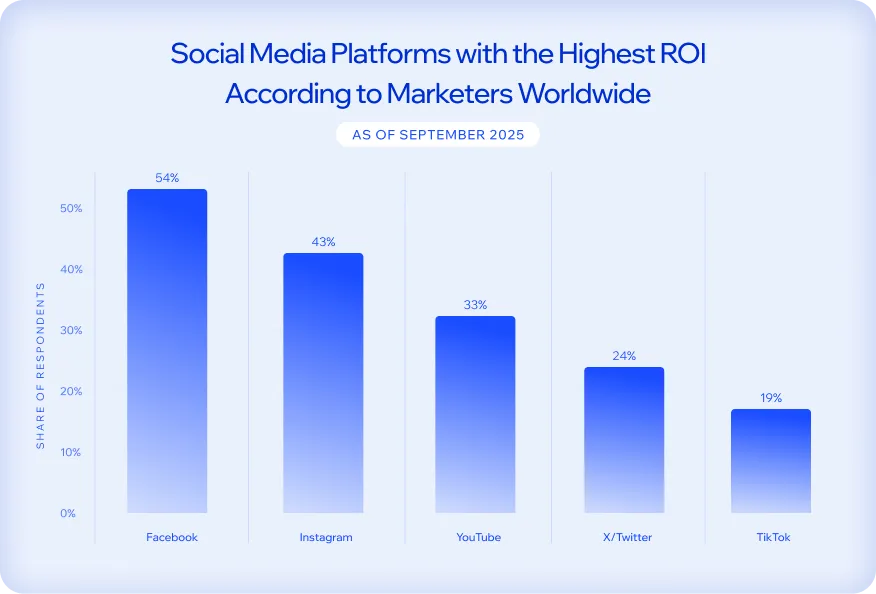
For years, social media has been among the most popular channels for advertisers. According to Statista, Facebook is the leading platform for marketing, followed by Instagram and LinkedIn.
Social media platforms offer scalable audience targeting, optimization tools, and a more or less predictable customer acquisition cost. However, factors like rising CPMs and stricter privacy regulations are making it difficult to achieve the necessary results with social campaigns alone. Therefore, many advertisers are considering allocating a part of their social spend to CTV ads for performance marketing.
Thanks to the programmatic technology, CTV has evolved into a full-scale advertising environment. With household-level targeting, improved attribution capabilities, and growing premium inventory, it is becoming an attractive alternative for advertisers focused on measurable ROI.
Is CTV better than Facebook ads for ROI? Obviously, not always. CTV can deliver greater results than Facebook or any other social media platform, but the right choice depends on campaign objectives, audience behavior, and measurement capabilities. In this article, we will:
Compare CTV and social media advertising.
Examine where CTV can deliver stronger returns.
Explain how modern household targeting and measurement make those results possible.
Clarify how Attekmi‑powered CTV marketplace / white‑label exchange can make this channel more profitable for publishers.
Keep reading to learn more.
CTV vs OTT advertising explained (and where social fits)
Before comparing CTV advertising with social media campaigns, let’s explore the two terms that are often used interchangeably: OTT and CTV. While they are closely related, they refer to different parts of the streaming ecosystem, and understanding this difference is important.
CTV vs OTT: the basic definitions
OTT (Over-the-Top) refers to streaming content delivered over the Internet instead of through traditional television infrastructure. Users access such content through apps and platforms on a wide range of devices, including smartphones, tablets, laptops, desktops, gaming consoles, and connected TVs.
In turn, CTV (Connected TV) refers specifically to the device or screen used to watch streaming content. This includes smart TVs, devices like Roku, etc. When viewers watch an OTT service on one of these devices, they are consuming OTT content through a CTV environment.
In other words, CTV is a subset of the broader OTT ecosystem. Every CTV ad is an OTT ad, but not every OTT ad is shown on a television screen. Some OTT campaigns may reach users on mobile devices or desktops, while CTV campaigns focus specifically on the household viewing context.
How CTV and social work differently as ad channels
CTV and social media platforms are two completely different advertising environments.
Thus, CTV ads typically appear before, during, or after streaming content, occupy the entire screen, and are often non-skippable or only partially skippable. Since viewers are usually watching video content in a relaxing atmosphere, such ads tend to receive higher levels of attention. Besides, in many households, multiple people watch together, allowing a single impression to influence more than one viewer.
Social media ads are delivered within feeds, Stories, Reels, or short-form video streams where users continuously decide whether to engage or move on. Creative assets must capture attention within seconds, while platform algorithms determine when, where, and how frequently ads are shown. Social campaigns also benefit from immediate engagement opportunities through clicks, likes, comments, shares, and in-app conversions.
Comparing CTV and social media based on CPM cannot really provide an accurate picture of value. ROI depends on several factors, including how much attention an ad receives, how precisely audiences are targeted, whether the creative matches the viewing environment, and how effectively conversions can be measured. Understanding these variables is essential for determining which channel is likely to deliver stronger results for a particular campaign. However, both CTV and social media ad spend keep growing. Ad spending in the social media advertising market worldwide is expected to surpass $338 billion in 2026. In turn, global CTV ad spending is projected to exceed $38 billion by 2027.
Is CTV better than Facebook ads for ROI? It depends on how you use it
Now let’s dive deeper into CTV vs social media ads ROI. Rather than treating CTV and social media as competitors, advertisers should understand the unique strengths and limitations of each and evaluate how well they align with their specific business goals.
Strengths and weaknesses of social media ads for ROI
First of all, let’s explore the advantages of social media marketing:
Advanced algorithms continuously optimize campaigns toward conversions, helping marketers reach users who are most likely to complete a desired action.
Features such as lookalike audiences, dynamic creative optimization, and automated bidding make it relatively easy to scale campaigns while maintaining efficiency.
Social ads are clickable, allowing users to move from impression to purchase, sign-up, or app install within seconds. This makes metrics such as CPC, CPA, and ROAS straightforward to track, while campaigns can be adjusted almost instantly based on performance data.
Combined with the massive user bases of platforms like Facebook and Instagram, social media offers exceptional reach and flexibility. 57% of consumers discover new brands on social media platforms.
According to Statista, Facebook remains the leading platform in terms of ROI:
Source: Statista
As for the key challenges, they are as follows:
As more and more businesses compete in the same auctions, CPMs are increasing, as well as customer acquisition costs.
Privacy changes (like, for instance, tracking limitations) have reduced attribution accuracy, making it harder to understand which campaigns truly drive conversions.
Social media is an increasingly crowded advertising environment. Users scroll through content rapidly, and dozens of sponsored posts can be delivered within a single session.
Ad fatigue can develop quickly, requiring advertisers to refresh creative assets regularly while competing for attention in an environment designed for continuous scrolling.
CTV’s ROI potential across the funnel
CTV has traditionally been associated with upper-funnel objectives such as brand awareness, but its role has expanded significantly.
Upper and mid-funnel:
Ads appear in premium streaming environments on large screens, where viewers are generally more engaged than they are while scrolling through social feeds.
The full-screen viewing experience, combined with longer-form creative opportunities, often results in stronger message retention and brand recall.
CTV campaigns often generate higher brand awareness and recognition than social media placements. For instance, CTV ads drive a 20% higher brand recall than mobile video advertisements.
Lower funnel:
Modern CTV attribution and incrementality solutions allow advertisers to connect TV ad exposure with subsequent actions across mobile devices, desktops, etc.
Instead of measuring only reach and impressions, advertisers can now evaluate CTV campaigns using metrics such as return on ad spend (ROAS), cost per completed view (CPCV), view-through conversions, incremental conversions, and brand lift.
Campaigns can be optimized toward measurable business outcomes, including online purchases, subscription sign-ups, and app installs.
Instead of focusing on immediate clicks, advertisers can assess how CTV influences the entire customer journey – from initial awareness to conversion. When effective storytelling is combined with precise household targeting, frequency management, and reliable attribution, CTV can match or even exceed social media ROI.
When CTV tends to beat social on ROI
CTV advertising is not a universally effective tactic. However, in certain scenarios, it can be the best choice. Here are several examples:
Brands selling products or services with a high average order value or a longer decision-making process. Industries such as financial services, automotive, travel, and premium e-commerce often benefit from CTV's ability to build trust and explain more complex value propositions before customers make purchasing decisions.
Campaigns that are designed around cross-device customer journeys. A viewer may first encounter a brand on their TV, then later search for it on their smartphone or complete a purchase on a laptop. Modern attribution technology helps advertisers connect these touchpoints, allowing them to understand how television exposure contributes to conversions.
When advertisers can leverage household-level audience data alongside robust measurement frameworks. Instead of simply maximizing impressions, marketers can identify which households are most valuable, control exposure frequency, and measure business outcomes with much greater precision.
Keep in mind that there are two “sides” of CTV advertising. While marketers plan and launch campaigns to deliver engaging experiences to their audiences via large screens, publishers monetize their inventory. Thanks to programmatic technology, the process is partially automated – auctions are completed within milliseconds, which streamlines monetization efforts.
How to target households on CTV
While social platforms typically build profiles around individual users, CTV focuses primarily on the household – the shared viewing environment where multiple people may see the same advertisement.
Household-level targeting basics
Household identification is typically based on signals such as IP addresses, household or device IDs, platform identifiers, and first-party audience data. Together, these identifiers help determine which devices belong to the same household without relying on personally identifiable information.
Advertisers can then build campaigns using a variety of targeting methods, including:
Geographic targeting: Ranging from countries and regions to cities, ZIP/postal codes, or designated market areas.
Demographic targeting: Where such data is available (e.g., through a platform).
Contextual targeting: Based on the type of content being streamed, such as sports, news, lifestyle, entertainment, or specific genres that align with campaign objectives.
First-party audience targeting: Using, for instance, customer data from loyalty programs to reconnect with known audiences.
Third-party audience segments: Where available, they allow advertisers to reach households with particular interests, purchasing behaviors, or lifestyle characteristics.
Keep in mind that household targeting must comply with regulations such as GDPR and CCPA, as well as the policies of platforms. As privacy standards continue to evolve, many advertisers prioritize privacy-friendly approaches, such as contextual targeting.
Practical household targeting strategies
Effective CTV campaigns combine audience intelligence with thoughtful campaign management.
One common strategy is activating first-party customer data. Brands can segment high-value customers based on purchase history, subscription status, or loyalty program participation, then use clean rooms or trusted data partners to match those audience segments with relevant CTV households. This allows advertisers to reach existing customers with retention campaigns or find similar households for acquisition efforts.
Contextual targeting is another popular tactic. Advertisers can place campaigns alongside content categories that align with consumer intent. For example, a financial services provider may focus on business or news content. Matching creative to relevant viewing contexts can improve engagement without requiring extensive personal data.
Frequency management is important as well. CTV advertisements are viewed on a shared screen, and repeated exposure can reinforce brand messaging. However, delivering the same ads too often may reduce effectiveness and waste advertising spend. Many advertisers apply household-level frequency caps (often four to seven exposures per household across a campaign), although the optimal frequency depends on campaign goals, creative quality, audience size, and purchase cycle.
Note that while marketers benefit from CTV advertising capabilities, media owners gain inventory monetization opportunities. Launching a white-label AdTech solution (like the one offered by Attekmi) instead of relying on a third-party platform can be a way to drive income with maximum effectiveness.
Recommended tools and methods for measuring CTV ROI
Relying only on media delivery metrics (like impressions) is not enough anymore. To evaluate the campaign performance effectively, advertisers should select metrics and measurement methods that align with their business objectives.
Core CTV metrics to track
Measuring the effectiveness of CTV campaigns requires an all-encompassing approach:
Delivery metrics: Advertisers should track impressions, frequency, CPM, video completion rate, and cost per completed view (CPCV) to evaluate how efficiently campaigns are reaching their audiences.
Reach metrics: Instead of measuring only the total number of impressions served, advertisers should distinguish between unique households reached and duplicated reach.
Outcome-based metrics: View-through conversions, incremental reach, incremental lift, and return on ad spend (ROAS) provide a more complete understanding of campaign effectiveness.
However, different stakeholders require different reporting perspectives. For instance, marketing teams typically need visibility into audience reach, frequency, customer journeys, and attribution. In turn, finance leaders are primarily interested in business outcomes. Effective CTV reporting should meet the needs of all audiences.
Attribution and measurement tools
As for recommended tools for measuring CTV ROI, several types of solutions are often required:
CTV attribution platforms help connect television ad exposure with downstream actions such as app installs, account registrations, e-commerce purchases, and subscription conversions across multiple devices.
Programmatic solutions (like demand-side platforms) offer reporting capabilities that often go beyond delivery metrics. Campaigns can be monitored in nearly real time.
Note that publishers also need to monitor the performance to identify both opportunities and weaknesses, as well as to prove the value of their inventory for advertisers. Having your own AdTech solution can simplify this process. For instance, a white-label platform from Attekmi offers advanced analytics and reporting capabilities. Besides, you can request custom functionalities, so that the solution will be tailored to your needs in full.
How to “report like a CFO” on CTV ROI
Coming back to reporting tactics and methods for advertisers, the most effective reports begin with business outcomes: revenue generated, new customers acquired, subscriptions, app installs, qualified leads, etc. ROAS and customer acquisition cost can be the next results to show.
Then, frequency, reach, completion rates, audience composition, and creative performance can provide additional valuable context. It is also important to move beyond last-touch attribution wherever possible. Comparing campaign performance against a baseline helps demonstrate the true incremental value created by CTV advertising.
Finally, robust CTV reporting should rely on multiple sources, including platform analytics, pixel-based conversion tracking, cross-device attribution, brand lift surveys, etc.
How businesses use Attekmi‑powered CTV to scale profits
For programmatic media buying, advertisers use demand-side platforms. In turn, publishers leverage supply-side solutions for inventory monetization. However, third-party systems often imply limited control, the lack of visibility into demand, etc. That is why more and more media owners prefer to sell their CTV inventory via white-label AdTech systems.
From selling CTV via other platforms to running an Attekmi-powered marketplace lane
With an Attekmi-powered solution, you can bypass the limitations of development from scratch and launch your system in the shortest amount of time. If we summarize the key benefits, they are as follows:
You are in full control of everything.
The platform is completely customizable. Apart from UI personalization, it implies custom on-request feature development – this way, the platform is fully tailored to your requirements
The solution supports not only CTV but also desktop, mobile web, and in-app environments, which provides you with ultimate flexibility.
Advanced targeting and filtering settings allow you to connect with the most relevant supply.
Sophisticated fraud detection and prevention mechanisms help you ensure brand safety.
Comprehensive analytics and reporting for effective optimization.
Scalable infrastructure enables smooth business growth.
No hidden fees involved.
Compliance with regulations like GDPR, COPPA, etc.
Proactive customer support to assist you with strategy adjustments.
Example scenarios
We have already explored the use cases for advertisers. Now, let’s dive deeper into potential scenarios for media owners. Here are several examples:
Increasing auction competition: A publisher connects with multiple DSPs through an AdTech solution, creating more competition for each impression and improving yield.
Protecting brand safety: The publisher approves which advertisers and creative categories can access the inventory, reducing the risk of unsuitable ads appearing alongside premium content.
Reducing operational complexity: Rather than managing separate integrations for every demand partner, the publisher centralizes monetization through a single white-label platform.
Expanding internationally: A regional streaming service opens its inventory to global demand partners while maintaining local pricing rules and advertiser controls.
How to test CTV vs social ROI in your own business
Advertisers trying to choose between CTV and social media ads should prioritize a data-driven approach. The only reliable way to determine whether CTV or social media delivers better ROI is to test both channels under comparable conditions.
Design a fair test
Step 1: Defining clear KPIs. Depending on campaign objectives, these may include return on ad spend (ROAS), cost per acquisition (CPA) or cost per registration (CPR), incremental lift, customer acquisition cost, etc.
Step 2: Creating a testing environment. Allocate comparable budgets to CTV and social campaigns targeting similar audience segments with the same offer, messaging, and campaign duration.
Step 3: Measurement. Whenever possible, use the same attribution methodology, conversion definitions, and attribution windows across both campaigns.
Optimize, then compare
One of the most common mistakes is comparing channels before they have been properly optimized. A CTV campaign launched with broad targeting or excessive frequency should not be expected to outperform a mature social campaign that has benefited from weeks of algorithmic learning – and the opposite is also true.
Instead, advertisers should allow each channel to go through multiple optimization cycles. This includes refining creative assets, adjusting audience targeting, optimizing household frequency, and continuously reviewing attribution data to improve campaign efficiency. Comparing fully optimized campaigns produces far more meaningful insights than evaluating initial performance alone.
Once both channels have been optimized over several campaign cycles, compare not only their direct ROI but also their incremental contribution to business growth. In many cases, the strongest results come from combining CTV and social media rather than treating them as competing channels.
Conclusion
There is no universal answer to whether CTV is better than Facebook or other social media platforms for ROI. The right channel depends on advertising objectives, target audience, creative strategy, and the ability to measure results accurately.
Rather than choosing one channel over the other, advertisers should focus on understanding the strengths of each and building a complementary strategy. CTV can create awareness and strengthen brand recall, while social media can capture the demand and convert it efficiently. When supported by consistent measurement and continuous optimization, the combination of both channels often delivers stronger and more sustainable ROI than either could achieve alone.
In turn, CTV media owners should consider using white-label technology for effective inventory monetization. With advanced control over the processes, they can achieve stable income growth.
Ready to launch your own AdTech solution? Just contact Attekmi.
FAQ
No. The channel that delivers the best ROI depends on factors such as campaign objectives, target audience, creative strategy, and measurement capabilities. While CTV can help with driving awareness and incremental reach, social media remains highly effective for direct-response campaigns and lower-funnel conversions.
Run time-boxed campaigns with comparable budgets, audiences, and offers, while using consistent attribution windows and success metrics such as ROAS, CPA, and incremental lift. It is also important to optimize both channels before comparing results, as early performance rarely reflects their full potential.
CTV campaigns typically target households using privacy-conscious identifiers such as household IDs, device IDs, platform identifiers, and contextual signals. Advertisers should also comply with regulations like GDPR and CCPA by relying on consented first-party data, contextual targeting, and approved audience segments where applicable. Using a privacy-compliant AdTech solution (like platforms offered by Attekmi) can be helpful as well.
Most advertisers use a combination of CTV measurement tools and metrics: attribution platforms, DSP reporting, and independent measurement solutions to evaluate CTV performance. Together, these tools can measure ROAS, view-through conversions, incremental lift, household reach, frequency, brand lift, cross-device conversions, etc.
An Attekmi-powered CTV exchange gives media owners greater control over inventory, auction dynamics, and reporting. The solution’s advanced analytics capabilities enable more accurate measurement and better optimization.


'%3e%3cpath%20d='M415.5%20380.133C415.5%20554.655%20911.5%20609.133%20714%20818.633C447%20850.133%20200%20677.655%20200%20503.133C200%20328.611%20341.478%20187.133%20516%20187.133C690.522%20187.133%20415.5%20205.611%20415.5%20380.133Z'%20fill='%231A4CFF'/%3e%3c/g%3e%3cg%20filter='url(%23filter1_f_654_7533)'%3e%3cpath%20d='M819.862%20539.146C969.42%20389.588%20963.912%20273.412%201000.6%20310.096C1037.28%20346.78%201059.92%20590.588%20910.362%20740.146C760.804%20889.704%20503.861%20847.646%20447.362%20760.146C348.862%20547.146%20670.304%20688.704%20819.862%20539.146Z'%20fill='%23052AAE'/%3e%3c/g%3e%3cg%20filter='url(%23filter2_f_654_7533)'%3e%3cpath%20d='M647.331%20285.725C443.031%20230.983%20408.998%20311.131%20358.6%20243.729C295.498%20194.631%20571.852%2052.1078%20776.152%20106.85C980.452%20161.592%201072.5%20405.139%201024.97%20497.82C889.759%20689.623%20851.631%20340.467%20647.331%20285.725Z'%20fill='%231B4DFF'/%3e%3c/g%3e%3c/g%3e%3cdefs%3e%3cfilter%20id='filter0_f_654_7533'%20x='0'%20y='-12.8672'%20width='960.465'%20height='1035.25'%20filterUnits='userSpaceOnUse'%20color-interpolation-filters='sRGB'%3e%3cfeFlood%20flood-opacity='0'%20result='BackgroundImageFix'/%3e%3cfeBlend%20mode='normal'%20in='SourceGraphic'%20in2='BackgroundImageFix'%20result='shape'/%3e%3cfeGaussianBlur%20stdDeviation='100'%20result='effect1_foregroundBlur_654_7533'/%3e%3c/filter%3e%3cfilter%20id='filter1_f_654_7533'%20x='228.938'%20y='103.27'%20width='998.816'%20height='935.965'%20filterUnits='userSpaceOnUse'%20color-interpolation-filters='sRGB'%3e%3cfeFlood%20flood-opacity='0'%20result='BackgroundImageFix'/%3e%3cfeBlend%20mode='normal'%20in='SourceGraphic'%20in2='BackgroundImageFix'%20result='shape'/%3e%3cfeGaussianBlur%20stdDeviation='100'%20result='effect1_foregroundBlur_654_7533'/%3e%3c/filter%3e%3cfilter%20id='filter2_f_654_7533'%20x='149.441'%20y='-105.473'%20width='1087.81'%20height='860.301'%20filterUnits='userSpaceOnUse'%20color-interpolation-filters='sRGB'%3e%3cfeFlood%20flood-opacity='0'%20result='BackgroundImageFix'/%3e%3cfeBlend%20mode='normal'%20in='SourceGraphic'%20in2='BackgroundImageFix'%20result='shape'/%3e%3cfeGaussianBlur%20stdDeviation='100'%20result='effect1_foregroundBlur_654_7533'/%3e%3c/filter%3e%3c/defs%3e%3c/svg%3e)