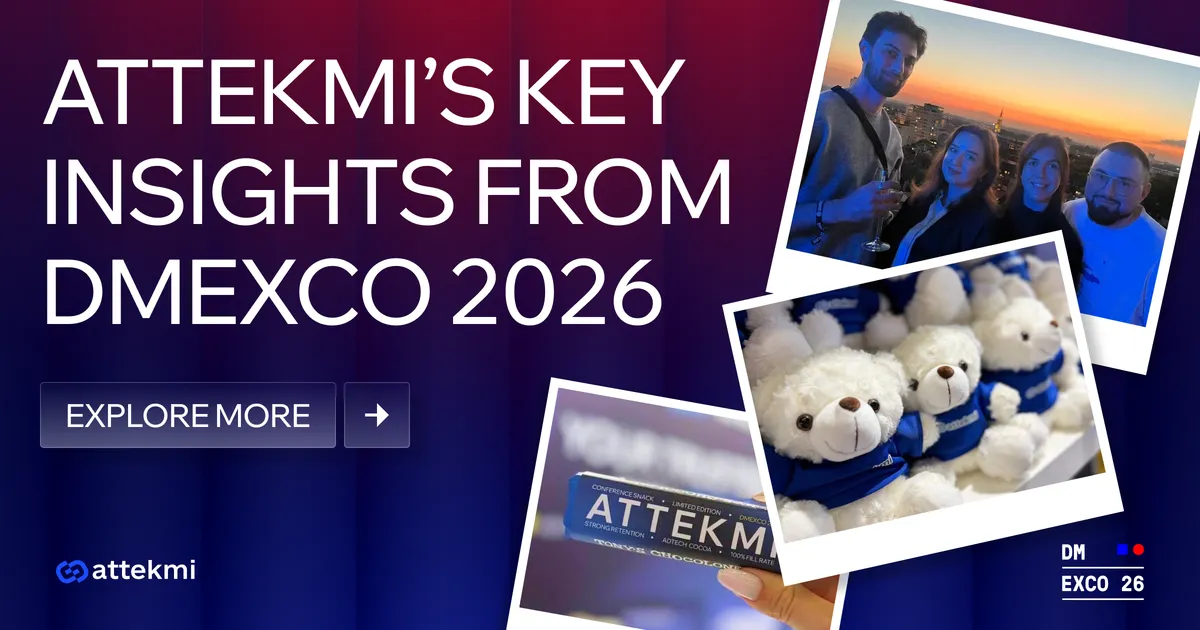
DMEXCO 2026 was very productive for the Attekmi team. We had loads of insightful conversations and are now ready to share the key insights with you. AI was the most popular topic, but other trends were widely discussed as well: privacy compliance, transparency, CTV advertising, and many others.
DMEXCO 2026 was a blast! These were two very productive days, full of AdTech conversations and fun. Now, our team is back home (tired, but very happy), so we are ready to share some insights with you. The best way to discover what is going on in the industry is to talk to other AdTech experts, so read on to discover what ideas we got after having so many conversations during the event.
AI keeps conquering the AdTech industry
At DMEXCO 2026, AI was one of the hottest topics. We expected this – AI technology offers loads of opportunities and impacts multiple industry aspects. AI-driven media buying, targeting, optimization, and personalization – these are just some of the applications. Moreover, AI is turning from a standalone functionality into an entire intelligence layer within the advertising ecosystem.
For programmatic advertisers and media owners, the main idea is pretty simple. Adopting AI functionalities becomes a must, as when done correctly, this is a way to gain a competitive edge. You only have to keep an eye on AI, as its effective performance still requires human oversight.
However, for AdTech providers, things are a bit more complicated. Adding some AI capabilities and then saying that the platform is “AI-powered” is a pretty popular tactic nowadays. The problem is that equipping an AdTech solution with AI just because everyone around is talking about it often implies little value.
To remain competitive, you need to understand which of your customers’ problems AI can really solve. That is exactly the approach we follow at Attekmi. We regularly collect feedback from our partners to identify and prioritize product enhancements that should be implemented next. For instance, AI can identify patterns in supply and demand, detect unusual traffic, predict revenue trends, optimize floor strategies, and so on. However, there is no need for you to develop all of these functionalities at once. Learn more about your clients’ pain points, and then help them address these issues with the right capabilities. This way, your platform will be more than “AI-powered”. It will offer greater business value and enable your customers to achieve their goals with higher efficiency.
Efficiency becomes as important as scale
For programmatic players, business growth is often associated with adding more partners, integrations, impressions, technology layers, and so on. Fortunately, this is steadily changing, as the approach we described does not always lead to the expected results – now the industry is increasingly focusing on efficiency and measurable value.
Most importantly, efficiency should be ensured at multiple levels. For instance, for publishers, this may include identifying the most effective demand partners, reducing duplicated demand, optimizing latency, adjusting floors based on real performance, and so on. It is important to remember that scale and efficiency are not opposites. You can still grow your business, but this growth should be controlled. For example, as a publisher, you may build more demand connections, but it is essential to make sure that every new connection brings enough value to justify the growing complexity of your ecosystem.
The next stage of programmatic growth will not be based on simply adding more components. Instead, we expect it to be about making the existing environment work better.
Transparency and control are turning into competitive advantages
The programmatic ecosystem is extremely complex, and the problem is that this complexity keeps increasing. However, nowadays advertisers and publishers are prioritizing supply-chain efficiency, trust, and accountability. They aim to know who participates in transactions, how decisions are made, etc.
Controlling transparency is a way to gain a competitive edge. For instance, if a publisher controls which demand sources access inventory, how auctions are configured, and what data is available in reporting, they have much more visibility into the monetization process. As a result, they can make more informed decisions. By the way, this is one of the reasons why more and more media owners switch to white-label infrastructure – it enables them to gain greater control over monetization operations.
If we sum up here, everything is pretty straightforward. Whether you are a publisher, an advertiser, or an AdTech provider, being transparent and understanding what is going on within your ecosystem is a way to remain competitive and build trusted relationships with your clients or partners.
Programmatic is becoming more selective
Programmatic open auctions are definitely not going anywhere, but as we already mentioned, efficiency becomes as important as scale. Market participants are increasingly prioritizing quality over quantity. For instance, a limited number of high-performing advertisers can bring much better results to a publisher than a wide pool of media buyers of different quality.
As a media owner, you should not aim for more demand. What you really need is more relevant demand. Transparency and supply-path optimization can help you achieve this, but there is one more thing that you can (and should) try. Be more selective about where your inventory goes and which demand can access it.
What does this mean? Avoid relying solely on open auctions – combine OpenRTB with direct deals, private marketplace deals, and other approaches. For example, PMPs can help you create more controlled relationships with buyers. Programmatic guaranteed can be used for predictable transactions. Preferred deals can give selected buyers priority access to specific inventory. Finally, open auctions can help you monetize remnant ad space by providing you with broader demand access.
The main idea here is that combining several programmatic approaches can help you monetize more effectively. By the way, we have recently added the PMP Deals functionality to our Attekmi Enterprise solution.
CTV continues to reshape programmatic advertising
CTV advertising (and monetization) keeps gaining traction as it brings together characteristics of traditional television and digital marketing. Programmatic technology makes this possible; however, CTV requires infrastructure that can handle more than standard display advertising.
CTV monetization introduces different requirements around VAST and video delivery, frequency management, inventory quality, measurement and reporting, etc. For media owners, that means that CTV requires more specialized monetization logic than, for instance, traditional web or in-app inventory.
Even though the CTV ecosystem is pretty fragmented at the moment, the growing popularity of this advertising approach unlocks benefits for both marketers and publishers. Experimenting with CTV advertising or monetization can help you diversify your strategy and gain an additional competitive advantage. For AdTech providers, this also implies the need to equip their solutions with CTV advertising capabilities – for them, this is also a way to remain competitive and meet the changing needs of their clients.
Privacy compliance remains a challenge
Privacy-first targeting, cookieless advertising, new identity solutions, and privacy-compliant data processing – these and other topics have been widely discussed since Google announced its cookie deprecation plans. Nowadays, privacy is more than just a legal question. It increasingly affects product architecture, data flows, targeting methods, consent management, measurement, and integrations.
AdTech vendors need to understand that privacy compliance has to be built into the infrastructure rather than added at the end. This means considering data collection and storage, regional requirements, consent signals, contextual targeting, identity solutions, etc.
Both advertisers and publishers are increasingly focusing on privacy compliance and privacy-friendly operations. Helping them achieve these goals is a way to build trust and maintain a competitive edge. Therefore, we expect more AdTech providers to treat privacy as an architectural requirement, not just a nice-to-have feature.
The publisher’s role in the AdTech is changing
Many topics discussed at DMEXCO 2026 (efficiency, transparency, supply path optimization, and others) ultimately raised the same question: how much control should publishers have over their monetization infrastructure?
More and more media owners are becoming the true AdTech industry participants instead of being users of third-party monetization platforms – this means the increasing demand for white-label solutions. Such platforms are pre-built but customizable, so there is no need to build every component from scratch. This way, you can enter the market quickly and still offer a branded solution to your partners or clients.
Note that the AdTech market offers an entire range of white-label platforms: SSPs, ad exchanges, and so on. However, the right choice depends on what you actually aim to control. This can be, for instance, demand relationships, auction rules, reporting, etc.
At the same time, this trend does not mean that every media owner needs a white-label solution. For example, if you are only entering programmatic monetization, an external tool is more than enough. Over time, as you understand how everything works and what your next objectives are, you may want to consider white-label technology.
Final words
Keeping an eye on AdTech trends is a must to remain competitive, but you should not follow all of them blindly (even though some of them, like privacy compliance, are critical). Focus on those that align with your current needs and strategy. For instance, adding CTV monetization is not the best tactic if the rest of your setup does not work properly yet.
Thanks to everyone who joined us at DMEXCO 2026! Those were two awesome days, and we are already looking forward to coming back. See you next year in Cologne!
Searching for a fully customizable white-label monetization solution? Contact Attekmi.


'%3e%3cpath%20d='M415.5%20380.133C415.5%20554.655%20911.5%20609.133%20714%20818.633C447%20850.133%20200%20677.655%20200%20503.133C200%20328.611%20341.478%20187.133%20516%20187.133C690.522%20187.133%20415.5%20205.611%20415.5%20380.133Z'%20fill='%231A4CFF'/%3e%3c/g%3e%3cg%20filter='url(%23filter1_f_654_7533)'%3e%3cpath%20d='M819.862%20539.146C969.42%20389.588%20963.912%20273.412%201000.6%20310.096C1037.28%20346.78%201059.92%20590.588%20910.362%20740.146C760.804%20889.704%20503.861%20847.646%20447.362%20760.146C348.862%20547.146%20670.304%20688.704%20819.862%20539.146Z'%20fill='%23052AAE'/%3e%3c/g%3e%3cg%20filter='url(%23filter2_f_654_7533)'%3e%3cpath%20d='M647.331%20285.725C443.031%20230.983%20408.998%20311.131%20358.6%20243.729C295.498%20194.631%20571.852%2052.1078%20776.152%20106.85C980.452%20161.592%201072.5%20405.139%201024.97%20497.82C889.759%20689.623%20851.631%20340.467%20647.331%20285.725Z'%20fill='%231B4DFF'/%3e%3c/g%3e%3c/g%3e%3cdefs%3e%3cfilter%20id='filter0_f_654_7533'%20x='0'%20y='-12.8672'%20width='960.465'%20height='1035.25'%20filterUnits='userSpaceOnUse'%20color-interpolation-filters='sRGB'%3e%3cfeFlood%20flood-opacity='0'%20result='BackgroundImageFix'/%3e%3cfeBlend%20mode='normal'%20in='SourceGraphic'%20in2='BackgroundImageFix'%20result='shape'/%3e%3cfeGaussianBlur%20stdDeviation='100'%20result='effect1_foregroundBlur_654_7533'/%3e%3c/filter%3e%3cfilter%20id='filter1_f_654_7533'%20x='228.938'%20y='103.27'%20width='998.816'%20height='935.965'%20filterUnits='userSpaceOnUse'%20color-interpolation-filters='sRGB'%3e%3cfeFlood%20flood-opacity='0'%20result='BackgroundImageFix'/%3e%3cfeBlend%20mode='normal'%20in='SourceGraphic'%20in2='BackgroundImageFix'%20result='shape'/%3e%3cfeGaussianBlur%20stdDeviation='100'%20result='effect1_foregroundBlur_654_7533'/%3e%3c/filter%3e%3cfilter%20id='filter2_f_654_7533'%20x='149.441'%20y='-105.473'%20width='1087.81'%20height='860.301'%20filterUnits='userSpaceOnUse'%20color-interpolation-filters='sRGB'%3e%3cfeFlood%20flood-opacity='0'%20result='BackgroundImageFix'/%3e%3cfeBlend%20mode='normal'%20in='SourceGraphic'%20in2='BackgroundImageFix'%20result='shape'/%3e%3cfeGaussianBlur%20stdDeviation='100'%20result='effect1_foregroundBlur_654_7533'/%3e%3c/filter%3e%3c/defs%3e%3c/svg%3e)