Businesses are increasingly using CTV advertising on their own programmatic exchanges or SSPs to gain more control over monetization, data activation, auction transparency, and buyer relationships. By combining premium CTV inventory with first-party data, supply-path optimization, and strong measurement capabilities, companies (like the ones partnering with Attekmi) monetize CTV space more effectively and build more sustainable long-term revenue strategies.
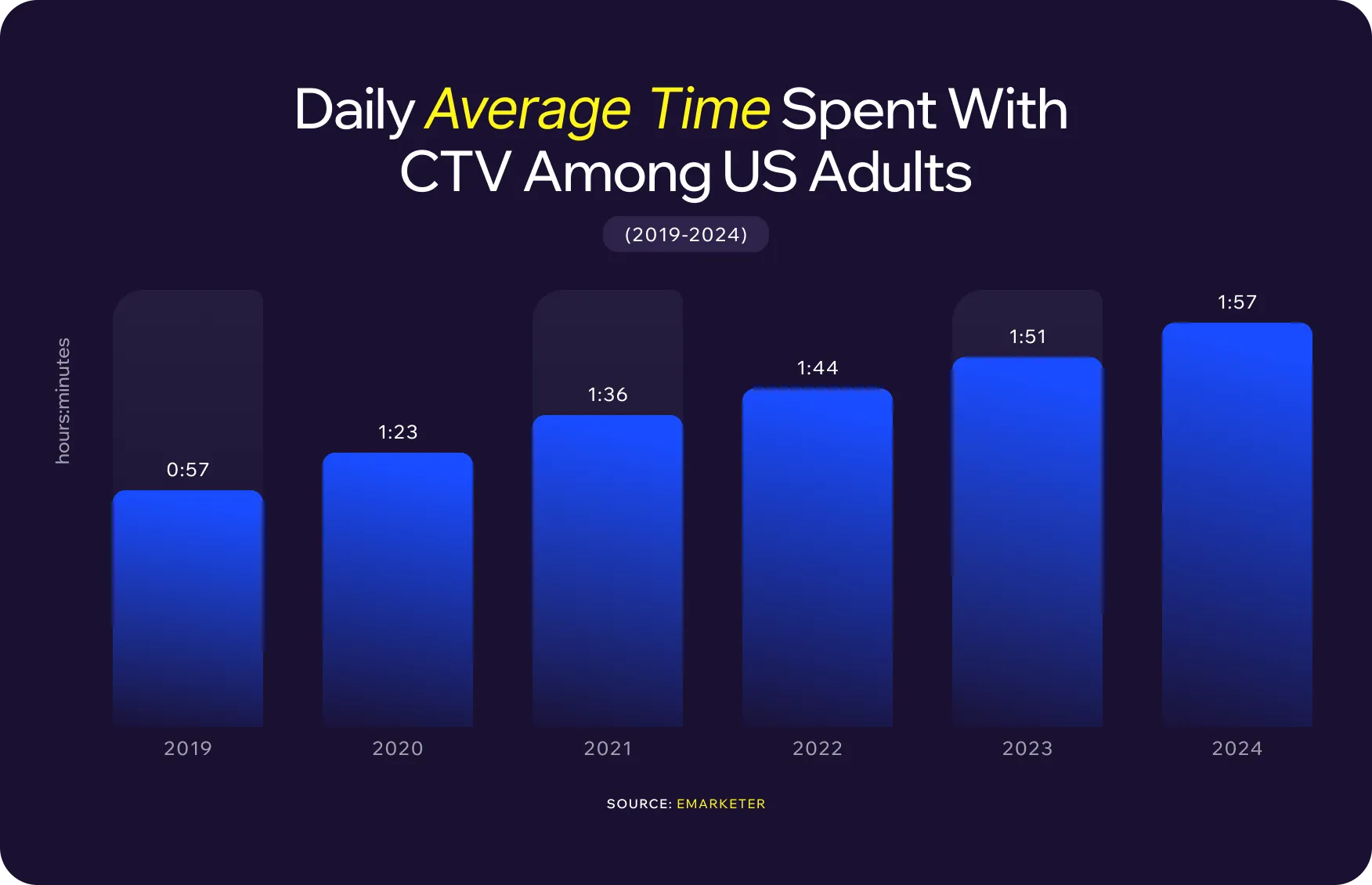
Investments in CTV advertising keep growing. In 2025, CTV ad spending in the USA reached over $33 billion. By 2029, this figure is forecasted to exceed $52 billion. The reason for this is obvious – CTV advertising enables brands to reach highly engaged audiences with much greater accuracy than in the case of traditional TV advertising. Besides, viewers tend to spend more and more time watching CTV content. While in 2019, it was around 1 hour, in 2026, the average time spent per day with CTV will increase to nearly 3 hours.
At the same time, the growing popularity of CTV advertising enables media owners to drive higher income. However, just selling ad space is not the only way to enhance monetization. How to do this and why consider CTV advertising in terms of increasing profit?
Attekmi has been building AdTech platforms with support for CTV since 2018, and, so far, has earned the trust of more than 250 partners. This guide was created on the basis of our experience, so read on to discover the answers.
Why CTV is a natural fit for effective monetization
First and foremost, let's find out why CTV is a great choice for maximizing income.
From awareness to sales lift
CTV combines TV‑level storytelling with digital‑level targeting, frequency control, and measurement. Unlike traditional TV, CTV enables brands to reach engaged viewers based on behavioral, contextual, geographic, and first-party data signals. This makes it possible to reach users who are more likely to convert while delivering premium, full-screen video experiences that drive attention and recall. For brands operating in highly competitive markets, that combination is especially valuable.
For instance, a food delivery app competing in a crowded market may use CTV to target households that frequently watch sports content in the evening hours, then retarget users with mobile offers immediately after exposure.
CTV is no longer limited to upper-funnel awareness campaigns. Modern programmatic infrastructure enables companies to connect storytelling with measurable business outcomes across the entire customer journey.
Common outcomes include the following:
Increased website traffic and online purchases
Higher app install volumes and app engagement
Larger basket sizes and higher average order values
Stronger customer retention and repeat purchases
For example, a subscription-based fitness platform may run CTV campaigns promoting workout content while simultaneously measuring app installs, trial subscriptions, and long-term subscriber retention.
Another fact worth mentioning is that the number of CTV users demonstrates steady growth. In 2022, the number of CTV households in the USA reached 111 million. By 2027, it is projected to surpass 120 million.
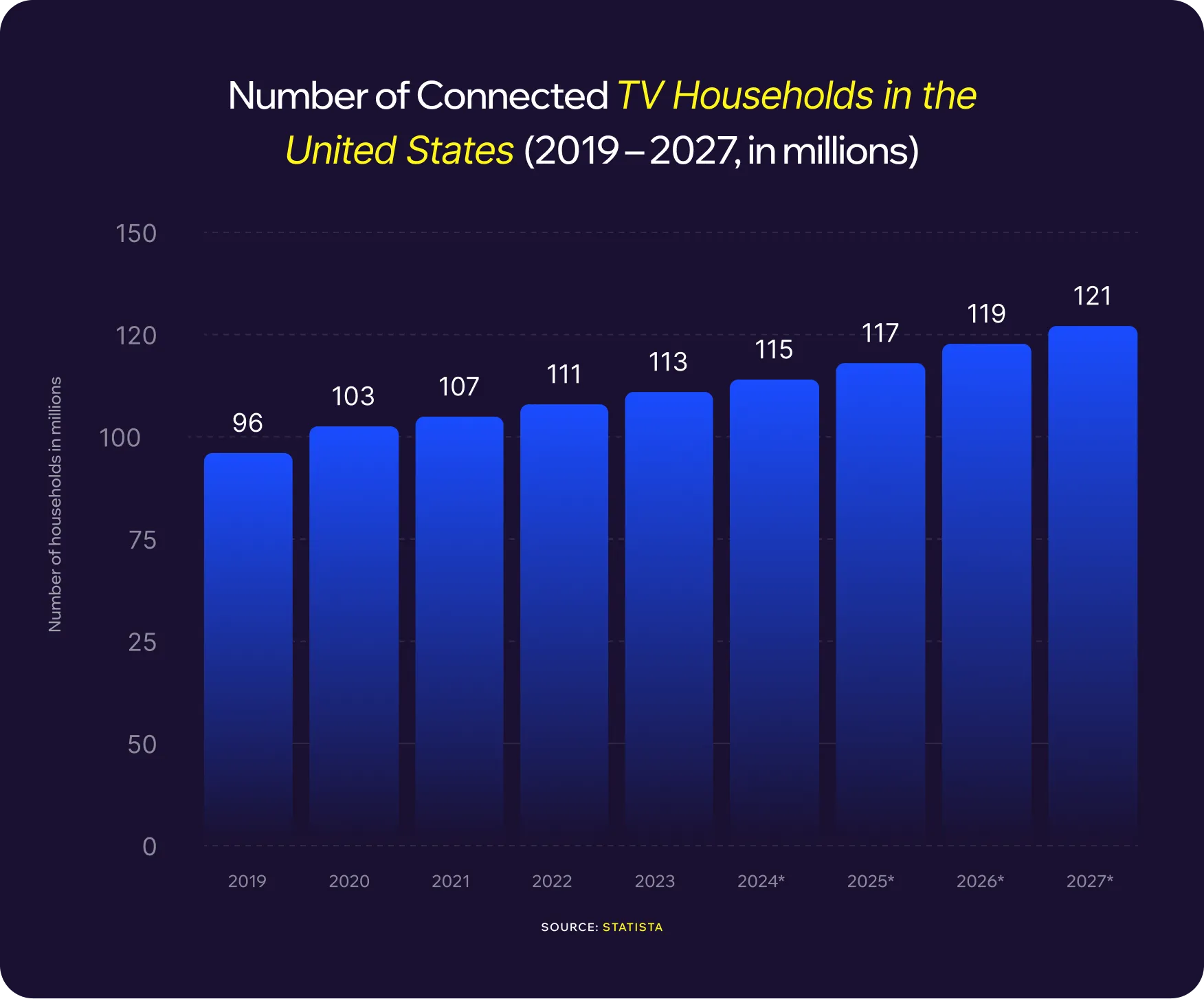
This explains why CTV ads are getting more and more popular among advertisers. In turn, media owners strive to meet the increasing demand, so the number of streaming platforms keeps growing as well. Thanks to programmatic technology, it is easy for publishers to monetize their inventory in a partially automated manner.
The missing piece: owning the programmatic pipe
To buy CTV ads programmatically, advertisers leverage demand-side platforms. As for publishers, they use supply-side solutions to monetize their ad space. But how do DSPs and SSPs connect with each other? This link is called an ad exchange, which is a digital marketplace connecting media buyers and sellers. By managing an ad exchange platform and helping the right CTV demand meet the right CTV supply, you can earn from media trading. Such a solution can also be used for more effective inventory monetization.
What it means to run CTV on your programmatic exchange
Now let’s dive a little bit deeper into technical (and not only) aspects.
From a standard user to a platform owner
When you use a third-party SSP, there is no way for you to impact the ad exchange processes. You can leverage only the SSP functionalities to monetize your ad space. However, when using your own programmatic exchange / white‑label ad exchange / custom SSP, you gain much greater control over the operations and, as a result, can optimize your CTV monetization efforts with greater efficiency. An opportunity to drive media trading income is another benefit to keep in mind.
Note that launching such a solution does not require development from scratch. Attekmi offers a white-label solution with CTV support, and it is fully customizable. Apart from UI personalization, you can count on custom on-request feature development, so that the platform will be tailored to all your needs.
How an ad exchange connects CTV supply and demand
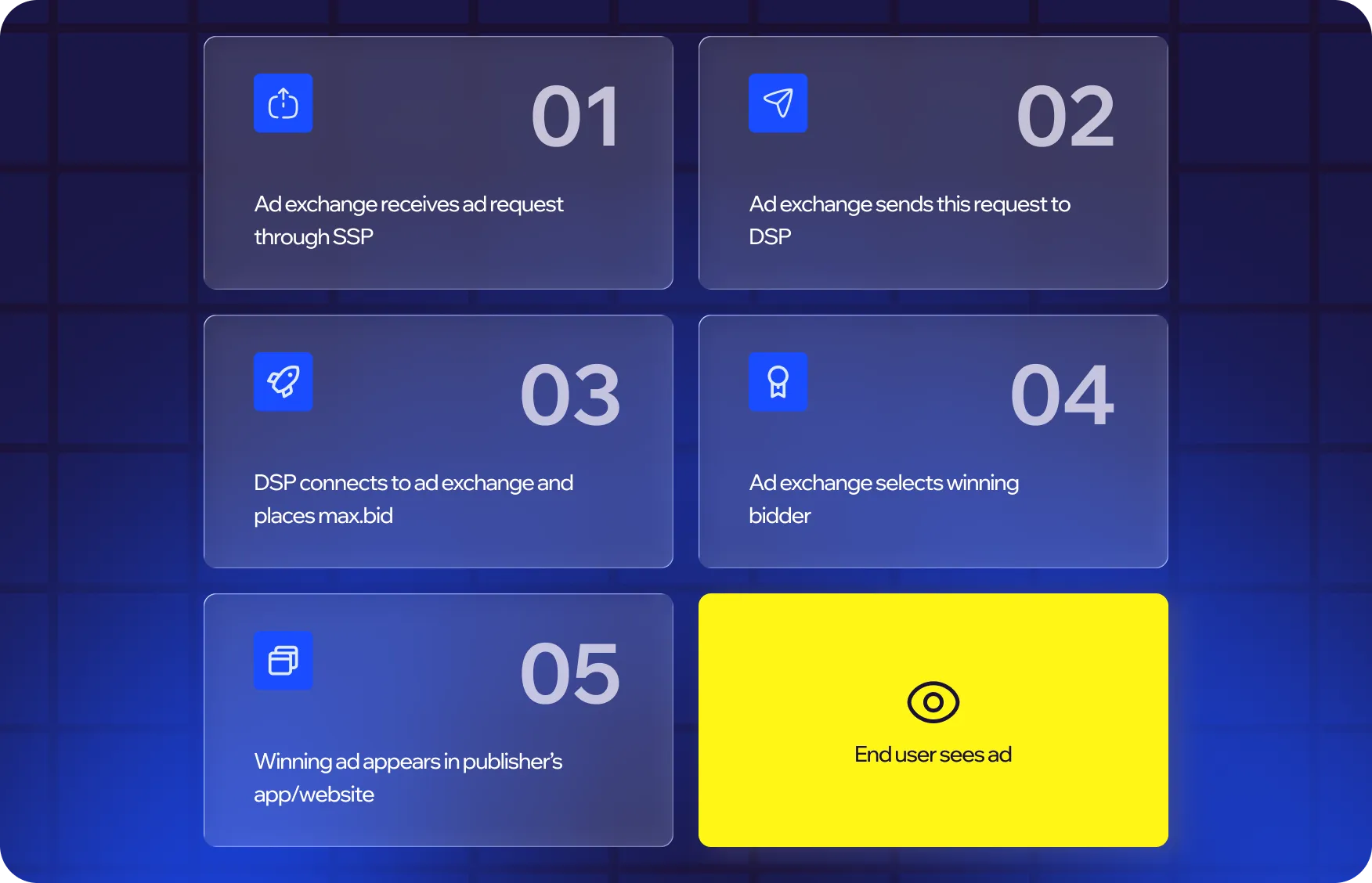
Ad exchanges operate on a real-time basis. The process described below may seem pretty time-consuming, but in reality, everything happens within milliseconds. Thanks to programmatic technology, when a CTV impression becomes available, a relevant ad is delivered to a user virtually immediately.
Benefits compared to the classic approach
Operating your own ad exchange offers an entire range of benefits in comparison with using a third-party SSP solution:
Much greater control over demand quality, which contributes to your brand safety. By operating your own exchange, you can approve specific DSPs, apply stricter creative review policies, and prioritize trusted advertisers that align with your audience and brand image. For instance, a premium streaming platform focused on family entertainment may block low-quality clickbait ads.
Higher visibility into the fee structure. After launching your own exchange, you gain direct visibility into bid flows, buyer activity, etc., making it easier to identify inefficiencies and optimize monetization. For instance, a large media company using multiple intermediaries through a third-party SSP may struggle to understand how much revenue is lost to hidden platform fees and resellers. Having a proprietary platform solves this problem.
Margin control enables you to stabilize your income and increase it gradually. For example, a FAST channel operator relying entirely on external SSPs may experience fluctuating revenue shares and limited pricing flexibility. By moving its inventory to a proprietary exchange setup, the company can reduce dependency on external fees, keep a larger share of media spend, and gradually improve margins as demand grows.
It becomes much easier to experiment with different types of deals, formats, frequency rules, etc. For instance, an e-commerce media network operating its own exchange can quickly test shoppable CTV formats, category-based sponsorships, and so on. Instead of waiting for the SSP-side feature releases, the company can adjust auction logic in real time based on campaign performance and other factors.
How you can use CTV ads to monetize more effectively
Since the demand for CTV ads is increasing, offering such inventory can help you drive higher income. Let’s imagine that you have already chosen a white-label ad exchange solution or a custom supply-side platform. What is next? Here are a few key steps to take.
Build a strong first-party data strategy
First‑party data and CTV are pretty inseparable nowadays. More and more of Attekmi’s partners are adopting the privacy-first approach, and the evolving privacy regulations prove the fact that using first-party data is turning into a must. Additionally, first-party data offers much more significant value than third-party cookies. Here is the data that you may need:
Logged-in user behavior
Viewing patterns
Subscription data
Contextual signals
Understanding your audience is a way to ensure differentiation and attract relevant demand.
Prioritize supply path optimization
SPO is not a new trend. In 2019, 87% of brands, agencies, and DSPs implemented it actively. Nowadays, SPO is even more important as the AdTech ecosystem has become more complex since that time.
Modern CTV media buyers (and not only CTV) prioritize more transparent inventory access. They want fewer intermediaries and lower fees, and you should meet these expectations to build trust and ensure stable income growth. Therefore, follow the SPO practices.
Measure and optimize continuously
Programmatic technology makes CTV monetization highly effective, but it is still crucial to keep an eye on the performance. This enables you to detect both opportunities and weaknesses and adjust your strategy on time. Otherwise, without strong reporting, even premium inventory can underperform.
Attekmi use cases – how clients combine CTV and their exchange
Attekmi’s solution supports CTV formats and environments, but this is not the only benefit to keep in mind. Take a look at the results achieved by some of our partners.
Marketplace growth with multi‑format traffic
For Mobupps, we built several individual features, including a custom adapter (for connecting endpoints with unique requirements) and a custom billing model (to standardize the billing mechanism). This way, the white-label platform was fully aligned with the needs of our partner.
As a result, Mobupps could automate programmatic inventory purchasing and selling while distributing CTV, mobile app, banner, and video traffic efficiently and transparently. The key outcomes include 207% revenue growth and 371% ROI.
Scaling profit and ROI with CTV‑ready marketplaces
Outstanding customer service has always been among our most prominent competitive advantages. With our proactive assistance, Toucan Ads, a company working with advertising and mobile app publishers (including CTV apps and online websites), managed to achieve 453% ROI and 682% revenue growth. It has also gradually scaled the platform and reached 60k QPS.
Fast deployment and multiple marketplaces
While building an AdTech solution from scratch can take years, a white-label platform from Attekmi can be launched much faster (and it will still meet all your requirements). Thus, StreamKey migrated to a new marketplace within a few weeks, achieved 1637% ROI, and doubled the revenue. In addition, the platform capacity grew from 10k to 20k QPS.
In turn, ExplorAds launched two marketplaces. For instance, one of them reached payback in one month and 487% ROI in four months.
Designing a CTV monetization‑lift strategy on your exchange
How to monetize CTV ads effectively? Here are the recommendations to consider.
Define monetization goals and KPIs
First and foremost, you need to define clear goals. For example, you may want to maximize CPMs, increase fill rate, improve advertiser retention, and so on. By prioritizing a specific objective, you will be able to select relevant KPIs: average CPM, fill rate, viewer completion rate, etc.
With goals and KPIs in mind, you will be able to focus on your long-term success instead of short-term revenue spikes.
Build the right CTV demand
Effective monetization depends not only on the demand volume – its quality is a more important factor. Therefore, you need to create an environment that would be attractive for trusted advertisers. Apart from building partnerships with credible DSPs and ensuring transparency, do not forget to keep your system secure. Ad fraud remains a challenge for the whole AdTech industry, and CTV is no exception. In the third quarter of 2024, 23% of traffic to CTV advertising (worldwide) was invalid.
To address this challenge and contribute to a safer global advertising ecosystem, Attekmi’s white-label solution supports the integration of a variety of traffic and demand scanners, including but not limited to Pixalate, Protected Media, and Forensiq.
Besides, there are loads of targeting and filtering settings to apply – if you help advertisers reach their audiences effectively, your monetization efforts will deliver better results.
Connect measurement and incrementality testing
To retain advertisers and secure higher ad spend, you need to prove the true value of your inventory. Apart from measuring the outcomes continuously, consider running incrementality tests. Obviously, incrementality testing is usually initiated by marketers, but for you, it can be helpful as well. Incrementality tests enable you to prove that your CTV inventory performs effectively, which helps build trust and increase CPMs over time.
Note that with a white-label monetization solution, measuring the results becomes a much easier task since you are in full control of everything and can access all the data you need.
When should a business consider running CTV on its own exchange?
Launching a CTV ad exchange or SSP provides greater control over monetization, data, and partnerships with media buyers. For some businesses, investing in such a solution can create a long-term strategic advantage. For others, managed monetization can still be the best choice.
Signs you’re ready
From our experience, here are the signs indicating that you may be ready to operate CTV monetization through your own ad exchange or SSP:
You have reached sufficient scale and developed clear monetization priorities.
You have strong first-party data (more than 80% of marketing leaders prioritize it to create customer value, and so should you).
You are frustrated with third-party platform fees and the lack of control.
You have large (or even growing) volumes of premium CTV inventory.
You require some space for experimentation.
You have existing relationships with advertisers or agencies.
You aim for greater differentiation.
When managed platforms may still be enough
For many CTV media owners, managed platforms still remain a better option. By choosing such a solution, you have much lower control, but infrastructure costs are lower as well. Besides, there is no need for you to deal with integration management and many other tasks. A managed platform may be the best fit in the following situations:
Your inventory scale and internal resources are limited at the moment.
You focus on maximizing immediate demand access.
You prioritize simplicity instead of customization.
You do not require advanced control.
Conclusion
Using a white-label solution instead of a third-party one can boost your CTV monetization effort, but everything depends on your objectives, requirements, and resources. Choosing a monetization platform from Attekmi is a way to achieve greater control over the processes, maximize transparency, and increase revenue. Besides, it can be launched within a few weeks, and our team is ready to equip it with custom functionalities for you. In addition, there is no need for you to worry about platform maintenance and upgrades – this is our responsibility. You can focus on your CTV monetization goals and tasks, while we will keep your solution competitive and effective.
Ready to monetize your CTV inventory with your own SSP or ad exchange? Let’s talk.
FAQ
Businesses use CTV ads on their own programmatic exchange to gain greater control over auctions, pricing, and buyer relationships. This allows them to reduce intermediary fees, activate first-party data more effectively, and optimize monetization strategies around higher-value demand.
The most important CTV metrics for proving monetization lift typically include CPM growth, fill rate, bid density, completion rate, revenue per stream, and advertiser retention. Many businesses also track CTV attribution and incrementality, household reach, and frequency metrics to demonstrate that campaigns are driving measurable business outcomes rather than just impressions.
It becomes beneficial for a business to run CTV campaigns on its own exchange when it has enough premium inventory, first-party data, advertiser relationships, and operational expertise to support more advanced monetization strategies. Businesses often move toward proprietary or white-label exchange infrastructure when they want greater transparency, more auction control, stronger SPO positioning, and better long-term margin retention than managed platforms typically provide.
Measure CTV success by tracking both monetization and campaign quality metrics: CPM, fill rate, bid density, advertiser retention, and others. Additionally, pay attention to reach, frequency, attribution, and incrementality to understand if the inventory drives higher revenue and generates outcomes that can attract long-term demand.


'%3e%3cpath%20d='M415.5%20380.133C415.5%20554.655%20911.5%20609.133%20714%20818.633C447%20850.133%20200%20677.655%20200%20503.133C200%20328.611%20341.478%20187.133%20516%20187.133C690.522%20187.133%20415.5%20205.611%20415.5%20380.133Z'%20fill='%231A4CFF'/%3e%3c/g%3e%3cg%20filter='url(%23filter1_f_654_7533)'%3e%3cpath%20d='M819.862%20539.146C969.42%20389.588%20963.912%20273.412%201000.6%20310.096C1037.28%20346.78%201059.92%20590.588%20910.362%20740.146C760.804%20889.704%20503.861%20847.646%20447.362%20760.146C348.862%20547.146%20670.304%20688.704%20819.862%20539.146Z'%20fill='%23052AAE'/%3e%3c/g%3e%3cg%20filter='url(%23filter2_f_654_7533)'%3e%3cpath%20d='M647.331%20285.725C443.031%20230.983%20408.998%20311.131%20358.6%20243.729C295.498%20194.631%20571.852%2052.1078%20776.152%20106.85C980.452%20161.592%201072.5%20405.139%201024.97%20497.82C889.759%20689.623%20851.631%20340.467%20647.331%20285.725Z'%20fill='%231B4DFF'/%3e%3c/g%3e%3c/g%3e%3cdefs%3e%3cfilter%20id='filter0_f_654_7533'%20x='0'%20y='-12.8672'%20width='960.465'%20height='1035.25'%20filterUnits='userSpaceOnUse'%20color-interpolation-filters='sRGB'%3e%3cfeFlood%20flood-opacity='0'%20result='BackgroundImageFix'/%3e%3cfeBlend%20mode='normal'%20in='SourceGraphic'%20in2='BackgroundImageFix'%20result='shape'/%3e%3cfeGaussianBlur%20stdDeviation='100'%20result='effect1_foregroundBlur_654_7533'/%3e%3c/filter%3e%3cfilter%20id='filter1_f_654_7533'%20x='228.938'%20y='103.27'%20width='998.816'%20height='935.965'%20filterUnits='userSpaceOnUse'%20color-interpolation-filters='sRGB'%3e%3cfeFlood%20flood-opacity='0'%20result='BackgroundImageFix'/%3e%3cfeBlend%20mode='normal'%20in='SourceGraphic'%20in2='BackgroundImageFix'%20result='shape'/%3e%3cfeGaussianBlur%20stdDeviation='100'%20result='effect1_foregroundBlur_654_7533'/%3e%3c/filter%3e%3cfilter%20id='filter2_f_654_7533'%20x='149.441'%20y='-105.473'%20width='1087.81'%20height='860.301'%20filterUnits='userSpaceOnUse'%20color-interpolation-filters='sRGB'%3e%3cfeFlood%20flood-opacity='0'%20result='BackgroundImageFix'/%3e%3cfeBlend%20mode='normal'%20in='SourceGraphic'%20in2='BackgroundImageFix'%20result='shape'/%3e%3cfeGaussianBlur%20stdDeviation='100'%20result='effect1_foregroundBlur_654_7533'/%3e%3c/filter%3e%3c/defs%3e%3c/svg%3e)