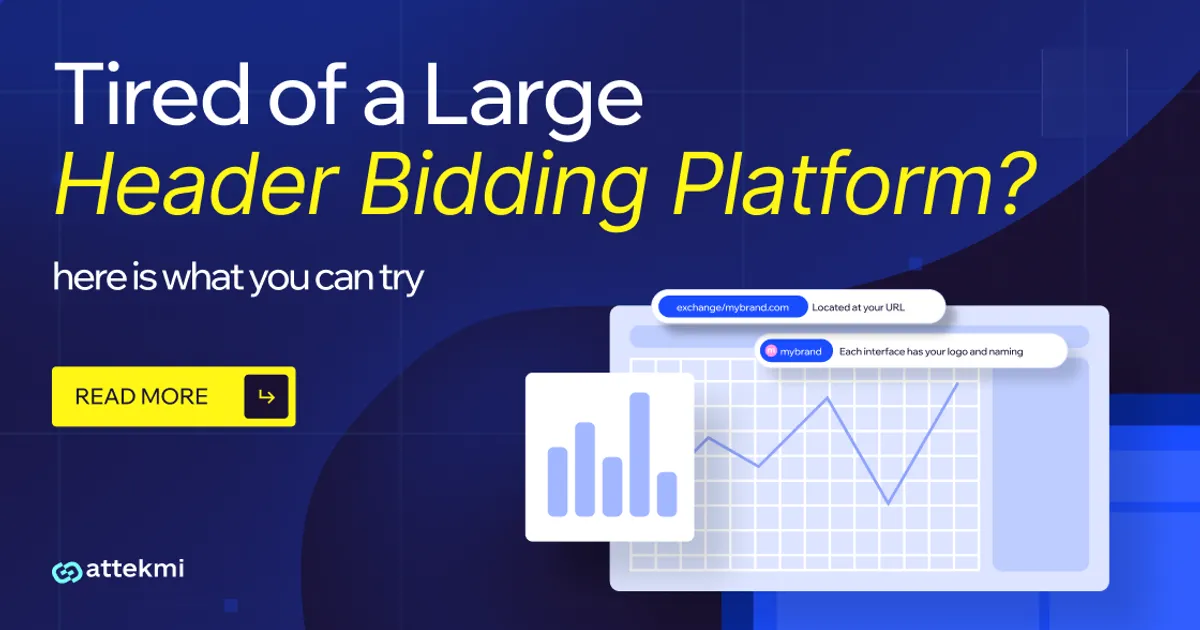
Alternatives to header bidding giants include optimizing existing setups, trying different approaches (like PMPs), or adopting custom and white-label SSP or ad exchange infrastructure. Some publishers move toward more flexible monetization environments (like Attekmi) that allow them to own auction logic, data, and roadmap. Attekmi offers a custom SSP / exchange option for media owners who require ultimate control and customization.
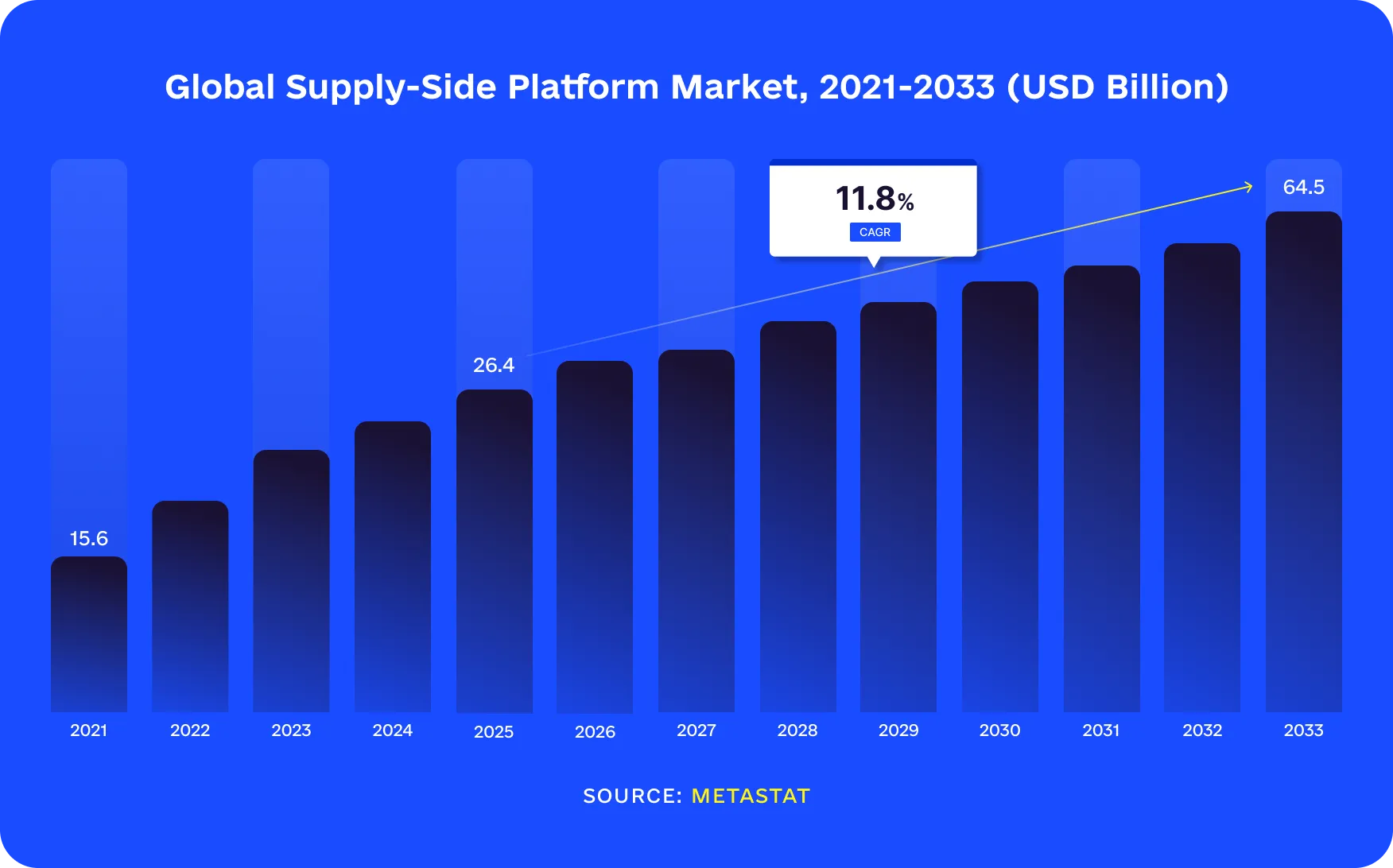
Large header bidding platforms became dominant in the market for a reason. They are established ecosystems offering publishers access to a diverse pool of media buyers, optimization tools, and other benefits. They are scalable and easy to use. And, obviously, such solutions significantly contribute to the growth of the global SSP market. In 2025, it was valued at over $26 billion, and by 2033, this figure is expected to surpass $64 billion.
However, some disadvantages are here as well. The fee structure is often difficult to understand fully, while customization opportunities are highly limited. Besides, choosing such a platform implies complete dependence on its specific roadmap. That is why more and more media owners are considering alternatives to header bidding giants nowadays. What are these options and why choose them?
Building AdTech solutions since 2018, we have gained vast experience with header bidding and other programmatic approaches. This article is based on the insights we gained while helping our partners set up and manage their platforms. Read on to discover how our SSP solution can help you reach new heights.
Why publishers are rethinking their dependence on header bidding giants
First and foremost, let’s dive deeper into the reasons why publishers move away from large header bidding solutions.
The benefits that made header bidding giants dominant
In comparison with the classic waterfall model, header bidding demonstrates greater efficiency. As of July 2025, among one million websites receiving the largest traffic, 2.2% was using the header bidding technology. The same applies to the 7% of websites among the top 100 thousand, and 10% among the top 10 thousand.
As for the key benefits of large platforms, they are as follows:
A unified access to a wide range of demand sources accelerates and simplifies monetization.
Ready-to-use analytics dashboards, optimization tools, and other features reduce operational friction.
Reduced internal engineering burden solves the complexity – you can focus on your goals and key tasks instead of maintaining the platform.
For instance, if you are a small publisher, building relationships manually may take loads of time, but by connecting to a large platform, you get access to dozens of DSPs, agencies, etc. This way, you can increase competition and fill rate much faster.
Where header bidding giants fall short for advanced publishers
While the advantages listed above offer convenience, the drawbacks are impossible to ignore:
Limited transparency into all fees and auction logic – the lack of visibility may affect optimization decisions.
Since everyone uses the same stack, achieving significant differentiation can be challenging.
The lack of customization opportunities also limits experimentation. You may want to test custom mechanics or floor rules, but standardized systems are usually optimized for scalability, not flexibility.
You fully depend on the vendor roadmap, which may not be fully aligned with your needs and objectives.
Imagine the following scenario: two competing news publishers use the same major header bidding platform with nearly identical demand sources, auction settings, and optimization algorithms. As a result, both companies offer very similar inventory access and performance, so that for both of them it becomes challenging to stand out strategically.
The risk of over‑reliance on one wrapper or SSP
One more risk worth mentioning is business and technical lock-in. Migrating away from a large provider can be expensive and time-consuming, while testing alternatives and diversifying revenue streams can be challenging.
Additionally, privacy regulations keep getting stricter, while expectations around consent management, data governance, and transparency are increasing. You may want to have greater control over data and related processes, but relying on an external platform will not help you achieve this goal.
What alternatives to header bidding giants may look like
Publishers seek more flexibility and control over their monetization infrastructure, so the alternatives to large systems are getting increasingly diverse. The choice depends on your scale, technical resources, revenue goals, and ownership requirements. Here are the key options to consider.
Fine‑tuning existing header bidding setups
Instead of abandoning a platform entirely, some teams stay with large wrappers but optimize partner mix, floors, and timeouts. Such operational improvements provide more control and better revenue efficiency. For instance, you may adopt a dynamic floor strategy that would adjust pricing and deliver better outcomes than static rules.
Multi‑SSP strategies and direct deals
Expanding monetization opportunities with additional supply-side platforms or private marketplaces is another popular option. This helps diversify revenue streams and avoid becoming too dependent on a single vendor’s demand, pricing logic, and roadmap decisions.
In turn, investing in programmatic guaranteed and preferred deals (both options fall under the programmatic direct approach) allows for building long-lasting partnerships with trusted advertisers and enhancing brand safety. Programmatic direct is among the fastest-growing segments, with a CAGR of 14.6% (between 2026 and 2034). Joining it is a way to monetize more effectively.
Running a custom SSP or ad exchange
In case you are eager to become fully independent, there are two options to consider: to build your own header bidding solution or go for a white‑label SSP / ad exchange.
While custom development can take months or even years, a white-label platform can be launched much faster and at a much lower cost. At the same time, certain platforms (like those offered by Attekmi) are fully customizable. Apart from UI personalization, you can request custom functionalities, so the system will be fully tailored to your needs. This way, you own the roadmap, data, and margins, control the rules, and create connections with the partners you trust. Additionally, you do not have to worry about maintenance – this, as well as platform upgrades, is Attekmi’s responsibility.
How Attekmi’s custom SSP competes with header bidding giants
Considering the disadvantages of large header bidding platforms that we explored earlier, let’s take a look at the key benefits offered by Attekmi’s solution.
Control over auction logic and timeouts
With an external solution, you may have limited or even zero control over timeouts, floor strategies, prioritization between different auction types, etc. With Attekmi’s platform, you can experiment with different approaches and try different settings without the need to wait until a vendor changes something for you.
Transparent fee structure and margin ownership
The AdTech environment involves loads of participants and intermediaries, which contributes to the lack of transparency. For large third-party ecosystems, this is especially relevant.
In turn, controlling your infrastructure helps you see where every unit of revenue is captured. With Attekmi’s solution, you decide on the margin, optimize the supply paths, and benefit from extensive analytics. Besides, there are no hidden fees involved – you always know what you pay for.
Flexible integration model for Prebid, CTV, and apps
Attekmi’s solutions are all about flexibility:
Prebid server, Prebid.JS, RTB 2.6, VAST, and JS.
Cross-integration bidding (e.g., RTB to VAST).
Desktop, in-app, mobile web, and CTV environments.
Banner, audio, video, native, and CTV formats.
This way, you can monetize across diverse screens, formats, and integration types – all within a single platform.
Custom SSP tailored to your network or vertical
Large platforms are usually generic – they are not tailored to specific verticals (like gaming or retail media) and local language markets. Attekmi can help you launch a platform that would be structurally different from global systems and enable you to monetize a certain niche with greater efficiency.
When a custom SSP is a better fit than a header bidding giant
How to make sure that you are ready for a custom SSP? Here is the checklist, as well as suggestions on how to choose an SSP for publishers.
7 signs you’ve outgrown your current header bidding setup
The following factors signal that you should start searching for alternatives to Prebid‑only setups and too large third-party ecosystems:
You require advanced controls that your vendor cannot or will not prioritize.
You are running setups that are too complex for a one‑size‑fits‑all wrapper (e.g., you are a multi-region brand).
You strive for ownership and control over the roadmap.
You are losing flexibility, so experimentation becomes challenging.
You want to diversify your revenue streams and reduce dependence on a single monetization partner.
You are struggling to differentiate your inventory (and since global programmatic ad spend is expected to approach $800 billion by 2028, differentiation is a really important factor).
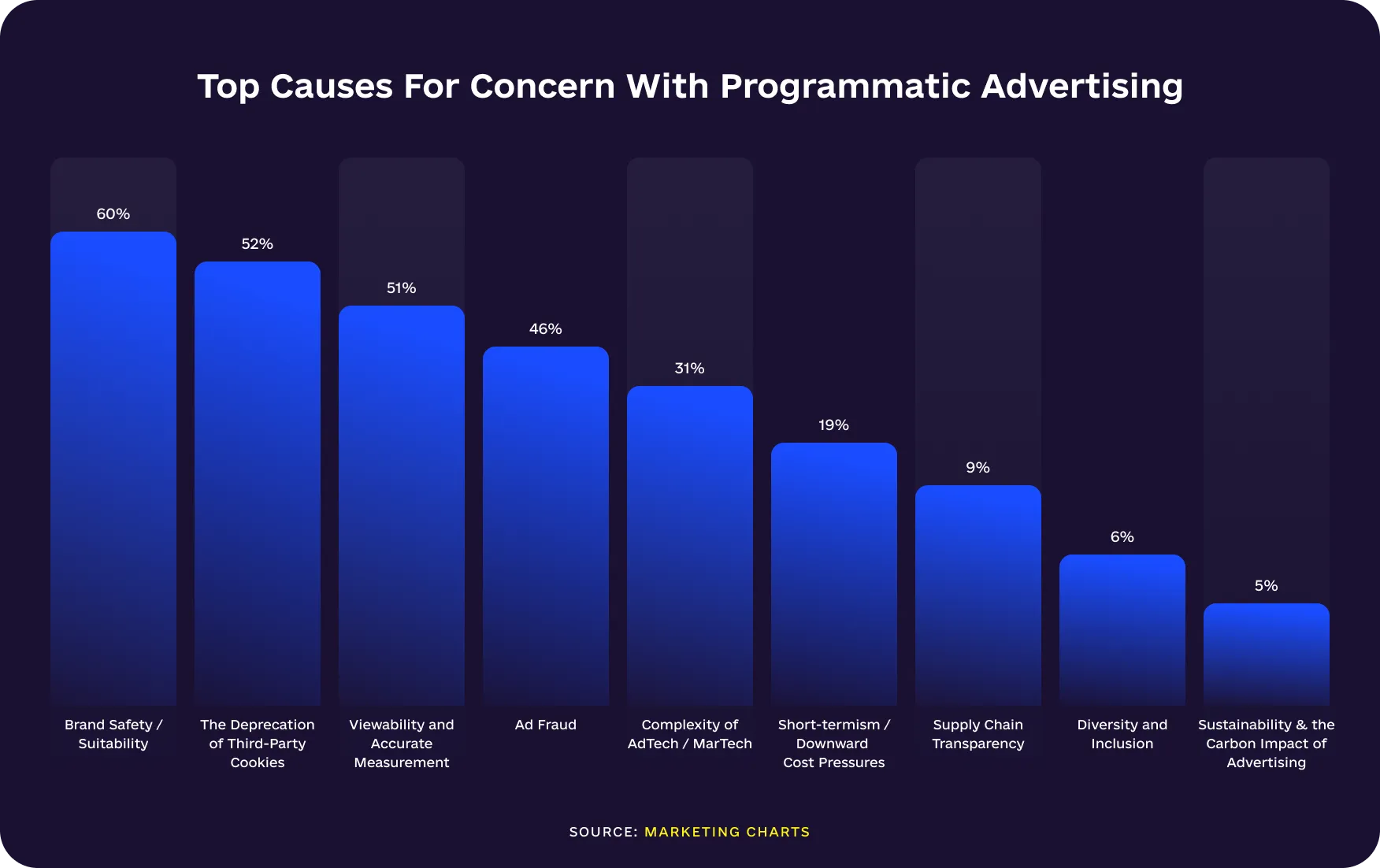
Analytics feels fragmented because some data you require is inaccessible or hard to export (viewability and accurate measurement are among the leading causes for concern with programmatic advertising).
Evaluating SSP / exchange fit and selection
When evaluating SSP and exchange fit and selection, the factors below tend to determine whether a platform will serve you long-term or become another bottleneck:
Control and transparency. You should be able to understand how auctions are structured, how bids are prioritized, how fees are applied, etc.
Integration flexibility. You need a wide range of integration types to monetize across different environments and formats.
Reporting and data access. You need deep performance insights for effective and data-driven optimization.
Roadmap alignment. Make sure that your potential platform can meet your long-term goals.
Customization opportunities. Check if you can request additional functionalities.
Privacy and compliance. Privacy regulations and security concerns keep shaping the AdTech industry. The right platform should already be compliant with regulations like GDPR and offer capabilities to help you operate in a privacy-friendly manner.
Now that you know how to choose an ad exchange for publishers (or an SSP), note that Attekmi is a strong option offering ownership and customization combined with quick time to market. You get a custom solution fully tailored to your requirements – just as if you were building one on your own, but the process is much faster.
“Publishers want the ability to define their own auction mechanics, manage data more independently, and adapt monetization strategies without waiting for a third-party roadmap. For media owners with mature AdTech operations, infrastructure ownership is becoming a strategic asset, not just a technical decision.”
As the CEO of Attekmi and a member of the Forbes Technology Council, Roman drives innovation and growth through business leadership and AdTech industry impact.
For instance, Mobupps, one of Attekmi’s partners, required a robust RTB technology that would support its reach expansion – launching a white-label platform that would handle operations across different regions became a way for them to achieve their goals. After reaching out to Attekmi, Mobupps also requested several individual features (for connecting endpoints with unique requirements and standardizing the billing mechanism). Attekmi equipped a white-label solution with these functionalities, adjusted the platform, and delivered a comprehensive onboarding. In combination with post-installation support, this enabled Mobupps to achieve 371% ROI and 207% revenue growth.
When header bidding giants still make sense
Even though alternative monetization options are gaining momentum, large platforms still offer value, especially for smaller publishers with limited internal resources and teams focused on stable monetization instead of deep customization. Such systems are not necessarily ineffective – they are just too standard for advanced media owners. They can be a practical choice in the following scenarios:
You prioritize predictable revenue and workflow stability over flexibility and experimentation.
You do not plan to scale at the moment.
Your resources are too limited.
You do not require customization and too strong differentiation.
You rely on standardized formats and workflows.
You need a lower-risk way to enter programmatic monetization.
Implementation paths: how publishers move away from header bidding giants
Ready to switch to a custom SSP? Here are the steps to take.
Learn more about Attekmi’s solution
Get a deeper dive into the opportunities offered by Attekmi’s white-label solution. Feel free to request a consultation – we are here to answer all your questions.
Phasing in Attekmi’s custom SSP
After you make sure that Attekmi’s solution is your best fit, do the following:
Provide the Attekmi team with your specific requirements (if any).
After the requested changes are implemented, set everything up (we will help you do this).
Monitor the performance continuously and scale gradually.
Measuring success beyond simple CPM uplift
When measuring success, pay attention to the following:
Effective net revenue after fees
Data ownership and flexibility
Time-to-launch for new deals and integrations
Reduced dependence on third-party vendors
Conclusion
While large header bidding systems offer some benefits, they are limited in terms of flexibility, customization, and control – that is why more and more publishers are switching to alternative options like, for instance, white-label ad exchanges or SSPs. For you, this may be the right move as well, but you need to evaluate your resources and requirements first. The recommendations provided in this guide will help you make the right decision and choose the right AdTech partner.
Ready to launch your own AdTech solution? Contact Attekmi.
FAQ
Realistic alternatives usually fall into three categories: optimizing existing header bidding setups, diversifying across multiple SSPs, or adopting custom SSP/ad exchange infrastructure. Smaller publishers may focus on improving bidder mix, floors, and timeout strategies, while larger publishers often explore hybrid or white-label solutions that provide greater operational control. The best approach depends on technical resources, revenue goals, and how much ownership the publisher wants over monetization infrastructure.
ublishers should evaluate how much transparency, flexibility, and operational control an exchange provides. Important factors include auction-level reporting, support for custom business rules, integration flexibility, scalability, and privacy controls. It is also important to assess whether the platform’s roadmap aligns with the publisher’s long-term monetization strategy rather than only short-term revenue optimization.
Publishers should evaluate transparency, demand quality, reporting depth, and customization capabilities. A strong SSP should support flexible deal structures, provide clear visibility into fees and auction behavior, and allow publishers to adapt floor strategies or traffic allocation rules without excessive vendor dependence. Strong technical support and responsiveness to custom requirements also become increasingly important as monetization strategies become more sophisticated.
There is no universal “perfect” timeout because the ideal setting depends on page speed requirements, user geography, bidder responsiveness, and the number of participating demand partners. Many publishers test timeouts within the 500–1500 millisecond range, balancing bid density against latency and user experience. The most effective approach is continuous testing that measures not only revenue impact, but also page performance, viewability, and session quality.
Publishers often consider custom SSP or exchange infrastructure when standardized platforms start limiting growth, flexibility, or strategic differentiation. Common signals include the need for advanced auction controls, growing operations, complex multi-brand monetization structures, or frustration with limited transparency and vendor roadmap constraints. Moving toward a custom setup typically makes the most sense when monetization becomes a core strategic capability rather than simply a managed service.


'%3e%3cpath%20d='M415.5%20380.133C415.5%20554.655%20911.5%20609.133%20714%20818.633C447%20850.133%20200%20677.655%20200%20503.133C200%20328.611%20341.478%20187.133%20516%20187.133C690.522%20187.133%20415.5%20205.611%20415.5%20380.133Z'%20fill='%231A4CFF'/%3e%3c/g%3e%3cg%20filter='url(%23filter1_f_654_7533)'%3e%3cpath%20d='M819.862%20539.146C969.42%20389.588%20963.912%20273.412%201000.6%20310.096C1037.28%20346.78%201059.92%20590.588%20910.362%20740.146C760.804%20889.704%20503.861%20847.646%20447.362%20760.146C348.862%20547.146%20670.304%20688.704%20819.862%20539.146Z'%20fill='%23052AAE'/%3e%3c/g%3e%3cg%20filter='url(%23filter2_f_654_7533)'%3e%3cpath%20d='M647.331%20285.725C443.031%20230.983%20408.998%20311.131%20358.6%20243.729C295.498%20194.631%20571.852%2052.1078%20776.152%20106.85C980.452%20161.592%201072.5%20405.139%201024.97%20497.82C889.759%20689.623%20851.631%20340.467%20647.331%20285.725Z'%20fill='%231B4DFF'/%3e%3c/g%3e%3c/g%3e%3cdefs%3e%3cfilter%20id='filter0_f_654_7533'%20x='0'%20y='-12.8672'%20width='960.465'%20height='1035.25'%20filterUnits='userSpaceOnUse'%20color-interpolation-filters='sRGB'%3e%3cfeFlood%20flood-opacity='0'%20result='BackgroundImageFix'/%3e%3cfeBlend%20mode='normal'%20in='SourceGraphic'%20in2='BackgroundImageFix'%20result='shape'/%3e%3cfeGaussianBlur%20stdDeviation='100'%20result='effect1_foregroundBlur_654_7533'/%3e%3c/filter%3e%3cfilter%20id='filter1_f_654_7533'%20x='228.938'%20y='103.27'%20width='998.816'%20height='935.965'%20filterUnits='userSpaceOnUse'%20color-interpolation-filters='sRGB'%3e%3cfeFlood%20flood-opacity='0'%20result='BackgroundImageFix'/%3e%3cfeBlend%20mode='normal'%20in='SourceGraphic'%20in2='BackgroundImageFix'%20result='shape'/%3e%3cfeGaussianBlur%20stdDeviation='100'%20result='effect1_foregroundBlur_654_7533'/%3e%3c/filter%3e%3cfilter%20id='filter2_f_654_7533'%20x='149.441'%20y='-105.473'%20width='1087.81'%20height='860.301'%20filterUnits='userSpaceOnUse'%20color-interpolation-filters='sRGB'%3e%3cfeFlood%20flood-opacity='0'%20result='BackgroundImageFix'/%3e%3cfeBlend%20mode='normal'%20in='SourceGraphic'%20in2='BackgroundImageFix'%20result='shape'/%3e%3cfeGaussianBlur%20stdDeviation='100'%20result='effect1_foregroundBlur_654_7533'/%3e%3c/filter%3e%3c/defs%3e%3c/svg%3e)