The best RTB setups for mobile monetization include running RTB through high-quality exchanges or white-label marketplaces, using in-app bidding and hybrid bidding in combination with mediation, and optimizing partner mix, pricing, placements, and frequency. AdTech infrastructure like Attekmi’s white-label solution can support such mobile ad monetization setups while providing publishers with greater control and enhanced transparency.
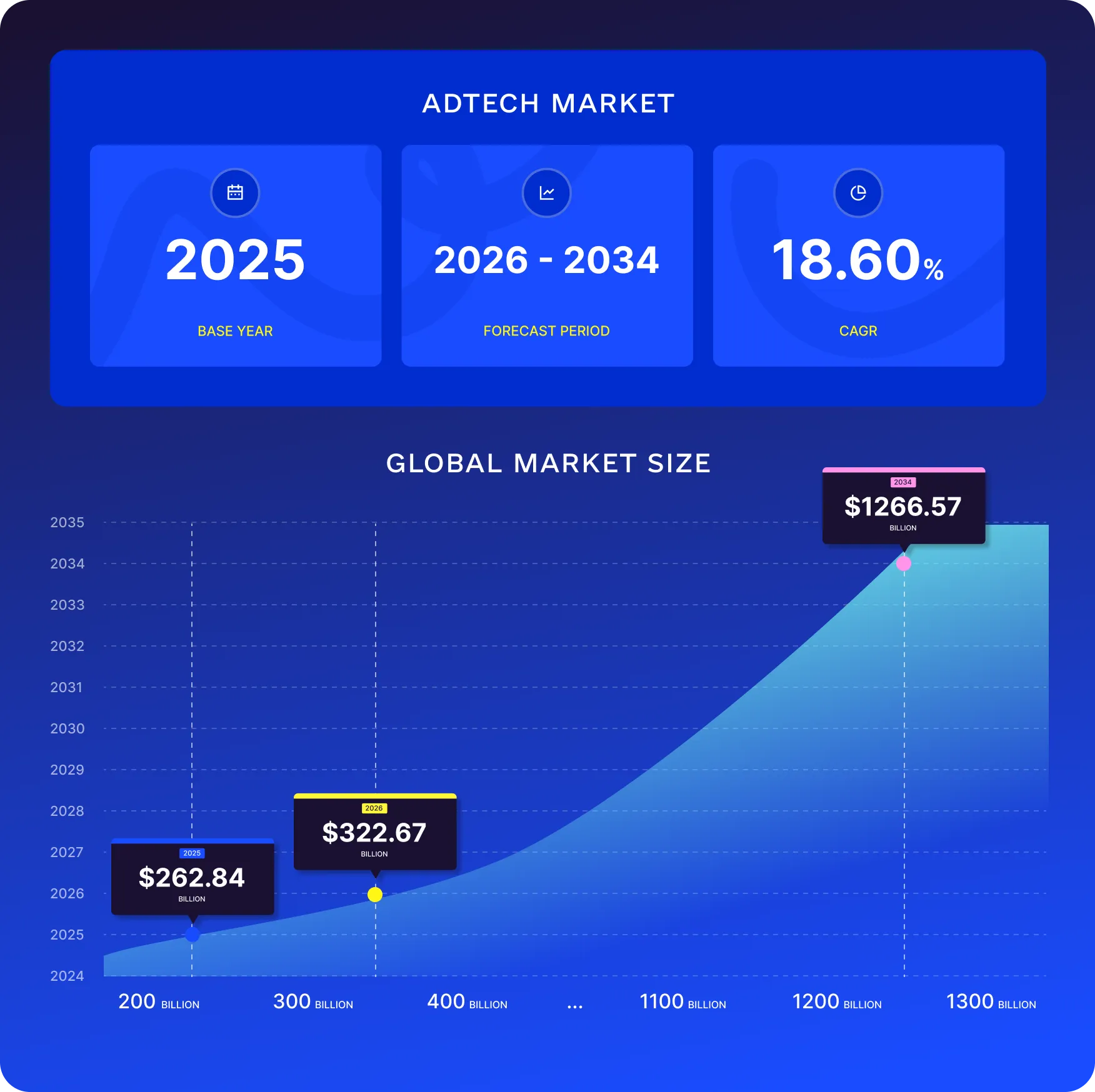
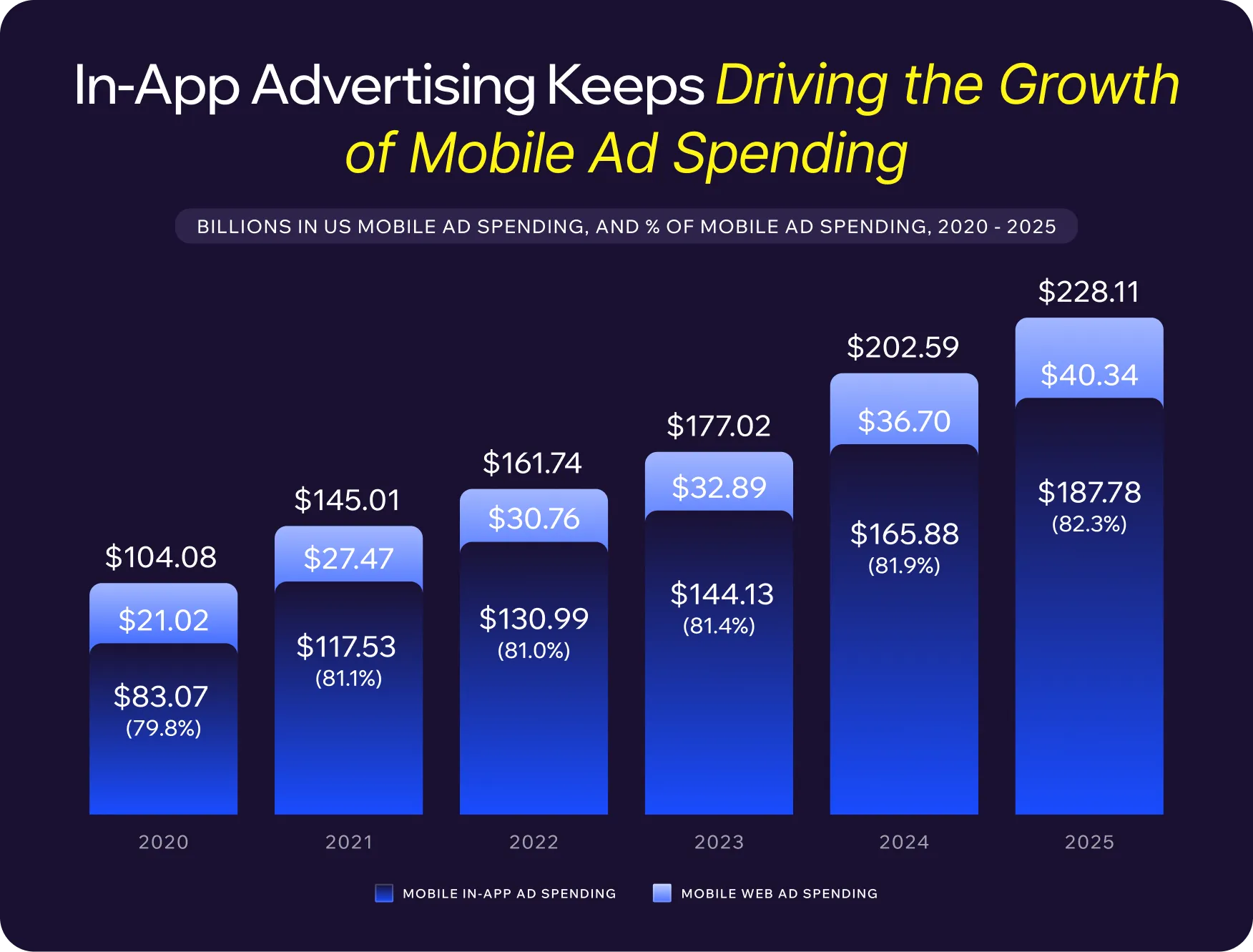
The mobile advertising market size reached over $262 billion in 2025 and is forecasted to surpass 1,266 billion by 2034. This growth is outlined by multiple factors, including the fact that smartphones are the most commonly used devices for accessing the Internet.
For publishers and app developers, this introduces a range of monetization opportunities; on the other hand, certain challenges are also in place, e.g., high competition, the risk of ad fatigue, and so on.
You may already be familiar with some of the best RTB setups for mobile app user acquisition. However, for effective monetization of your ad inventory, you need to consider other tactics and methods.
Our Attekmi team has been creating AdTech solutions supporting mobile ad formats and environments since 2018. Relying on our extensive experience, we have created this guide to help you enhance your mobile ad monetization strategy. Read on to learn more.
What makes programmatic mobile advertising unique?
Programmatic mobile marketing works in a different way than desktop advertising, and for publishers, these differences matter as well.
In‑app vs mobile web – inventory and data differences
In-app advertising runs inside mobile applications. Depending on user consent and platform policies, publishers may access device-level identifiers, session depth, app usage events, in-app purchases, etc. This creates a pretty structured environment for advertisers and contributes to effective monetization. On the other hand, publishers must be aware of app store rules, consent prompts, and measurement limitations, as they may affect targeting and campaign optimization.
Mobile web inventory exists inside the browser environment, so it is more similar to classic web advertising. Data collection usually depends on browser signals, contextual information, session behavior, etc. Privacy restrictions introduce certain challenges, but mobile web inventory is usually easier to deploy since publishers do not need app store approvals or SDK integrations.
From a monetization perspective, in-app inventory tends to deliver stronger performance due to richer signals, while mobile web offers greater flexibility, higher accessibility, and easier implementation. Note that the same monetization strategy will not perform equally well across both environments.
The mobile monetization stack at a glance
To monetize their inventory, publishers typically use supply-side platforms (SSPs). However, sometimes (especially in the case of in‑app RTB), media owners may leverage ad networks or mediation platforms. From there, inventory flows into SSPs and exchanges and becomes available for advertisers.
However, if you require deeper control over monetization processes, you may want to consider white-label AdTech infrastructure. From our experience, this is a way to drive higher income, as you can eliminate unnecessary intermediaries and set your own rules.
Best RTB setups for mobile ad monetization: what actually works
The number of smartphone users is increasing continuously – by 2029, it is forecasted to surpass 6 billion. Therefore, with the wrong tactics, you simply miss monetization opportunities. Let’s review the approaches that will help you monetize effectively.
Tactic 1: establish a clean, testable RTB foundation for mobile monetization
To minimize risks, it is always better to start small and test everything before you decide to scale.
Start with clear goals
First and foremost, identify your objectives. Obviously, you strive to increase your income, but, from our experience, you should be more specific. For instance, you may want to prioritize revenue per daily active user, eCPM and fill efficiency, yield per session, and so on. Without clear goals, you may make wrong optimization decisions.
Choose the right monetization platform
Basically, the easiest thing that you can do is to choose a solution supporting mobile web and in-app advertising and offering strong fraud controls, optimization tools, and analytics features. Such platforms are a good choice for testing your inventory in the RTB setup.
However, over time, consider phasing in white-label AdTech. This way, you will gain much greater control over your monetization processes. Certain solutions (like the one offered by Attekmi) can even be equipped with custom functionalities, so that you will get an SSP or a mobile ad exchange / in‑app marketplace / SSP fully tailored to your needs.
Tactic 2: use in‑app bidding and hybrid mediation for better competition
Programmatic mobile monetization offers multiple approaches, and the waterfall model is not the best of them
Why pure waterfalls no longer cut it
The waterfall approach involves poor prioritization and loads of manual adjustments. Besides, it often results in latency and UX issues. However, the most significant disadvantage is that you often miss higher bids. Since bidding happens sequentially, your inventory may simply not reach an advertiser ready to pay for its true value.
In‑app bidding basics (SDK-based, server‑side, hybrid)
In turn, in-app bidding allows multiple demand partners to compete for impressions in real time, which helps increase CPMs and improve the overall efficiency. This way, mobile header bidding / in‑app bidding (the concept is the same, but the environment is different) can drive much better results than waterfall while also creating more favorable conditions for advertisers.
There are several common ways publishers implement in-app bidding:
SDK-based. Software development kits are integrated directly into the app. Auction logic becomes “closer” to the application, but there is a risk of latency.
Server-side. Bid requests are routed through external infrastructure or mediation servers. The winning result is then returned to the app.
Hybrid. A combination of both models that usually implies greater flexibility.
Many publishers (especially the growing ones) prefer the hybrid approach as it allows them to balance monetization with effective app performance. However, small media owners may choose the SDK-based approach, while large app ecosystems may rely on server-side or custom auction infrastructure. These two models are also the best fit for RTB exchanges, as putting exchange demand into the SDK setup may create unnecessary complexity.
Designing a setup that respects UX
Monetization should not maximize bid density at the expense of app retention. For instance, aggressive ad delivery logic can result in latency, session interruption, and poor overall experience. In turn, such consequences can reduce long-term revenue. Therefore, frequency control becomes especially important.
Tactic 3: build the right RTB partner mix for sustainable mobile ad monetization
Some SSPs or ad exchanges may perform well for premium, high-intent inventory, while others may deliver better results in broader monetization scenarios. Therefore, you should treat your partners and solutions differently.
Optimize partner mix by inventory segment
You may want to apply the following segments:
Geography
Device platform
Ad format
Placement type
Demand type
App category (if relevant)
For instance, one SSP may be effective in terms of delivering rewarded videos in tier-1 markets, while another may provide stronger fill rates in tier-3 geos. Such an approach can increase your revenue much more effectively than broad partner-level optimization.
How many partners are too many on mobile?
Working with a high number of partners and solutions may look like a good idea, but actually, it can lead to the following issues:
Auction duplication
Redundant bid requests
Higher latency
Greater complexity
Reporting fragmentation
Fee leakage
Harder optimization
Smaller media owners often benefit from a smaller selection of strong partners, which creates higher competition without increasing complexity. Larger publishers with more diverse inventory may work with a greater number of partners, but even at scale, your goal should not be to maximize partner count. You should focus on the value of every partner you work with. You can evaluate it by tracking unique bid density, auction latency impact, win-rate contribution, revenue lift, etc.
Tactic 4: optimize formats and placements for mobile monetization
Smartphone screens are obviously smaller, so it is crucial to choose formats and placements carefully.
Format mix: interstitial, rewarded, native, video
Different formats attract different demand, so the best thing that you can do is to offer diverse inventory. For instance, these can be video or native ads, rewarded advertisements, interstitials, and so on. The choice also depends on the type of your app or mobile web environment. For example, rewarded ads are popular in in-game advertising (and mobile in-game ad spend is forecasted to reach almost $8 billion by 2030).
Note that you should not have a universal monetization strategy for all the formats you offer. Instead, build format-specific RTB logic based on how each inventory type behaves.
Placement decisions that protect UX
Even the most effective formats can affect your monetization efforts if they are placed poorly. Moreover, placement is not the only thing that matters: ad timing and frequency are on the list as well. Do not rely on assumptions – run A/B tests to see which decisions deliver better results and higher income. Remember, you need to optimize fill rate without hurting UX.
Tactic 5: improve fill rate and eCPM without ruining user experience
Obviously, you want to drive higher income, but simply delivering more ads is not the way to go – this will affect user experience and lead to ad fatigue. Moreover, some of your app users or website visitors may simply install ad blockers, so that you will not be able to monetize their experience anymore. For instance, in 2025, 68% of adult users in the USA were somewhat or very likely to install ad blockers on their mobile devices.
Adjusting floor pricing is a much more effective method.
Smart floor pricing and pacing for global campaigns
Mobile inventory is highly dynamic, and pricing that works for one segment may not deliver the expected results in another one. Thus, you need segmented floor logic based on inventory characteristics and auction behavior.
Your optimization framework may include floors by:
Geography (tier-1, tier-2, tier-3, etc.)
Platform (iOS and Android often attract different demand)
Placement type (premium placements vs remnant inventory)
Format (different formats usually have different values)
Here is an example for you: tier-1 markets often support aggressive floor pricing because competition there is stronger. However, setting the same minimum bid for tier-2 and tier-3 is usually a mistake, as it can be too high for actual demand. This can lead to lower fill rates, unsold impressions, and lower income in general. You need to run tests and experiments to identify proper pricing: for instance, you may test geo-specific pricing thresholds or measure floor impact by ad format.
Frequency capping and session‑level controls
Publishers often focus on CPM optimization, but performance may decline quickly if ad exposure goes too far. Too many ads per user or per session can reduce session length, increase churn, and affect long-term monetization. For mobile apps, where user patience is often limited, this is especially critical.
Frequency capping allows you to limit how often users see ads over a given period, e.g., per session, per day, per hour, and so on. In turn, session-level controls provide you with additional ways to ensure proper user experience. For instance, you may want to limit interstitials in the first few minutes of the session.
Such rules can usually be managed through mobile mediation and RTB platforms, exchange controls, etc. Everything depends on your stack. In any case, by using frequency capping and session-level controls, you can achieve the following:
Users stay longer
More sessions can be monetized
Ad fatigue declines
Your revenue increases
Tactic 6: Use a white‑label exchange or marketplace to get more control
Getting your own RTB solution is a way to gain greater control over the monetization processes and ensure stronger differentiation.
Why some businesses run their own exchanges
At a smaller scale, using third-party AdTech solutions makes sense, as you gain quick access to demand and minimize technical complexity. However, as your mobile monetization scales, you may need more control than an external platform may offer.
This is where white-label infrastructure becomes relevant – publishers use it to create a more controlled environment around their supply. Such an approach implies the following key advantages:
You can connect multiple supply sources under one marketplace
You gain greater transparency into fees, auction behavior, and performance
You have full control over setups
What Attekmi’s white‑label exchange gives to monetization teams
Attekmi’s white-label solution supports both in-app and mobile environments (in addition to desktop and CTV), and a wide range of ad formats: banner, video, audio, native, and CTV.
The solution is equipped with a variety of targeting and filtering settings to help you maximize performance and bring your monetization effort to the next level. In addition, you can integrate diverse fraud detection and prevention tools (e.g., Forensiq and Pixalate) to keep your system secure. Advanced analytics capabilities assist you with adjusting your strategy, as well as identifying both opportunities and weaknesses.
However, the biggest advantage of Attekmi’s solution is that it gets fully tailored to your requirements: from UI personalization to custom on-request feature development.
Note that we also offer a white-label ad server solution, as well as a wide range of AdTech services.
Implementation roadmap: upgrading your programmatic mobile setup step by step
The steps described below will help you enhance your mobile monetization stack.
Step 1: audit your current stack
Before changing anything, check how your current stack performs. Take a look at all the monetization systems you are using at the moment and audit their performance. The key goal here is to check if there are any inefficiencies. This must be done before introducing additional potential complexity.
Step 2: introduce better RTB competition
Depending on the review results, your next steps may include the following:
Adding more SSPs or exchanges
Expanding access to RTB demand
Reducing over-reliance on the waterfall model
Improving bid competition across formats, geos, etc.
Optimizing auction logic
Step 3: evaluate whether you need your exchange layer
Here are the signals that may indicate your readiness for your own ad exchange or SSP solution:
You manage multiple apps or mobile web resources
You operate across large impression volumes
You aim for better transparency
You strive to eliminate unnecessary intermediaries (and their fees)
You need advanced control over platform logic, optimization, etc.
You need features that your current stack is not equipped with
You require greater differentiation
Once you make sure that you are ready, keep in mind that Attekmi can be the best fit for your business. Apart from advanced functionalities and special customization opportunities, you can count on all-encompassing and proactive support. In addition, we approach every partner individually, so you will have a unique roadmap aligned with your needs.
Conclusion
The efficiency of mobile monetization depends on an entire range of factors – the recommendations provided above will help you adjust your strategy. Remember that continuous performance analysis is a must – this is the way to enhance your strategy quickly and prevent income drop.
Attekmi’s white-label solution is your opportunity to drive monetization on your own terms, unlock full control over the processes, and gain a competitive advantage.
Ready to gain greater control with your own white-label infrastructure? Contact us.
FAQ
The perfect setup depends on scale, user geography, formats, and whether you need more control over monetization operations. Usually, effective setups include in-app bidding, hybrid mediation, format and placement optimization, building the right RTB partner mix, and using white-label infrastructure. It is also crucial to optimize fill rates and eCPM without hurting user experience.
There is no universal number, but more partners do not always mean greater revenue. For instance, smaller apps may perform well with 5-10 strong demand partners, while larger apps can support broader setups. It is important to track revenue, fill, and latency instead of just adding as many partners as possible.
Usually, yes, as in-app bidding improves transparency and competition. However, waterfalls can still work in certain scenarios, so many publishers combine different approaches to reach their goals.
Try optimizing ad placements and formats, utilizing smart floor pricing, ensuring demand partner quality, and setting up frequency caps and session-level controls.
When you require greater control over the processes and auction logic, aim for differentiation and transparency, and operate at a large scale.


'%3e%3cpath%20d='M415.5%20380.133C415.5%20554.655%20911.5%20609.133%20714%20818.633C447%20850.133%20200%20677.655%20200%20503.133C200%20328.611%20341.478%20187.133%20516%20187.133C690.522%20187.133%20415.5%20205.611%20415.5%20380.133Z'%20fill='%231A4CFF'/%3e%3c/g%3e%3cg%20filter='url(%23filter1_f_654_7533)'%3e%3cpath%20d='M819.862%20539.146C969.42%20389.588%20963.912%20273.412%201000.6%20310.096C1037.28%20346.78%201059.92%20590.588%20910.362%20740.146C760.804%20889.704%20503.861%20847.646%20447.362%20760.146C348.862%20547.146%20670.304%20688.704%20819.862%20539.146Z'%20fill='%23052AAE'/%3e%3c/g%3e%3cg%20filter='url(%23filter2_f_654_7533)'%3e%3cpath%20d='M647.331%20285.725C443.031%20230.983%20408.998%20311.131%20358.6%20243.729C295.498%20194.631%20571.852%2052.1078%20776.152%20106.85C980.452%20161.592%201072.5%20405.139%201024.97%20497.82C889.759%20689.623%20851.631%20340.467%20647.331%20285.725Z'%20fill='%231B4DFF'/%3e%3c/g%3e%3c/g%3e%3cdefs%3e%3cfilter%20id='filter0_f_654_7533'%20x='0'%20y='-12.8672'%20width='960.465'%20height='1035.25'%20filterUnits='userSpaceOnUse'%20color-interpolation-filters='sRGB'%3e%3cfeFlood%20flood-opacity='0'%20result='BackgroundImageFix'/%3e%3cfeBlend%20mode='normal'%20in='SourceGraphic'%20in2='BackgroundImageFix'%20result='shape'/%3e%3cfeGaussianBlur%20stdDeviation='100'%20result='effect1_foregroundBlur_654_7533'/%3e%3c/filter%3e%3cfilter%20id='filter1_f_654_7533'%20x='228.938'%20y='103.27'%20width='998.816'%20height='935.965'%20filterUnits='userSpaceOnUse'%20color-interpolation-filters='sRGB'%3e%3cfeFlood%20flood-opacity='0'%20result='BackgroundImageFix'/%3e%3cfeBlend%20mode='normal'%20in='SourceGraphic'%20in2='BackgroundImageFix'%20result='shape'/%3e%3cfeGaussianBlur%20stdDeviation='100'%20result='effect1_foregroundBlur_654_7533'/%3e%3c/filter%3e%3cfilter%20id='filter2_f_654_7533'%20x='149.441'%20y='-105.473'%20width='1087.81'%20height='860.301'%20filterUnits='userSpaceOnUse'%20color-interpolation-filters='sRGB'%3e%3cfeFlood%20flood-opacity='0'%20result='BackgroundImageFix'/%3e%3cfeBlend%20mode='normal'%20in='SourceGraphic'%20in2='BackgroundImageFix'%20result='shape'/%3e%3cfeGaussianBlur%20stdDeviation='100'%20result='effect1_foregroundBlur_654_7533'/%3e%3c/filter%3e%3c/defs%3e%3c/svg%3e)