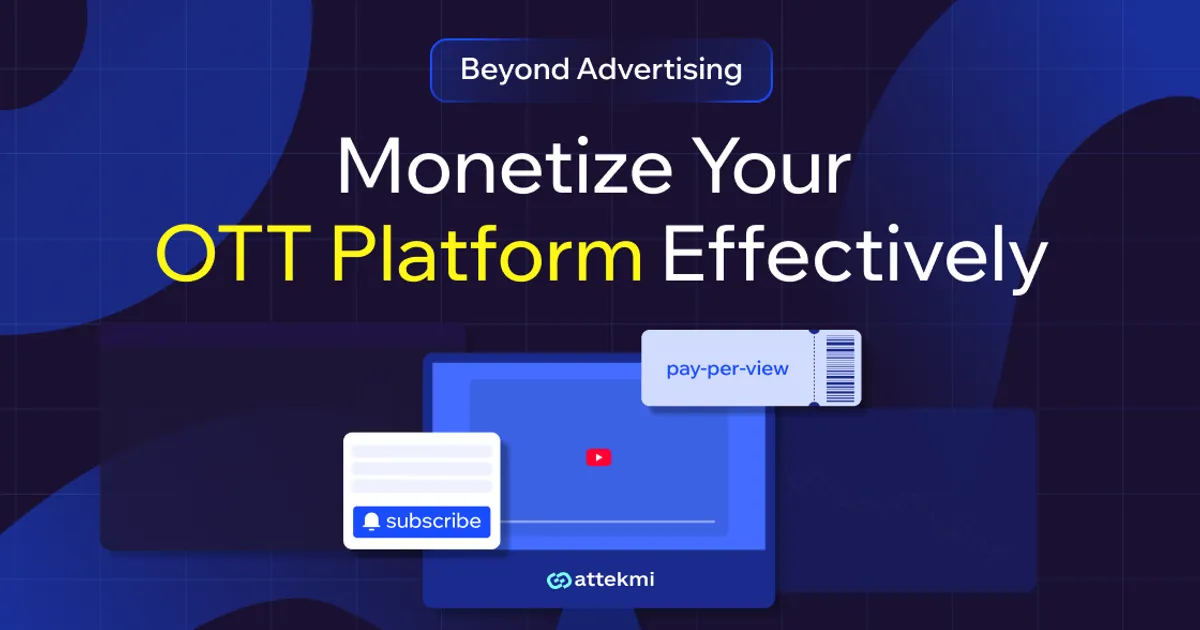
OTT (over-the-top) advertising keeps gaining momentum due to multiple reasons. First of all, audiences are increasingly switching from traditional TV to streaming services – they require enhanced control over what and when they watch. Secondly, OTT marketing allows for precise targeting, easier measurement, greater engagement, and interactivity. Thirdly, it ensures more effective spending and is accessible even for small businesses.
While media buyers keep investing in OTT advertising, media owners benefit from monetization opportunities. But what are the key monetization models to consider? What are their advantages and disadvantages? How to monetize with maximum efficiency? Are ads the only way to monetize an OTT platform?
In this detailed guide on OTT video monetization, we answer these and other questions, so read on to discover how to enhance your strategy, increase performance, and drive revenue.
Key takeaways:
OTT monetization does not rely only on advertising – there are different models that you can try to drive income.
The choice of the model highly depends on your current content strategy, audience behavior, the state of the market, and other factors.
Hybrid models enable revenue stream diversification, which helps reduce risks.
Prioritizing long-term sustainability remains a crucial task regardless of the chosen monetization approach.
What is OTT monetization?
Before we start, it would be useful to briefly clarify the difference between OTT and CTV advertising – they are often confused with each other. Basically, CTV advertising is a subset of OTT marketing. OTT is a delivery method. That is any video content streamed over the Internet, including the one you consume via your smartphone or laptop. CTV refers to Internet-connected devices (smart TVs, gaming consoles, and streaming gadgets).
Here are two examples. The first one is about seeing an ad on your smart TV’s screen while using the Roku Streaming Stick device to watch a show on Hulu. The second example refers to seeing an ad on your smartphone while watching something on the YouTube app. Both these examples are OTT, but only the first one is CTV.
Now let’s get back to OTT platform monetization. So, OTT monetization is all about turning digital content consumption into predictable, scalable revenue. Unlike traditional broadcasting, OTT platforms can leverage multiple monetization models. Some of them generate revenue from content distribution via subscriptions, others rely on advertising, and so on.
The flexibility of OTT allows platforms to tailor revenue strategies to audience behavior, geography, and content type. Some OTT platforms can also generate income through content licensing deals, brand integrations, etc.
The choice of the OTT model directly impacts the platform’s scalability. The wrong choice can result in, for instance, reduced lifetime value and increased churn rate. In terms of profitability, there are loads of nuances to consider as well. For example, if you monetize via advertising, you still need to balance user experience with ad load. This is essential to maximize yield without harming retention.
OTT video on demand models overview
Here are some of the most popular models to consider (and we will review each option in detail in the next sections of the article):
SVOD (subscription video on demand): Users pay a recurring fee for unlimited or tier-based access to content libraries. This model prioritizes customer retention, content exclusivity, and predictable revenue.
AVOD (advertising-based video on demand): Platforms monetize user attention through pre-roll, mid-roll, and post-roll advertisements, sponsored content, programmatic ads, dynamic ad insertion, etc. Such models heavily rely on audience scale, engagement metrics, and precise targeting.
TVOD (transactional video on demand): This model (pay-per-view or rentals) works well for high-demand live events, niche premium content, and early-access releases.
Hybrid model: a mix of different approaches.
“Scalability in OTT advertising doesn’t come from adding more ads – it comes from making each impression smarter, more relevant, and more measurable.”
Olena Chudinovych
Attekmi’s CPO
What is SVOD (subscription video on demand)?
Now, let’s dive deeper into the SVOD meaning. That is a monetization model in which users pay a recurring fee (usually, monthly or annually) for unlimited access to a platform’s content library. Note that subscribers gain access to a content catalog during their subscription period – there are no additional payments per title involved. Netflix can serve as a great example here.
Subscription renewal is usually automatic (unless users cancel), which ensures predictable cash flow and allows platforms to forecast revenue more accurately. To maximize user retention, SVOD platforms prioritize large content catalogs, frequent updates, and strong recommendation systems.
How the SVOD model works
For users, everything is simple– they create an account and select a subscription plan. After payment confirmation, they get access to the content. Usually, due to recurring payments, it remains active until the subscription is canceled.
Monthly billing is more flexible for users, but for platform owners, it introduces higher churn risks. In turn, annual billing usually ensures greater retention and often offers some discounts.
Note that SVOD users typically expect personalized recommendations, frequent content updates, high-quality streaming, seamless multi-device access, and ad-free or at least limited-ad experiences.
Advantages and disadvantages of SVOD
As for the key advantages, these are predictable and stable revenue, higher customer lifetime value, and stronger loyalty (if you do everything right).
Common challenges include churn risks (users can cancel anytime), high content costs (global distribution rights, licensing deals, etc.), and budget sensitivity (modern customers often have multiple subscriptions).
What is AVOD (advertising video on demand)?
As for the AVOD meaning, that is a monetization model where users access content for free, while the platform generates revenue through advertising. Instead of paying a subscription fee, viewers “pay” with their attention. Tubi is a typical example here as it offers no paid plans or subscription fees. Instead, its monetization fully relies on ads.
Nowadays, AVOD is gaining popularity due to increasing subscription pricing, subscription fatigue, and growing advertisers’ demand for OTT advertising. It can be especially effective when the content library is rather broad than exclusive, and when audience scale is a priority.
How advertising-based revenue is generated
AVOD platforms monetize user engagement by selling inventory embedded within video streams. Common formats include pre-roll ads (before content starts), mid-roll ads (during playback), post-roll ads (after content ends), and sponsored content or branded integrations. Note that the placement strategy directly impacts user experience and retention.
Advertisers typically pay based on impressions (CPM model), but some other options, like completed views, are utilized as well. Premium content and high-quality environments usually result in higher revenue, but other factors should be considered as well: seasonality, targeting quality, brand safety standards, and others.
Advantages and disadvantages of AVOD
Free access enables quick audience growth, which allows AVOD OTT platforms to scale faster than SVOD ones. Besides, since AVOD attracts price-sensitive viewers, it becomes more appealing for advertisers who plan to scale. Another benefit is that the more users watch, the higher income a platform can drive.
However, in comparison with SVOD, average revenue per user is often lower (unless the platform has an impressive number of users). Apart from this, AVOD implies dependency on advertiser demand, while high ad load can increase the churn rate and reduce session time. For marketers, that is a disadvantage as well, since high frequency of ads can affect brand perception.
What is TVOD (transactional video on demand)?
The TVOD meaning is as follows: it is a monetization model where users pay for access to specific pieces of content rather than subscribing to an entire platform. Each transaction unlocks a single movie, episode, or live event. Typically, there are two options for viewers to consider:
Rental: Users pay a fee to get a time-limited access to the content piece. After expiration, the content becomes unavailable unless a user purchases it again.
EST (electronic sell-through): Users purchase a title permanently, usually for a higher price than in the case of rental. The content always remains accessible in their library.
TVOD use cases and pricing logic
TVOD is usually effective for new releases (before they become available on subscription-based platforms), live sports, one-time events, concerts, niche content, etc.
TVOD pricing is usually based on content exclusivity, production budget, market demand, and available alternatives. Premium content is the key factor driving the success of TVOD platforms since high-intent users are willing to pay more for immediate access to a special experience. Since payment is tied directly to a title, TVOD platforms can often be more profitable than those relying on advertising.
Advantages and disadvantages of TVOD
Apart from typically higher revenue, TVOD platforms offer flexible pricing control – owners can adjust pricing based on demand, geography, release timing, and other factors. Besides, users do not have to purchase subscriptions – they pay only for what they want to watch. This ensures direct revenue instead of relying on long-term retention.
However, scalability is limited since revenue heavily depends on continuous releases of attractive titles. If content is not updated regularly, transactions decline. Besides, revenue forecasting is a pretty challenging task as there are no recurring bills involved. Moreover, it may be essential for you to promote new titles to drive transactions, which implies additional investment.
Hybrid OTT monetization models explained
Hybrid models combine two or more approaches (for instance, SVOD and AVOD) within a single platform ecosystem. Users have different options to choose from: an ad-free premium tier, cheaper subscriptions with ads, free ad-supported access, pay-per-view events, and so on. For example, YouTube is a classic freemium streaming platform. You can watch content for free, but there will be ads. However, if you upgrade to the Premium plan, you will enjoy an ad-free experience.
Hybrid models are becoming more and more common due to several reasons. First of all, they allow you to attract both price-sensitive users and those who are ready to pay for special experiences. Secondly, they enable you to diversify revenue streams and help increase average revenue per user. Thirdly, they offer downgrade options instead of cancellations, which helps reduce churn rate. Basically, such models offer a greater balance between scale and profit.
When hybrid models make sense
Hybrid models can be especially effective in the following situations:
When the market is saturated: If the number of subscribers is growing too slowly, adding an ad-supported tier can help attract new users and retain those who have already subscribed.
When content production costs are too high: Premium content creation requires stable revenue streams. Hybrid monetization compensates content investment and improves profitability.
In emerging or price-sensitive regions: Offering multiple tiers simplifies market entry. You can start small and then try to upsell your offering.
When the churn rate increases: Instead of just losing users, you can offer them downgrade options. This will help you preserve your relationships with users while still maintaining monetization.
Advantages and disadvantages of hybrid models
The key advantages of hybrid models include revenue diversification, reduced financial risks, greater flexibility, broader audience reach, and improved monetization efficiency.
As for the challenges, such platforms require a pretty sophisticated infrastructure. Besides, lower-priced tiers can reduce the adoption of premium plans. One more thing to pay attention to is that balancing subscription and advertising KPIs requires more advanced analytics.
Comparing SVOD vs AVOD vs TVOD
Imagine that you need to choose a single monetization model: SVOD, AVOD, or TVOD. Which of them to prefer? The table below will help you make a choice.
SVOD | AVOD | TVOD | |
Revenue predictability | High (due to recurring payments) | Medium to low (depending on demand, seasonality, etc.) | Low (tied to release cycles and individual title performance) |
Revenue stability | Strong | Volatile | Event-driven and inconsistent |
Average revenue per user potential | High (if you control churn) | Lower (scale is essential) | High per transaction but not recurring |
Audience reach | Moderate | Very high | Limited |
Content strategy focus | Large libraries, exclusive originals, continuous updates | Broad catalog, brand-safe inventory | Premium content, new releases, live events |
Retention dependency | Very high (churn directly impacts revenue) | Moderate (engagement drives monetization) | Low (conversion per title is more important) |
User commitment | Ongoing subscription relationship | No financial commitment | One-time purchase decisions |
Scalability opportunities | Through subscriber acquisition and retention | Through audience growth and ad impressions | Through the volume of premium releases |
Best market fit | Mature markets with paying users | Emerging or price-sensitive markets | Premium or event-based distribution |
Choosing the right OTT monetization strategy
In terms of OTT monetization, choosing the right model is not just about selecting the one with the highest revenue potential. The choice should be aligned with your content type, audience behavior, and long-term business goals. Here are several recommendations to pay attention to.
Start with your content strategy
First and foremost, analyze your current content strategy and the existing consumption patterns. For instance, if you offer exclusive content and update it regularly, users may be willing to pay for consistent access to it. Therefore, SVOD or a hybrid model may be the best choice. In turn, for user-generated content, AVOD may be more effective.
Analyze your audience behavior
Understanding your viewers plays a crucial role. Is your audience price-sensitive? Do they prioritize flexibility? How often do they consume content? Are they ready to watch ads? Answers to these questions should have a direct impact on your choice. For example, TVOD may be a good choice for high-intent niche audiences, while a hybrid or AVOD approach can work well for price-sensitive and casual viewers.
Define revenue priorities
Different models support different business objectives. Do you require predictable recurring revenue? That is what SVOD offers. Are you planning to grow your audience quickly? Consider AVOD. Do you want to get maximum revenue per release? TVOD may be the best option. Are you in search of some balance between different goals? The hybrid approach may be exactly what you are looking for.
Consider market maturity
Besides, analyze the state of the market. If the market is mature, monetization via the SVOD model can turn into a really challenging task – a hybrid approach is likely to deliver better results. For emerging markets, you may want to consider AVOD or freemium models.
Evaluate operational capabilities
Each model requires different infrastructure and operational capabilities. For instance, SVOD needs subscription management, churn analytics, and retention strategies. AVOD OTT requires advertising partnerships, inventory management, and yield optimization. TVOD is all about pricing control, event marketing, and release window strategy. With hybrid models, everything is even more complicated, as they combine different approaches.
Note that your final decision should take into account all the factors mentioned above. Relying on a single one is not the way to go.
OTT monetization best practices
Choosing a monetization model is only a starting point. Here are several recommendations that will help you drive income effectively.
Test before you scale
Each action requires validation – otherwise, you may fail. Therefore, test pricing tiers, experiment with ad load intensity, test time-limited TVOD releases, and so on. Make data-driven decisions instead of relying on your intuition.
Balance access and revenue
Over-monetization can affect retention and scalability. Under-monetization limits your growth. Thus, it is essential to balance ad frequency and user experience (for AVOD), price sensitivity and churn risks (for SVOD), and premium pricing and conversion rates (for TVOD).
Focus on retention
Acquiring new users is an essential process, but it is pretty expensive. Therefore, do not neglect retention. The choice of methods depends on your model, but you may want to consider offering personalized content recommendations, upgrade and downgrade options, loyalty incentives, and so on. Minimizing latency plays an important role as well.
Consider diversifying revenue streams
Remember that relying solely on one monetization model increases risk – consider hybrid options instead. You may want to add ad-supported tiers to subscription platforms, introduce limited TVOD windows for premium releases, etc. It may also be helpful to explore sponsorship opportunities,
Monitor the key metrics
While advertisers should measure attribution, you must continuously track the metrics that are relevant to your model. For instance, in the case of OTT SVOD, these can be churn rate, subscriber growth, etc. For AVOD, consider fill rate, CPM, and other metrics. For TVOD, these may be conversion rate per title, revenue per release, and so on.
Prioritize long-term sustainability
Effective monetization is an evolving strategy. Depending on your chosen models, you may need to maintain reasonable ad loads, invest in consistent new content availability, protect user experience, build a strong first-party data strategy, and so on. This will help you maintain both your brand reputation and user trust.
Conclusion
As you can see, OTT monetization does not depend solely on ads. There are multiple models you can try, but the choice should be made carefully. Keep in mind that following a hybrid approach is among the most effective methods since it allows you to diversify your revenue streams.
The recommendations provided in this guide will help you make the right choice and monetize your platform efficiently. However, whichever option you prefer, keep in mind that monitoring the platform’s performance is a must. This way, you will be able to make data-driven decisions and implement changes on time.
Searching for a trusted AdTech partner? Contact us.
FAQ
In OTT monetization, pricing perception directly impacts conversions. If users see pricing as fair and aligned with content value, the conversion rate increases. Even small price differences can significantly affect sign-ups. Tiered pricing, free trials, and clear value communication reduce friction and boost overall subscription or purchase rates.
Yes. Older content can remain profitable, for instance, through AVOD OTT monetization or a bundle strategy. Evergreen titles often perform well in ad-supported models, where scale matters more than novelty. With proper curation and recommendation algorithms, such content can still generate steady long-term revenue.
Sure. Purchasing power, ad demand, and cultural preferences vary by region. Hybrid models are often the best choice for mature markets, while emerging markets usually favor AVOD. Ad CPMs, price sensitivity, and content demand also influence which monetization strategy performs best locally.


'%3e%3cpath%20d='M415.5%20380.133C415.5%20554.655%20911.5%20609.133%20714%20818.633C447%20850.133%20200%20677.655%20200%20503.133C200%20328.611%20341.478%20187.133%20516%20187.133C690.522%20187.133%20415.5%20205.611%20415.5%20380.133Z'%20fill='%231A4CFF'/%3e%3c/g%3e%3cg%20filter='url(%23filter1_f_654_7533)'%3e%3cpath%20d='M819.862%20539.146C969.42%20389.588%20963.912%20273.412%201000.6%20310.096C1037.28%20346.78%201059.92%20590.588%20910.362%20740.146C760.804%20889.704%20503.861%20847.646%20447.362%20760.146C348.862%20547.146%20670.304%20688.704%20819.862%20539.146Z'%20fill='%23052AAE'/%3e%3c/g%3e%3cg%20filter='url(%23filter2_f_654_7533)'%3e%3cpath%20d='M647.331%20285.725C443.031%20230.983%20408.998%20311.131%20358.6%20243.729C295.498%20194.631%20571.852%2052.1078%20776.152%20106.85C980.452%20161.592%201072.5%20405.139%201024.97%20497.82C889.759%20689.623%20851.631%20340.467%20647.331%20285.725Z'%20fill='%231B4DFF'/%3e%3c/g%3e%3c/g%3e%3cdefs%3e%3cfilter%20id='filter0_f_654_7533'%20x='0'%20y='-12.8672'%20width='960.465'%20height='1035.25'%20filterUnits='userSpaceOnUse'%20color-interpolation-filters='sRGB'%3e%3cfeFlood%20flood-opacity='0'%20result='BackgroundImageFix'/%3e%3cfeBlend%20mode='normal'%20in='SourceGraphic'%20in2='BackgroundImageFix'%20result='shape'/%3e%3cfeGaussianBlur%20stdDeviation='100'%20result='effect1_foregroundBlur_654_7533'/%3e%3c/filter%3e%3cfilter%20id='filter1_f_654_7533'%20x='228.938'%20y='103.27'%20width='998.816'%20height='935.965'%20filterUnits='userSpaceOnUse'%20color-interpolation-filters='sRGB'%3e%3cfeFlood%20flood-opacity='0'%20result='BackgroundImageFix'/%3e%3cfeBlend%20mode='normal'%20in='SourceGraphic'%20in2='BackgroundImageFix'%20result='shape'/%3e%3cfeGaussianBlur%20stdDeviation='100'%20result='effect1_foregroundBlur_654_7533'/%3e%3c/filter%3e%3cfilter%20id='filter2_f_654_7533'%20x='149.441'%20y='-105.473'%20width='1087.81'%20height='860.301'%20filterUnits='userSpaceOnUse'%20color-interpolation-filters='sRGB'%3e%3cfeFlood%20flood-opacity='0'%20result='BackgroundImageFix'/%3e%3cfeBlend%20mode='normal'%20in='SourceGraphic'%20in2='BackgroundImageFix'%20result='shape'/%3e%3cfeGaussianBlur%20stdDeviation='100'%20result='effect1_foregroundBlur_654_7533'/%3e%3c/filter%3e%3c/defs%3e%3c/svg%3e)