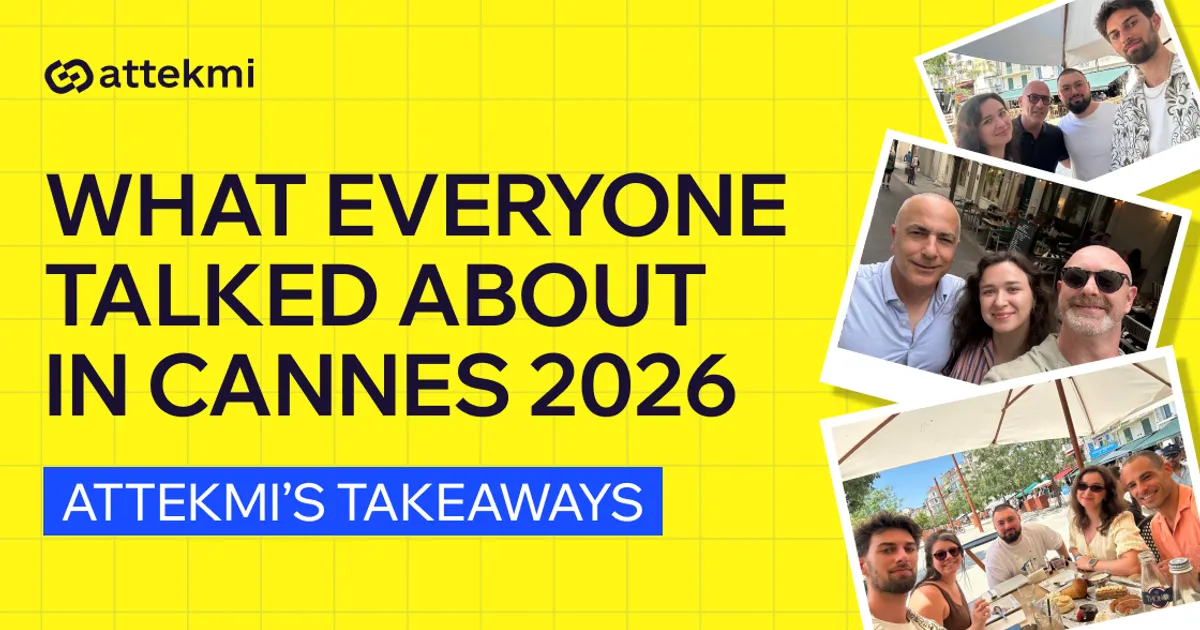
Cannes 2026 highlighted the current trends shaping the AdTech industry and gaining traction at the moment. The increasing importance of first-party data, the need for more advanced measurement capabilities, the evolution of supply path optimization, and the demand for operational simplicity were among the key tendencies discussed there (but not the only ones).
Cannes 2026 was a blast! Our Attekmi team had loads of interesting conversations there, and now we are ready to share the key insights with you. In short, the AdTech industry is getting more mature. Businesses are no longer focused only on growth – they are looking for greater efficiency and measurable value. What does this mean for companies offering AdTech solutions? Read on to learn more!
First-party data and identity strategies remain critical
Both advertisers and publishers are increasingly focusing on first-party data – this is not something new. Since traditional tracking methods like third-party cookies are steadily becoming history, marketers need privacy-friendly ways to reach relevant audiences and measure campaign effectiveness. In turn, media owners require first-party data to better understand their users and ensure more effective inventory selling.
However, in Cannes 2026, the main discussion point was not about how to collect the data, but how to activate it in the right way. Businesses need the infrastructure to analyze, segment, and leverage the data across different workflows.
In response to this tendency, AdTech platforms should evolve into data-enabled ecosystems. Solutions should help companies integrate first-party data sources into monetization workflows, create audience segments and activate them across demand channels, provide transparent reporting, and support privacy-compliant targeting and measurement. For AdTech providers that can assist businesses with turning first-party data into actionable opportunities, it will be much easier to gain and maintain a competitive advantage.
Programmatic advertising becomes more outcome-based
Impressions, clicks, and CPMs have been classic metrics to track for a pretty long time. However, modern advertisers and publishers prefer quality over quantity. For instance, marketers do not really focus on the volume of impressions anymore. Instead, they prioritize the quality of these impressions. They want to know if their campaigns drive real results and whether their advertising spend generates meaningful impact.
Thus, traditional metrics are not enough anymore. The fact that optimization is getting more and more sophisticated contributes to the industry's switch to advanced metrics.
Therefore, AdTech providers must adapt. Platforms should offer enhanced analytics and reporting capabilities, real-time optimization tools, better integration with measurement and attribution solutions, and machine learning models that improve decision-making. There are loads of AdTech platforms available in the market; however, the future belongs to those that can prove the value they create, not just enable media buying and selling.
Supply path optimization is entering a new phase
Initially, SPO (supply path optimization) was all about reducing the number of intermediaries and eliminating unnecessary expenses. But what started as a cost-saving initiative has evolved into a broader strategy for improving efficiency, transparency, and quality across the entire supply chain.
For both marketers and media owners, the focus is shifting from “fewer partners” to “better partners”. Let’s say, advertisers are increasingly evaluating their connections based on transparency, incremental value, inventory quality, data availability, and technology capabilities.
The growing importance of SPO implies a differentiation opportunity for AdTech vendors. A platform offering transparent reporting, detailed supply chain visibility, specialized environments (like, for instance, private marketplaces), and unique demand or inventory has a much higher chance of succeeding.
CTV advertising keeps reshaping programmatic
CTV advertising keeps getting more and more popular among marketers because it combines the reach of traditional television with advanced targeting capabilities. Besides, when designed properly, CTV ads can be very effective in terms of driving engagement. However, the growth of CTV also introduces certain challenges: fragmented inventory sources, different measurement standards, brand safety concerns, and so on. In turn, media buyers want the same level of transparency and control they have in other digital channels.
AdTech providers need to adapt their infrastructure to support the requirements of video and streaming environments. The essential improvements may include advanced VAST handling and validation capabilities, support for CTV-specific formats, better inventory transparency, more effective fraud prevention, quality control, and cross-channel measurement. Addressing all the challenges associated with CTV advertising is not an easy task, but vendors who manage to deal with it will be best positioned to benefit from CTV growth.
Businesses are increasingly prioritizing operational simplicity
AdTech solutions are complex on their own. However, the true challenge is that the advertising ecosystem itself is getting more and more complicated. The reason for this is that businesses have to manage multiple solutions, integrations, dashboards, and workflows.
As a result, companies are searching for solutions that can reduce operational complexity while maintaining flexibility and control. Their key priorities include easier integrations, automated workflows, unified reporting, and faster decision-making.
Considering this, AdTech providers should focus not only on functionality but also on usability. Flexible integrations, clear analytics, automation capabilities, an intuitive interface, and a simple onboarding process – these “nice to have” things are turning into something absolutely essential. Companies want complex AdTech operations to feel simple. Therefore, providers that combine advanced technology with ease of use will have a stronger market position.
More companies are exploring white-label solutions
More and more businesses are considering building their own programmatic environments instead of relying on third-party solutions. This is happening because companies strive for more control over monetization and other processes, ownership of data and relationships, custom workflows, and other benefits. While custom AdTech development can take loads of time and money, white-label technology allows companies to launch the required solutions quickly and in a cost-effective manner.
Therefore, we can expect the next generation of AdTech growth to come from empowering companies to create their own ecosystems. Instead of competing only as platforms, AdTech providers can turn into technology partners helping others build their own programmatic advertising businesses.
However, if the number of white-label solutions keeps growing, vendors will need to look for differentiation opportunities. For instance, these can include a wider selection of integration options, more advanced fraud detection and prevention capabilities, easier scalability, and so on.
Personal connections still matter in a technology-driven industry
Last but not least, technology is not the only thing that matters in AdTech – Cannes 2026 reinforced that relationships also remain central to the industry. Major partnerships are often built through face-to-face meetings, strategic conversations, industry collaboration, and trust between businesses.
While robust technology creates opportunities, strong partnerships turn them into stable business growth. Therefore, AdTech companies need to invest not only in product development. Understanding clients’ individual challenges and needs, providing strategic consulting alongside technology, building long-term partnerships, and collecting market insights during industry gatherings – all these tactics become more and more important.
To Sum Up
The AdTech industry evolves continuously, with new trends, challenges, and opportunities regularly entering the stage. Cannes 2026 proved that the market participants are increasingly prioritizing quality over quantity and adjusting their strategies accordingly. Fewer impressions that drive conversions are much better than hundreds of impressions with no meaningful results. Working with only a few trusted demand partners can be a much more effective approach than offering inventory to everyone. These are just a couple of examples. In turn, AdTech solution providers should adapt to the changing market needs. Doing this is a way to maintain a competitive edge.
Ready to launch your own monetization platform? Just contact the Attekmi team.

'%3e%3cpath%20d='M415.5%20380.133C415.5%20554.655%20911.5%20609.133%20714%20818.633C447%20850.133%20200%20677.655%20200%20503.133C200%20328.611%20341.478%20187.133%20516%20187.133C690.522%20187.133%20415.5%20205.611%20415.5%20380.133Z'%20fill='%231A4CFF'/%3e%3c/g%3e%3cg%20filter='url(%23filter1_f_654_7533)'%3e%3cpath%20d='M819.862%20539.146C969.42%20389.588%20963.912%20273.412%201000.6%20310.096C1037.28%20346.78%201059.92%20590.588%20910.362%20740.146C760.804%20889.704%20503.861%20847.646%20447.362%20760.146C348.862%20547.146%20670.304%20688.704%20819.862%20539.146Z'%20fill='%23052AAE'/%3e%3c/g%3e%3cg%20filter='url(%23filter2_f_654_7533)'%3e%3cpath%20d='M647.331%20285.725C443.031%20230.983%20408.998%20311.131%20358.6%20243.729C295.498%20194.631%20571.852%2052.1078%20776.152%20106.85C980.452%20161.592%201072.5%20405.139%201024.97%20497.82C889.759%20689.623%20851.631%20340.467%20647.331%20285.725Z'%20fill='%231B4DFF'/%3e%3c/g%3e%3c/g%3e%3cdefs%3e%3cfilter%20id='filter0_f_654_7533'%20x='0'%20y='-12.8672'%20width='960.465'%20height='1035.25'%20filterUnits='userSpaceOnUse'%20color-interpolation-filters='sRGB'%3e%3cfeFlood%20flood-opacity='0'%20result='BackgroundImageFix'/%3e%3cfeBlend%20mode='normal'%20in='SourceGraphic'%20in2='BackgroundImageFix'%20result='shape'/%3e%3cfeGaussianBlur%20stdDeviation='100'%20result='effect1_foregroundBlur_654_7533'/%3e%3c/filter%3e%3cfilter%20id='filter1_f_654_7533'%20x='228.938'%20y='103.27'%20width='998.816'%20height='935.965'%20filterUnits='userSpaceOnUse'%20color-interpolation-filters='sRGB'%3e%3cfeFlood%20flood-opacity='0'%20result='BackgroundImageFix'/%3e%3cfeBlend%20mode='normal'%20in='SourceGraphic'%20in2='BackgroundImageFix'%20result='shape'/%3e%3cfeGaussianBlur%20stdDeviation='100'%20result='effect1_foregroundBlur_654_7533'/%3e%3c/filter%3e%3cfilter%20id='filter2_f_654_7533'%20x='149.441'%20y='-105.473'%20width='1087.81'%20height='860.301'%20filterUnits='userSpaceOnUse'%20color-interpolation-filters='sRGB'%3e%3cfeFlood%20flood-opacity='0'%20result='BackgroundImageFix'/%3e%3cfeBlend%20mode='normal'%20in='SourceGraphic'%20in2='BackgroundImageFix'%20result='shape'/%3e%3cfeGaussianBlur%20stdDeviation='100'%20result='effect1_foregroundBlur_654_7533'/%3e%3c/filter%3e%3c/defs%3e%3c/svg%3e)