Key Takeaways
An ad network connects advertisers and publishers by aggregating inventory and enabling real-time bidding via DSPs and SSPs.
Starting an ad network from scratch requires a clear niche, reliable publishers, engaged advertisers, and a robust pricing strategy.
Critical components include targeting options, ad format support, campaign performance tracking, and full regulatory compliance.
Building a custom ad network entails significant hidden costs (infrastructure, maintenance, certifications, salaries), often exceeding $800,000 annually.
White-label AdTech offers a faster, more cost-effective alternative, allowing owners to focus on business development while technical operations are managed externally.
With the global market for digital advertising projected to reach $1,692.9 billion by 2033, the prospect of starting an ad network in this era is not only enticing but promising. But creating your own ad network goes beyond wishful thinking or the programming task.
Ad networks and ad exchanges are the operational houses for programmatic advertising. They provide the advertising technology flow through robust ad servers that automate the process of programmatic ad display. The increasing adoption of programmatic advertising – ad spend is projected to reach $1.1 trillion by 2030 – suggests the need for more ad networks. Discover the best ad networks for publishers to maximize your revenue and grow your audience.
But while ad and marketing entrepreneurs are usually excited about having an ad network, a server, or an ad exchange, they often fail to thoroughly calculate the cost of building one from scratch.
In this guide, we will not review how to build your own publisher ad server, explore how to build your own mobile ad server, or clarify the differences between ad exchange vs ad network in detail. Instead, we will focus on the ways to create ad network – read on to learn more.
What is an ad network?
An ad network refers to a technology that links advertisers with publishers (media owners of websites, blogs, applications, etc.) who wish to monetize their inventory through advertising. An ad network’s primary job is to aggregate ad inventory from publishers and resell it to the demand. But what is ad exchange? The ad exchange term, meanwhile, is often used interchangeably; however, these two technologies have some minor differences.
Besides, make sure to take a look at our list of top places to advertise your business. This will provide you with a better understanding of the AdTech ecosystem.
Principles of work
The ad network first compiles available ad spaces from publishers and media platforms and offers these spaces to interested buyers (typically in an RTB auction). A DSP (demand-side platform) bids on impressions in the RTB auction. When the highest bidder is defined, the ad content is immediately transmitted to the publisher’s SSP (supply-side platform) through an ad server. The ad server calls for the ad. Next, the ad is transferred from the ad server to the publisher’s site or application.
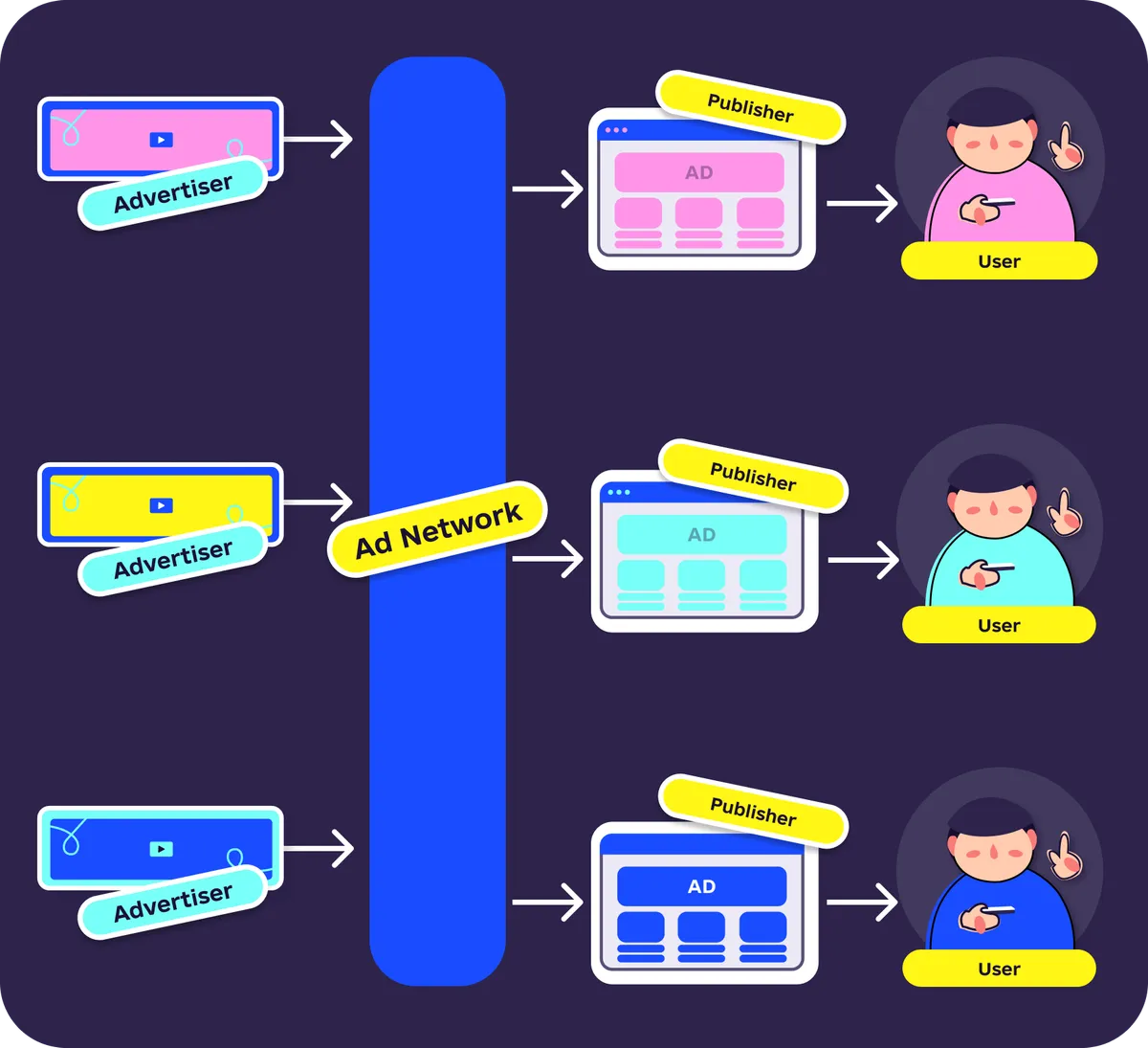
Ad networks earn profits by keeping a percentage of ad income paid by advertisers (also known as margins or commissions). And if we come back to the ad network vs ad exchange question, an exchange is a digital marketplace. In turn, ad networks perform as intermediaries between advertisers and publishers.
There are two ways to create an ad network: you either build from scratch or procure a white-label solution that you can deploy immediately.
Key benefits for AdTech companies
Before we explore how to start an ad network, let’s review the key benefits of doing so for AdTech businesses.
Greater control. If you create your own ad network, you gain greater control over supply and demand: inventory quality standards, ad formats, environments, etc. This allows for improving media quality and increasing trust.
Higher revenue. If you create ad network, you do not need to rely on external networks anymore, which eliminates the fees and enables you to retain a larger portion of the generated revenue. Besides, you offer additional services to your partners.
Stronger differentiation. Having your own ad network can help you stand out in the crowded market, as your business moves from being just another AdTech vendor. You may offer format-specific supply, exclusive inventory, etc.
Increased transparency and trust. With full visibility into the network, you can offer verified inventory sources, clear fee structures, and other benefits.
Increased transparency and trust
With full visibility into the network, you can offer verified inventory sources, clear fee structures, and other benefits.

How to build your own ad network
The question of how to build an ad network with easy-to-use technology and a friendly ad network dashboard at first glance may seem very complicated, but if you look at it consistently, it turns out to be quite understandable and explainable. Here are the steps to consider if you want to start your own advertising network from scratch.
Identify and define a specialty
You can’t accomplish everything at once when you’re new in a business. Your safest choice is to pick one or two comparable areas and begin looking for both large and small publishers.
Although advertisers are impressed by large traffic statistics, they are more interested in the conversion rates.
High traffic does not always translate to sales and conversion. Imagine publishing an ad for male shoes on a blog that focuses on male shoes compared to publishing the same ad on a blog that focuses on fashion in general. Although the former may have less traffic, the possibility of having greater conversion rates is much higher.
Engage publishers
To create an ad network, you’d have to acquire a share of a publisher’s inventory and sell it to advertisers. Here is a brief checklist to help you when searching for publishers to work with:
Ensure that your publishers have relevant content for your ad network, niche, and advertisers.
Note that most advertisers prefer traffic from the US, Canada, Australia, and EU countries. There is also a strong preference for English-speaking audiences.
Avoid publishers with inappropriate content.
Ensure that your publishers have unique and up-to-date content.
Attract advertisers
As much as you need publishers, you must also attract advertisers to your network. You can do this by creating an expressive display to highlight all of your benefits to a prospective client. Highlight compelling statistics and friendly partnership conditions. Also, include honest metrics and statistics that would intrigue the advertisers.
You can also attract advertisers by:
Reaching out to ad agencies.
Offering competitive ad rates.
Ensuring that your publishers have quality traffic that can convert for your advertisers.
Ensuring that your ad server is efficient and stable at all times.
Establish a price strategy
Most ad networks provide various pricing structures for online ads:
CPV (cost per view) – This is based on the payment model where the advertiser pays for each ad view. It’s most commonly utilized for video campaigns.
CPA (cost per action) – A payment model in which advertisers are charged for specific actions performed by the users. It may include clicks, sales, downloads, etc.
CPC (cost per click) – CPC implies that the advertiser will pay for every click an ad generates.
CPM (cost per thousand impressions) – This pricing model is based on ad impressions per thousand (in comparison, CPM vs eCPM: eCPM calculates total revenue across impressions, clicks, and conversions). It is particularly useful for enhancing brand exposure and awareness. What is eCPM in detail? Follow the provided link to discover the answer.
Select technology solution
Your tech stack is what powers the operations within the network, and the efficiency of your network determines whether more advertisers would want to collaborate with you. Your tech solution should offer flexibility and ease of use to every partner.
Your system should be able to manage media trading and collect information about the performance of your marketplace, partners, ad formats, and other important details. In summary, your solution must support all essential technologies that ensure efficient ad serving.
Key features your ad network must include
What is ad network integration? Let us explain. If you have the luxury of time and money, you may consider building from scratch. But first, you have to understand that having a robust and progressive ad network demands certain features that would require some complicated programming.
RTB capabilities
Real-time bidding (RTB) is the core technology of programmatic advertising, and ad networks heavily rely on it as well. RTB enables programmatic auctions that are completed within milliseconds, allowing advertisers and publishers to buy and sell inventory at scale.
However, developing RTB capabilities and ensuring their effective performance is a complex and time-consuming task.
Support for a variety of formats
An effective ad network should support a wide range of ad formats and environments. This provides advertisers and publishers with greater flexibility while you drive higher ROI.
Targeting functionalities
Your targeting features should include enough options. Here is an example of such:
Targeting by location
Targeting by interest
Keyword targeting
Demographic targeting
Contextual targeting, etc.
There are more targeting metrics; the best practice would be to define what your demand partners need and set up targeting options for them.
Your AdTech should offer demand partners the flexibility of choosing ad delivery style and ad payment type. This is important as ad campaigns and ad content are not the same, and not every format works for every ad content type.
Performance tracking
No advertising platform can function without adequate performance tracking. For example, you would want to keep track of which SSPs (supply partners) drive the most traffic, what types of traffic DSPs prefer, which ad formats are most frequently purchased, etc.
Anti-fraud tools
Fraud remains a significant problem for the digital advertising industry, so an effective ad network should be equipped with fraud detection and prevention tools. While advertisers and publishers benefit from enhanced brand safety, valid traffic, and accurate analytics, you build trust and maximize your income.
Compliance
In recent times, there have been regulatory demands that aim to protect the privacy of end-users, and all online advertising networks must adhere to these regulations. As an ad network owner, you should be able to provide your partners with a system that is compliant with relevant regulations.
Common challenges when building an ad network
Whether you want to build your own ad server, ad exchange, or ad network, there is a set of challenges involved. Here are some of the most common ones related to creating an ad network from scratch.
Fraud prevention
In advertising, fraud takes numerous forms, and your ad network should be capable of detecting and preventing various types of fraudulent activities. If you fail to implement such features properly, it will be impossible for you to build trust and drive ROI.
Technology complexity
Ad networks are complex to build since they must support a wide range of capabilities (which are complex on their own). Developing an ad network may take loads of time and money due to these technological challenges.
SPO pressure
Modern advertisers demand a minimum number of intermediaries and a clear fee structure. You need to justify your presence in the supply chain and explain your unique value.
Achieving sufficient scale
You need publishers to attract advertisers, and advertisers to attract publishers. However, doing so at the very beginning can be challenging, so most likely, you will face limited inventory and inconsistent fill rates. As a result, if you fail to solve these issues, it will be difficult for you to scale and reach your goals.
Building trust
Your partners need proof of your value, not just words. Therefore, you must ensure complete transparency, provide sufficient data, etc.
Costs of building and running an ad network
Considering the demand for the features highlighted above, one can only imagine what it would cost to create an ad network from scratch. The truth is that you may not be able to determine the real cost until the end of the project because there would be a lot of unseen and hidden costs that would rear up in the middle of development.
Full-time engineers
If you choose to create from scratch, you must be willing to employ the services of in-house ad network software engineers and QA testers who would maintain and operate the system. At least five employees would be required to manage an ad serving system that handles 500 million monthly requests; this would cost over $600,000 in salaries at the average engineering salary of $125k.
On the positive side, platforms with in-house teams are more likely to achieve higher yields and better efficiency. The AdEx Enterprise programmatic ad exchange platform is a great example of how internal expertise can optimize performance and drive results.
Developing from scratch would take several months to possibly a few years to have a sophisticated and efficient product. Of course, you can build a very simple ad system without any of these features in less time and much less money. But doing so would only limit you, and the business would most likely fail for lack of patronage. Rather than attempting to start your ad network from scratch, which can be problematic and expensive, you can adopt white-label solutions.
Although it may be difficult and misleading to estimate the true cost of creating your own ad network from scratch, it will cost around $800 thousand per year to maintain your own ad exchange or ad network.
Certifications and audits
Furthermore, creating an ad solution necessitates the acquisition of additional software tools, certifications, and audits. These expenses are easy to ignore or underestimate during budgeting. Nevertheless, they are essential services that come at a cost. Besides wages, you can spend more than $100,000 each year on certifications.
Maintenance and upgrade
It is not enough to know how to build an ad server, ad network, ad exchange, or any other programmatic platform. You will also have to routinely upgrade the system and run maintenance to ensure that the platform is efficient, fast, and available at all times. Running maintenance costs money that may not be easily ascertained. Sometimes you may need to pay for repairs that you did not expect. If a platform with 1 million monthly impressions tries to scale up to 100 million without a team dedicated to cost optimization and mitigating difficulties, it will collapse.
Don’t get discouraged yet; you can still own your ad network by taking advantage of white-label ad servers or networks.
Conclusion
In this article, we revealed how an ad network works, how to build your own ad network, and many other moments that will be helpful to you if you are interested in building an ad network.
If you decide to develop your own ad network solution (or, for instance, build your own ad network with ad serving platform), we strongly advise you to thoroughly assess your skills, as this is very demanding.
Alternatively, you can use white-label solutions. With Attekmi, you can get a fully customized platform that meets all of your company’s requirements, and that can be fully serviced by our team so that you can easily grow your revenue. Additionally, we offer AdEx Basic, AdEx Plus, and AdEx Enterprise ad exchange solutions.
Explore the case studies of Attekmi to learn more.
Does Attekmi seem to be the right choice? Let’s get in touch!
FAQ
An ad network is a platform that connects advertisers with publishers to display ads on various websites or applications. Creating your own ad network can provide control over ad placements, target specific audiences, and generate revenue from advertisers. It offers customization, increased monetization opportunities, and the ability to optimize ad performance based on your specific goals.
To build an ad network, you need a solid understanding of web development, including front-end and back-end technologies. Proficiency in programming languages such as JavaScript, HTML, and CSS is crucial. Additionally, knowledge of database management, server-side scripting, and APIs is essential. Strong analytical skills and familiarity with ad serving platforms and online advertising concepts are also beneficial.


'%3e%3cpath%20d='M415.5%20380.133C415.5%20554.655%20911.5%20609.133%20714%20818.633C447%20850.133%20200%20677.655%20200%20503.133C200%20328.611%20341.478%20187.133%20516%20187.133C690.522%20187.133%20415.5%20205.611%20415.5%20380.133Z'%20fill='%231A4CFF'/%3e%3c/g%3e%3cg%20filter='url(%23filter1_f_654_7533)'%3e%3cpath%20d='M819.862%20539.146C969.42%20389.588%20963.912%20273.412%201000.6%20310.096C1037.28%20346.78%201059.92%20590.588%20910.362%20740.146C760.804%20889.704%20503.861%20847.646%20447.362%20760.146C348.862%20547.146%20670.304%20688.704%20819.862%20539.146Z'%20fill='%23052AAE'/%3e%3c/g%3e%3cg%20filter='url(%23filter2_f_654_7533)'%3e%3cpath%20d='M647.331%20285.725C443.031%20230.983%20408.998%20311.131%20358.6%20243.729C295.498%20194.631%20571.852%2052.1078%20776.152%20106.85C980.452%20161.592%201072.5%20405.139%201024.97%20497.82C889.759%20689.623%20851.631%20340.467%20647.331%20285.725Z'%20fill='%231B4DFF'/%3e%3c/g%3e%3c/g%3e%3cdefs%3e%3cfilter%20id='filter0_f_654_7533'%20x='0'%20y='-12.8672'%20width='960.465'%20height='1035.25'%20filterUnits='userSpaceOnUse'%20color-interpolation-filters='sRGB'%3e%3cfeFlood%20flood-opacity='0'%20result='BackgroundImageFix'/%3e%3cfeBlend%20mode='normal'%20in='SourceGraphic'%20in2='BackgroundImageFix'%20result='shape'/%3e%3cfeGaussianBlur%20stdDeviation='100'%20result='effect1_foregroundBlur_654_7533'/%3e%3c/filter%3e%3cfilter%20id='filter1_f_654_7533'%20x='228.938'%20y='103.27'%20width='998.816'%20height='935.965'%20filterUnits='userSpaceOnUse'%20color-interpolation-filters='sRGB'%3e%3cfeFlood%20flood-opacity='0'%20result='BackgroundImageFix'/%3e%3cfeBlend%20mode='normal'%20in='SourceGraphic'%20in2='BackgroundImageFix'%20result='shape'/%3e%3cfeGaussianBlur%20stdDeviation='100'%20result='effect1_foregroundBlur_654_7533'/%3e%3c/filter%3e%3cfilter%20id='filter2_f_654_7533'%20x='149.441'%20y='-105.473'%20width='1087.81'%20height='860.301'%20filterUnits='userSpaceOnUse'%20color-interpolation-filters='sRGB'%3e%3cfeFlood%20flood-opacity='0'%20result='BackgroundImageFix'/%3e%3cfeBlend%20mode='normal'%20in='SourceGraphic'%20in2='BackgroundImageFix'%20result='shape'/%3e%3cfeGaussianBlur%20stdDeviation='100'%20result='effect1_foregroundBlur_654_7533'/%3e%3c/filter%3e%3c/defs%3e%3c/svg%3e)