While advertisers strive to create effective digital ads and drive conversions, what about website owners? In short, they can get paid to post ads, and, when everything is done in the right way, website monetization can bring stable and sufficient revenue. Programmatic is the most popular option to make money advertising for companies, but it is not the only approach.
So, how to make money from advertising? In this article, we will explore a range of methods and dive deeper into the aspects of programmatic advertising. Keep reading to discover how to make money by posting ads.
Key Takeaways
Website owners can monetize their traffic through multiple models: CPM (per 1,000 impressions), CPC (per click), and CPA (per action), each with unique strategies and risks.
Understanding your niche and audience is critical to selecting the best monetization model and ensuring ad relevance.
Ad exchanges enable scalable, automated revenue through advanced targeting, inventory control, and referral-based monetization.
Programmatic remains among the most popular monetization options since it implies automation and enables access to a wide pool of advertisers.
Programmatic monetization requires calibration of ad slots, performance tracking, and ongoing campaign optimization for success.
Strong content remains the foundation of monetization — without quality, ads alone won’t retain or convert audiences.
How to get paid for advertising on your blog or website
Before we start, let's take a few minutes to study the aspects of programmatic monetization.
Publishers who own websites, most often online media or blogs, use SSPs (supply-side platforms) to get paid for advertising. After placing their ad slots on SPPs, they only have to set the price and wait for the revenue. In turn, advertisers use demand-side platforms (DSPs) to launch and optimize their marketing campaigns.
Website owners usually pay a one-time fee for connecting to the platforms and then pay a percentage of the purchased ad slots. They do not bear additional expenses – all costs are borne by advertisers that operate through DSPs.
Key success factors behind programmatic advertising
How to make money in advertising? First and foremost, you need to perform two fundamental actions.
To get paid to advertise on your website, you need to perform two fundamental actions.
Understand your niche. That is a specific business environment in which your resource meets a particular demand.
Understand your target audience. Within the identified business niche, the content on your website attracts specific groups of people. For instance, if you run a website about the latest news in the automobile industry and want to earn money from your blog, you should assume that your site visitors own cars: this tells you something about their needs, habits, financial status, etc.
So, the niche and the target audience. You could begin posting ads for money when you have defined them and started building further actions based on this knowledge. However, different advertising models are determined by the type of payment: what exactly the advertiser pays the publisher for. Let’s examine their differences and purposes.
CPM: cost per mille
This is one of the leading payment types for programmatic, where the advertiser pays for each thousand ad impressions, depending on the resource traffic.
Calculation example: (cost of placement/website traffic) * 1000 = CPM.
CPM example = ($150 / 50,000) * 1000 = $3.
In this example, on a website with traffic of 50 thousand unique users for the selected period and $150 of placement cost, the CPM is $3.
The CPM model is ideal for beginners who have only started to discover how to make money selling ads online. Impressions may not convert into clicks and purchases, which is natural, but it is the cheapest way to test a particular campaign and draw necessary conclusions for adjusting activity.
CPC: cost per click
As the name implies, publishers get payment whenever the user clicks on the ad and visits the landing page with the advertised object. Many beginners may think CPC is more profitable than CPM, but they serve different purposes.
CPC is usually more expensive than paying for thousands of impressions.
The CPC model is used mainly in contextual targeting, which not all platforms support.
Anti-fraud mechanisms that protect advertisers’ money and publishers’ reputations are essential in this model. We advise you to pay close attention to this issue when working with the CPC payment agreement.
It is also worth remembering that an effective CPC model must be finely tuned and calibrated for each company. This means that you are unlikely to achieve the desired results with the initial settings, but over time, with the right approach, you will be successful.
CPA: cost per action
The last of the basic models is optimal for those who feel confident in the programmatic and have already figured out how to make money posting ads. The main difference between pay-per-action and other advertising payments is a certain degree of trust between the parties, which is determined by the reputation level.
If you decided to earn money from your blog some time ago and your resource has shown decent results, we recommend switching to the pay-per-action model. Since, in this case, targeting should be even more precise. Beginners in CPA can broadcast ads for a long time without any benefit if they cannot calibrate targeting correctly.

How to post ads for money on your blog or website
We will come back to programmatic advertising in the following sections. Now, consider other options for how to make money with ads. This is a partial list, but it is enough to get you started.
Sponsored posts
It is one of the popular ways to promote products and services in the premium segment. It’s not just when you get paid for advertising. It’s about investing in highly engaging content to attract visitors’ attention and persuade them to follow the links provided.
Let’s say you promote ads through slots placed on blog pages. This system is sound, but there are options to make it even better with a sponsored post. Let’s go back to the example of the car website.
Your PR managers find an interested advertiser, for example, who offers car alarms.
You agree to a sponsored post: who writes it, who approves it, the amount of payment, the period of stay on the website (temporary, permanent), and other points.
The copywriter creates the post, which is approved and posted on the website. For instance, an article about the importance of protecting cars in the first years after purchase provides statistics on thefts of cars without alarms and cars with alarms. In addition to being useful, the article natively advertises your partner’s service.
After publication, you get paid: usually, it is a one-time payment.
Depending on your agreement, a sponsored post may or may not have additional ad slots to maximize revenue. Posting ads for money, you shouldn’t forget that too many ads, even well-targeted ones, can be tiring for users.
Affiliate marketing
Affiliate marketing works on the same principle as a sponsored promotion. The main difference is the following:
The website owner usually promotes the partner’s product or service not with a single blog post but with a series of posts supported by landing pages;
To get paid for advertising, website visitors have to buy a product or order a service from the partner by clicking on an affiliate link from your website, and the reward is a percentage of the transaction amount;
This type of interaction between the parties is more long-term and close and often develops into official dealerships or similar promotion options.
You can combine affiliate marketing with programmatic advertising. At the same time, you should always choose the dominant type of monetization to improve the users’ experience without overwhelming them with offers.
Ad exchange
Programmatic exchanges are the core of the AdTech ecosystem. They connect publishers and advertisers in split seconds, optimizing yield management. Unlike affiliate and sponsored promotion, an ad exchange is a multichannel investment route where website owners earn from individual advertisers and demand aggregators with the most precise targeting and control through filtering. Here is how things work:
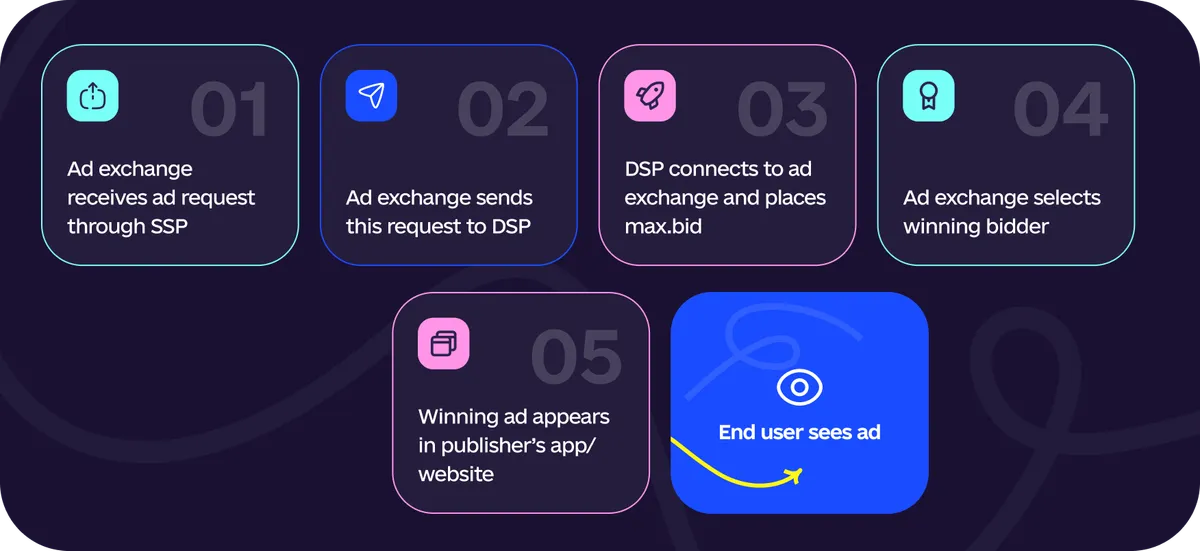
Here are the advantages of using an ad exchange over other ways to earn money from your website:
Precision targeting thanks to multichannel data integration;
Ability to connect any supply and demand partners you want to work with;
Support for all ad environments and formats;
Automatic workload optimization;
Detailed settings for connected channels (custom filters, blacklists, blocked categories, and others).
If you decide to use an ad exchange, the good news is that you may also monetize the platform itself. With Attekmi, you can get paid with ads and increase your income by referring additional publishers to your exchange.
Launching your ad exchange is a decisive step towards building a highly optimized advertising business. Attekmi solutions can become a core tool for selling ad space on your website and providing referral ad services. You will make money and gradually grow your platform into a passive income.
“The most sustainable monetization strategies prioritize user experience first. When ads feel relevant and non-intrusive, engagement stays high, and revenue follows naturally.”
Roman Vrublivskyi
CEO of Attekmi
Other proven methods to get paid for advertising
How do you make money posting ads? There are even more methods to consider, so read on to find out how to monetize your website or blog effectively.
Native ads
Native ads blend seamlessly into the content, and many advertisers integrate this type of marketing into their strategies to overcome the banner blindness challenge and minimize the ad fatigue risks. Therefore, offering such inventory can help you attract more advertisers and, as a result, increase your income. Besides, native ads do not feel intrusive. While posting ads to make money, you do not affect your visitors’ or users’ experience. Note that native advertising is especially popular among media websites.
Social media advertising monetization
Apart from this, you can drive income by promoting advertisers’ content across social media channels. This includes paid posts, story ads, or link placements that drive traffic to branded campaigns. Monetization depends on audience size, engagement rate, and platform reach.
Video advertising and ad revenue sharing
If you create engaging video content, you can earn by displaying pre-roll, mid-roll, or post-roll ads. In many cases, such content creators publish their videos on platforms like YouTube instead of their own websites. Therefore, if you are one of them, keep in mind that ad revenue is typically shared between you and the video ad network or platform.
Mobile app advertising
Mobile apps can be monetized through in-app ads such as banners, interstitials, rewarded videos, or native formats. As an app owner, you can earn revenue based on impressions, clicks, or completed views. This approach works best for free apps (or apps that offer free plans) with high daily active users and strong session frequency. For instance, the Duolingo app displays advertisements in between lessons. Besides, users can watch ads to earn additional points that are required for completing the lessons.
Email newsletter advertising
You may not consider newsletters when thinking about how to get paid to advertise. However, email newsletters can be pretty effective – they can generate revenue by including sponsored placements, banner ads, and so on. Advertisers pay for exposure to a targeted subscriber base, often on a cost-per-send or flat-fee basis. This model is effective when newsletters have high open rates and clear audience segmentation.
Influencer advertising campaigns
Influencer advertising involves partnering with brands to promote products across blogs, apps, or social channels. Payments are usually based on reach, engagement, or conversions. This method can be especially profitable and effective for you if you are a creator with a loyal audience and strong personal branding. The size of the audience matters, but it is not the main factor for advertisers looking for influencers. For them, a content creator with a small but loyal and highly engaged audience is a much better choice than an influencer with loads of inactive followers.
Programmatic advertising monetization
How to make money advertising? For website and app owners, programmatic is among the most effective options. We have already provided some details on this approach and explained why using your own ad exchange can be a great help. As for programmatic advertising itself, it allows you to sell your inventory in real time and scale effectively. You gain access to a wide pool of advertisers, and there are loads of supported formats, including but not limited to banner, native, video, audio, and CTV ads. In addition, you benefit from advanced targeting, better fill rates, and data-driven optimization.
As for the supported channels, you can count on desktop, mobile web, in-app, CTV, and other options. However, keep in mind that smartphones are the primary tool for researching websites worldwide. Since the third quarter of 2019, the share of mobile devices in total traffic has been over 50%.
One more thing to mention is that programmatic is not only about real-time and header bidding auctions. You can also experiment with so-called direct programmatic, which includes guaranteed and preferred deals.
These options require some preliminary negotiations, but they can help you build more lasting relationships with marketers. Besides, you will not have to worry that some inappropriate ads will appear on your website – you will know for sure what kind of content to expect.
To select the right advertisers, analyze the performance of the campaigns thoroughly – choose the ones that bring you the highest income while still delivering a relevant experience to your visitors.
How Attekmi solutions can skyrocket your revenue
During the article, we have repeatedly mentioned that Attekmi can become your reliable partner in monetizing website traffic. We offer ad exchange solutions that provide businesses with many integrative opportunities to improve yield management. A white-label option gets fully customized according to your needs: from UI personalization to on-request custom feature development.
You can explore our case studies to verify the positive results, see their precise measurements, and discover how you can get paid to advertise even more effectively.
Conclusions
Now you know how to make money with advertising. There is an entire range of options to consider; however, programmatic remains among the most effective ones. To start monetizing your inventory programmatically, make sure that your website (or app) offers high-quality content and drives a sufficient number of visitors. This way, it will be attractive for advertisers, which will help you drive income. Besides, many supply-side platforms have certain requirements for publishers, so check this when choosing your specific solution.
Note that apart from offering a wide range of ad exchange solutions, we also provide Ad Ops training and outstaffing services. Therefore, if you need a helping hand, just reach out to us.
Does Attekmi seem to be the right partner? Let’s get in touch.
FAQ
You can start earning with relatively low traffic, even a few thousand monthly visitors. However, meaningful revenue usually requires consistent traffic, strong engagement, and a clearly defined audience. Advertisers value quality and relevance more than raw visitor numbers.
There is no universal answer as revenue depends on audience quality, niche, format, and geography. Programmatic video, direct sponsorships, and affiliate advertising typically deliver higher payouts than display ads, especially for premium or highly targeted audiences.
Yes. For website owners, all customizations come through the supply-side platforms (SSPs). You can make money by posting ads and closely controlling this process: select specific traffic categories and improve targeting of user groups based on available data.
Again, yes. Depending on your chosen platform, you will have some analytics to track the campaigns’ performance. You can get more statistics by customizing the data collection and processing framework if necessary.
Our ad exchange solutions have all the features you need: diverse ad formats and traffic types, advanced targeting and filtering settings, cross-integration bidding capabilities, and so on. Additionally, our support team guides you all the way through.


'%3e%3cpath%20d='M415.5%20380.133C415.5%20554.655%20911.5%20609.133%20714%20818.633C447%20850.133%20200%20677.655%20200%20503.133C200%20328.611%20341.478%20187.133%20516%20187.133C690.522%20187.133%20415.5%20205.611%20415.5%20380.133Z'%20fill='%231A4CFF'/%3e%3c/g%3e%3cg%20filter='url(%23filter1_f_654_7533)'%3e%3cpath%20d='M819.862%20539.146C969.42%20389.588%20963.912%20273.412%201000.6%20310.096C1037.28%20346.78%201059.92%20590.588%20910.362%20740.146C760.804%20889.704%20503.861%20847.646%20447.362%20760.146C348.862%20547.146%20670.304%20688.704%20819.862%20539.146Z'%20fill='%23052AAE'/%3e%3c/g%3e%3cg%20filter='url(%23filter2_f_654_7533)'%3e%3cpath%20d='M647.331%20285.725C443.031%20230.983%20408.998%20311.131%20358.6%20243.729C295.498%20194.631%20571.852%2052.1078%20776.152%20106.85C980.452%20161.592%201072.5%20405.139%201024.97%20497.82C889.759%20689.623%20851.631%20340.467%20647.331%20285.725Z'%20fill='%231B4DFF'/%3e%3c/g%3e%3c/g%3e%3cdefs%3e%3cfilter%20id='filter0_f_654_7533'%20x='0'%20y='-12.8672'%20width='960.465'%20height='1035.25'%20filterUnits='userSpaceOnUse'%20color-interpolation-filters='sRGB'%3e%3cfeFlood%20flood-opacity='0'%20result='BackgroundImageFix'/%3e%3cfeBlend%20mode='normal'%20in='SourceGraphic'%20in2='BackgroundImageFix'%20result='shape'/%3e%3cfeGaussianBlur%20stdDeviation='100'%20result='effect1_foregroundBlur_654_7533'/%3e%3c/filter%3e%3cfilter%20id='filter1_f_654_7533'%20x='228.938'%20y='103.27'%20width='998.816'%20height='935.965'%20filterUnits='userSpaceOnUse'%20color-interpolation-filters='sRGB'%3e%3cfeFlood%20flood-opacity='0'%20result='BackgroundImageFix'/%3e%3cfeBlend%20mode='normal'%20in='SourceGraphic'%20in2='BackgroundImageFix'%20result='shape'/%3e%3cfeGaussianBlur%20stdDeviation='100'%20result='effect1_foregroundBlur_654_7533'/%3e%3c/filter%3e%3cfilter%20id='filter2_f_654_7533'%20x='149.441'%20y='-105.473'%20width='1087.81'%20height='860.301'%20filterUnits='userSpaceOnUse'%20color-interpolation-filters='sRGB'%3e%3cfeFlood%20flood-opacity='0'%20result='BackgroundImageFix'/%3e%3cfeBlend%20mode='normal'%20in='SourceGraphic'%20in2='BackgroundImageFix'%20result='shape'/%3e%3cfeGaussianBlur%20stdDeviation='100'%20result='effect1_foregroundBlur_654_7533'/%3e%3c/filter%3e%3c/defs%3e%3c/svg%3e)